
Our tulip hysteria continues: A history of the Netherlands’ love affair with a flower — from futures markets to famine soup
Part I: The Bubble That Wasn’t — Or Was It?
In February 1637, buyers stopped showing up to tulip auctions in Haarlem. Not just at one auction. At all of them. Almost simultaneously. A flower that had, just weeks earlier, been changing hands for the price of a canal house in Amsterdam was suddenly worth nothing. People were left holding contracts for bulbs still in the ground, bulbs nobody wanted, at prices nobody would pay.
That’s the story, anyway. The reality, as historians have been pointing out for decades, is considerably messier — and arguably more interesting.
Tulips arrived in the Netherlands in the 1590s, brought back by Dutch botanist Carolus Clusius, who established a botanical garden at the University of Leiden. They were a novelty from the Ottoman Empire — the name itself likely derives from the Persian word for turban, which the flower was thought to resemble. Clusius was famously protective of his collection. According to one account, his neighbours eventually broke into his garden and stole bulbs rather than wait for him to share them. The market, you could say, had started.
Source: Amsterdam Tulip Museum – History of the Tulip
What made certain tulips so staggeringly desirable were the ‘broken’ varieties — flowers streaked with flame-like patterns of two colours, each one unique. A bulb named Semper Augustus, with its white petals licked through with carmine red, was described in 1624 as something nobody had ever seen before. Nicolas van Wassenaer, who saw one growing in the garden of Adriaen Pauw — a director of the Dutch East India Company — wrote that the colour ran in an unbroken flame right to the top. Pauw refused to sell a single bulb despite wildly escalating offers, which some historians believe was itself a form of market manipulation, feeding the mania by keeping supply deliberately scarce.
Source: Tulip – Wikipedia, citing van Wassenaer (1624)
Nobody at the time understood why certain bulbs produced these spectacular patterns. The answer — a mosaic virus transmitted by aphids — wasn’t discovered until 1928. The virus weakened the plant over time, which meant the most beautiful and expensive tulips were also dying. Buyers were, in a sense, bidding fortunes for a ticking clock.
By 1634, tulip trading had spread beyond professional growers to the broader merchant class. Futures contracts — promises to deliver specific bulbs at set prices after the planting season — were traded at the Amsterdam Stock Exchange. The same bulb could change hands multiple times a day without ever leaving the ground. At the peak of the market in January 1637, a single Semper Augustus bulb sold for 10,000 guilders — enough to buy a grand house in Amsterdam’s most desirable district, complete with coach and garden.
Source: ‘There Never Was a Real Tulip Fever’, Smithsonian Magazine
Then came the Haarlem auction of February 3, 1637. No buyers.
Prices collapsed within days. The annualised rate of decline — calculated by economist Earl Thompson in a 2007 paper — was 99.999%. Contracts were voided, disputes dragged through the Dutch court system for years, and most deals were simply never honoured.
Source: Thompson, Earl (2007) – ‘The Tulipmania: Fact or Artifact?’ Public Choice 130, pp. 99–114
So: was it a bubble? Historian Anne Goldgar, who spent years in Dutch archives researching her book Tulipmania: Money, Honor, and Knowledge in the Dutch Golden Age, argues it’s more complicated. She found only 37 people who spent more than 300 guilders on tulip bulbs — the equivalent of a skilled craftsman’s annual wage. The popular image of chimney sweeps and fishwives gambling their life savings is, she says, almost entirely fiction, traceable to satirical pamphlets written after the crash, which were then plagiarised by Charles Mackay in his 1841 bestseller Extraordinary Popular Delusions and the Madness of Crowds — a book that has never been out of print and that has shaped popular understanding of the event ever since.
Goldgar jokes that her book should have been called “Tulipmania: More Boring Than You Thought.” Nobody drowned themselves in canals. Nobody lost their estate. The Dutch economy, then the richest per capita in the world, shrugged and moved on.
Source: Goldgar, Anne – Tulipmania: Money, Honor, and Knowledge in the Dutch Golden Age (2007)
And yet. Something real did happen. Prices did reach insane heights. Contracts did collapse. Traders did spend what, by any measure, was serious money on objects with no intrinsic value beyond beauty and social cachet. Whether or not it devastated the Dutch economy, tulip mania gave the world its first recorded example of a speculative market detaching entirely from the underlying value of the thing being traded. The metaphor was too useful to let facts get in the way, which is perhaps why economists still reach for it every time Bitcoin or tech stocks go parabolic.
Part II: Four Centuries of Dutch Tulip Obsession
From Luxury Goods to National Symbol
The collapse of 1637 did not kill the tulip. It killed some fortunes, irritated a lot of merchants, and produced a genre of morality literature. But the flower itself kept growing.
By the 18th century, the Bollenstreek — the bulb-growing strip of sandy coastal land between Haarlem and Leiden — had become the centre of a professional cut-flower and bulb export industry. The Dutch had figured out something important: tulips grew spectacularly well in the region’s well-drained, sandy soils. They developed techniques for forcing bulbs, for breeding new colours and forms, and for storing and shipping bulbs internationally. While other European nations had their own tulip crazes — France had experienced its own version of mania before the Dutch — none developed the industrial and scientific infrastructure that the Dutch did.
By the 19th century, tulip catalogues were being printed and distributed across Europe. Dutch nurseryman E.H. Krelage — the man who named the Darwin tulip group after Charles Darwin — bought up the best collections of florists’ tulips and systematically bred and catalogued them. It was the start of the modern tulip industry.
Source: National Trust – History of Tulips
The Hunger Winter: When the Dutch Ate Their Pride
There is a line of poetry, written in early 1945 by a correspondent for Het Volk, the Dutch underground resistance newspaper, that has stayed with historians:
It is better to eat tulip bulb soup / Than be bothered by a Kraut
It is better to eat sugar beet soup / Than doing forced labor for a Kraut
It takes a particular kind of spirit to write defiant satire when you’re eating flower bulbs to survive.
The Hongerwinter — the Hunger Winter of 1944–45 — was the worst famine in Western Europe during the Second World War. It began in September 1944, when Dutch railway workers went on strike to disrupt Nazi troop movements. The German military retaliated with a total blockade of food supplies to the western Netherlands. Then the canals froze. Amsterdam, Rotterdam, and The Hague — three of the country’s largest cities — were cut off from the food-producing east. By December, adult rations had dropped below 1,000 calories per day. By March 1945, they were below 600. At the lowest point, in February 1945, the official ration contained 340 calories.
Source: Atlas Obscura – ‘Tulip Bulb Soup: the Dutch Dish Born From Tough Times’
Over 22,000 people died. Millions more were permanently affected — including, as research published decades later would show, their descendants. Children born to mothers who were pregnant during the Hongerwinter showed elevated rates of obesity, diabetes, and other metabolic conditions well into old age. The famine left a biological mark across generations.
Source: Science History Institute – ‘The Winter When People Ate Tulips’
The Dutch government turned to tulip bulbs partly because they had no choice and partly because the Bollenstreek’s fields were right there. Tulip farming had ground to a halt, leaving stockpiles of unplanted bulbs. The authorities began selling bulbs through grocery stores and published recipes in local papers — rösti-style fritters, tulip bulb stamppot (mashed with whatever else was available), soup, and eventually flour for bread and savory cookies once someone worked out how to dry and grind them.
There was a catch. The core — a small, bitter, yellow germ at the centre of the bulb — is toxic. Culinary historian Christianne Muusers, who has spent years recreating wartime Dutch recipes, tells a story from a neighbour who grew up in Nazi-occupied Rotterdam. His father, eating almost nothing but tulip bulbs in 1944, didn’t know to remove the germ. The result was a severe intestinal blockage, a swollen belly, and days of agony before his body recovered.
Source: Muusers, Christianne – Coquinaria.nl (tulip bulb soup recipe and history)
Even Audrey Hepburn, whose family had moved to the Netherlands during the war, recounted eating tulips to survive. She spoke of the Hongerwinter repeatedly throughout her life, and many who knew her said it shaped her lifelong commitment to humanitarian work.
The use of tulips as food had actually started earlier, and less dramatically. Culinary historian Karlien Metz at the Dutch Resistance Museum has identified tulip bulbs appearing in a 1941 recipe for coffee substitute — ground alongside barley, rye, chicory, and acorns. A cartoon in the Haagsche Post that year showed a Dutch hostess asking two tourists visiting the tulip fields whether they’d prefer their coffee made from crocus, hyacinth, or real tulip bulbs. It was a joke. For a while.
Source: Historical Cooking Classes (Metz / Muusers) – wartime tulip use records
Today, a handful of Dutch chefs have reclaimed the tulip bulb as an ingredient. Café Caron in Amsterdam and De Librije in Zwolle have both put tulip on their menus. Properly prepared — core removed, layers separated — the bulb tastes something like a cross between white asparagus, walnut, and chestnut. It’s a long way from desperation food. Some Dutch people who lived through the Hongerwinter, though, can’t look at a tulip field without something shifting in them. One theme park in the Netherlands, Fluwel, notes that some elderly visitors find it difficult to be near tulip bulbs at all, even knowing they’ll never have to eat one again.
Source: Fluwel.com – ‘Eating Tulip Bulbs’
Part III: The World’s Flower — Dutch Tulips Today
The Netherlands produces around 60% of all tulip bulbs grown worldwide. In 2023, roughly 15,000 hectares of Dutch farmland were dedicated to tulip bulb cultivation — a 32% increase over the previous decade. The country ships approximately one billion flower bulbs to the United States alone each year, through a pre-clearance programme that has been running since 1951.
Source: Statista / CBS – Dutch tulip bulb cultivation area 2023
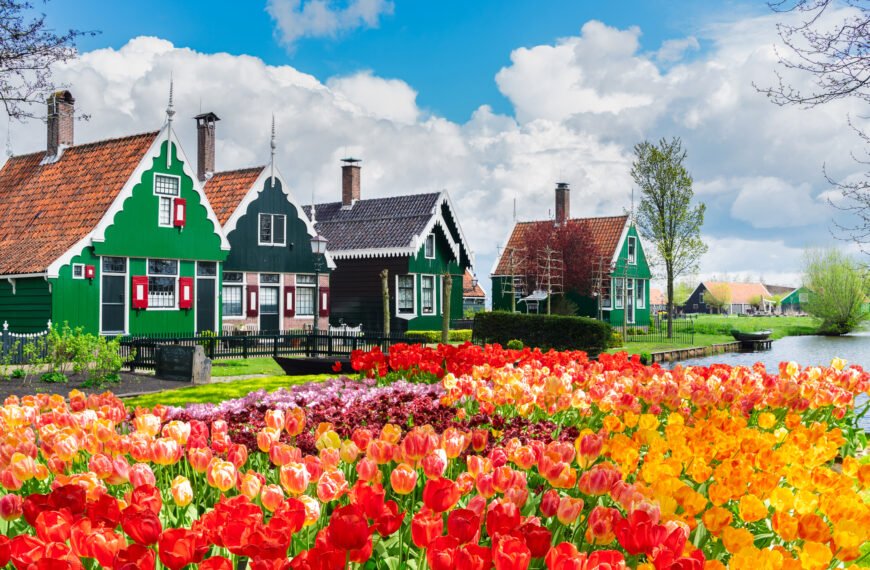
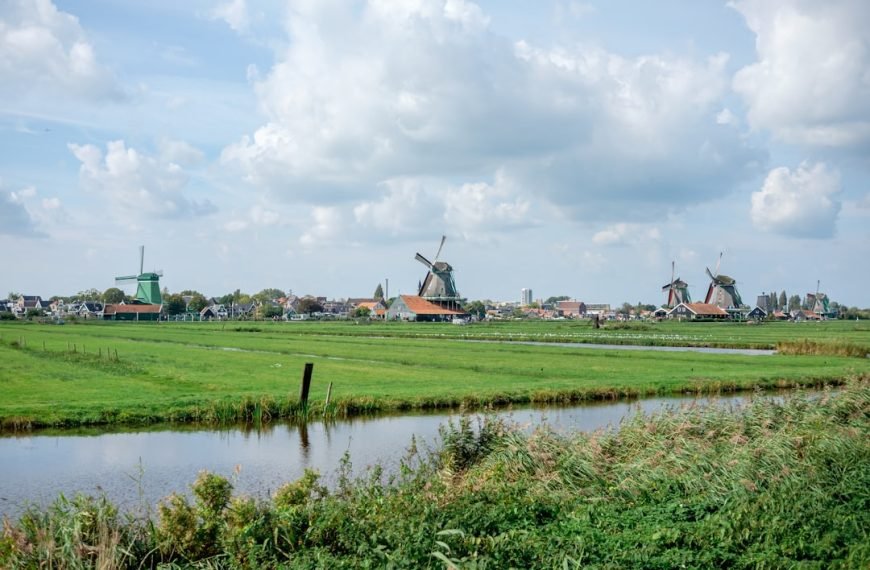
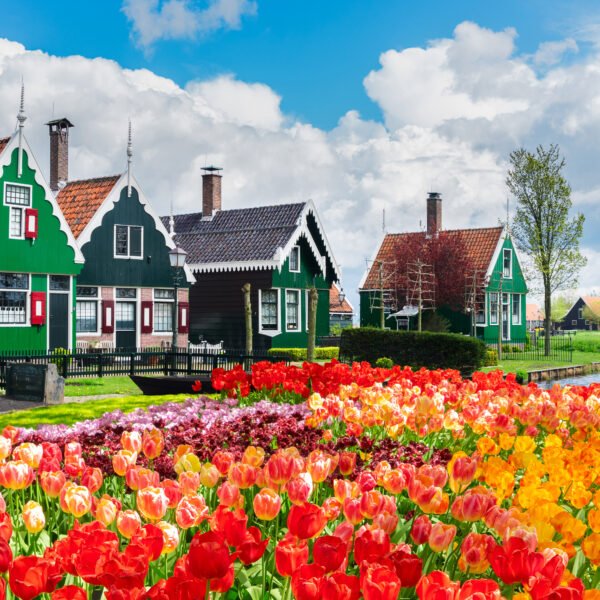
The Bollenstreek — literally the ‘bulb region’ — stretches along the sandy coastal strip south of Haarlem. In spring, it looks exactly like what it is: one of the most intensively cultivated agricultural zones on earth, with fields of red, yellow, white and purple running to the horizon. Keukenhof, the 32-hectare park at the heart of the region near Lisse, displays over 7 million bulbs across its eight-week spring season and draws around 1.5 million visitors annually. It is the world’s largest bulb garden, and it sells out.
The economics are formidable. Germany takes the largest share of Dutch flower exports — over three billion euros’ worth in 2023. The UK and France follow. Tulip exports specifically saw a 44% rise in value in recent years, reaching 320 million euros, with volume up 16% in the same period. And the flower market feeds into a much larger ecosystem: logistics, cold-chain infrastructure, floriculture technology, tourism, retail. The direct and indirect employment in the Dutch flower sector runs to approximately 250,000 jobs.
Source: Global Tulip Market – Market Data Forecast (2025)
There are darker numbers too. Between 2000 and 2017, the number of tulip bulb cultivation enterprises in the Netherlands dropped by 46% — from 1,663 to 893. The industry is consolidating, with larger operations absorbing smaller family farms. Pesticide use remains significant: Dutch tulip farming required roughly 26 kilograms of active pesticide substances per hectare in 2020. Reducing that figure while maintaining yields is one of the central challenges facing the sector.
Climate change adds its own pressure. Tulips need cold winters to vernalise — to complete the physiological process that triggers spring flowering. Warmer winters are already disrupting growing calendars. The same sandy coastal soils that made the Bollenstreek ideal for centuries are increasingly vulnerable to both drought and flooding.
The industry’s response has been characteristic Dutch pragmatism: precision agriculture, greenhouse technology, and the kind of co-operative research culture that strikes visitors from more competitive economies as almost baffling. Tulip Export (TTE) members share research findings and grant each other access to their premises. One grower interviewed by AIPH magazine described it as ‘co-opetition’ — a word that probably wouldn’t have made much sense to the speculators of 1637.
Source: AIPH – ‘From bulb to bloom, the remarkable journey of Dutch tulips’ (2024)
Coronavirus offered a sharp reminder of how fragile even this well-established industry can be. When borders closed in spring 2020, the Dutch had to destroy hundreds of millions of tulips — flowers in full bloom, unsellable. It was briefly, grimly reminiscent of 1637: beautiful flowers that nobody could buy. The industry bounced back within a season, which says something about the underlying demand. People, it turns out, still really want tulips.
Source: National Geographic – ‘Dutch tulip farmers are hoping for a post-pandemic boom’
The Tulip Family: A Guide to 15 Groups
Today there are over 4,000 named tulip cultivars, organised by the Dutch Royal General Bulb Growers’ Association into 15 official divisions. Here’s a guide to each one:
| Type | Key Characteristics | Notable Varieties | Bloom Time |
| Single Early | Classic cup shape, short sturdy stems (10–18″), one of the first to open in spring. Simple and elegant. | Apricot Beauty, Christmas Dream, Purple Prince | Early spring |
| Double Early | Peony-like, multi-layered blooms that look almost synthetic. Fragrant. Sometimes called ‘peony tulips.’ | Monte Carlo, Foxy Foxtrot, Foxtrot | Early spring |
| Triumph | The workhorse of tulips — mid-height, robust stems, enormous colour range. The most widely sold group. | Jan Reus, Blue Ribbon, Attila, Casa Grande | Mid-spring |
| Darwin Hybrid | Giant blooms on exceptionally tall, strong stems (18–24″). The best vase life of any group. Bred by Dirk Lefeber in the 20th century. | Apeldoorn, Pink Impression, Red Impression, Banja Luka | Mid-spring |
| Single Late | Elegant, orb-shaped flowers on the tallest stems (up to 30″). Includes some of the most unusual colour forms. | Queen of Night (near-black), Menton, Kingsblood | Late spring |
| Lily-flowered | Waisted stems with pointed, reflexed petals — the most sculptural tulip. Named for its resemblance to a day lily. | White Triumphator, Ballerina, Marilyn | Late spring |
| Fringed (Crispa) | Petals edged with crystalline fringes — called ‘tulips for touch’ because you want to test whether the fringe is real. Highly decorative. | Blue Heron, Hamilton, Cummins | Late spring |
| Viridiflora | Retains a vivid green streak on each petal even at full bloom. A botanical curiosity that divides opinion. | Spring Green, Artist, Flaming Spring Green | Late spring |
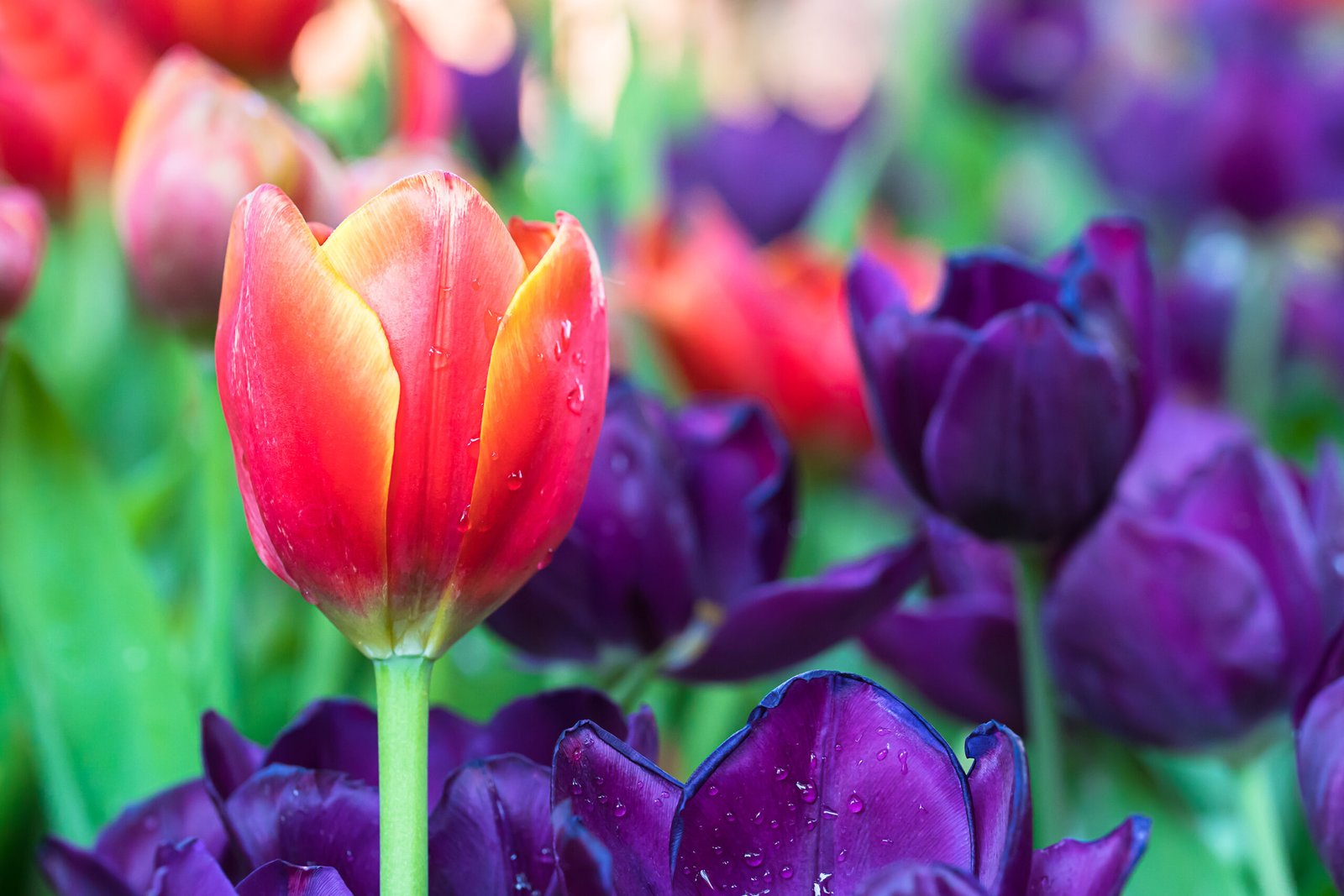
| Rembrandt | Flame-like streaks and feathered colour breaks — once caused by the tulip breaking virus, now bred as stable mutations. Named after the Golden Age painter. | Saskia, Absalon, Insulinde | Mid to late spring |
| Parrot | Dramatically ruffled, twisted, feather-like petals in bold colour combinations. The showiest tulip — and the most short-lived. | Black Parrot, Rococo, Estella Rijnveld, Flaming Parrot | Late spring |
| Double Late (Peony-flowered) | Very large, fully double blooms of exceptional visual weight. Sometimes mistaken for peonies. | Angelique (pink), Blue Diamond, Uncle Tom (mahogany-red) | Late spring |
| Kaufmanniana | Very early, very short (as little as 6″). Wide-opening waterlily shape. Perennialises reliably in the right conditions. | Stresa, Heart’s Delight, Johann Strauss | Very early spring |
| Fosteriana | Short to medium height, very large flowers that open flat in the sun. The Emperor group belongs here. | Orange Emperor, White Emperor, Red Emperor | Early spring |
| Greigii | Low-growing (8–12″) with distinctive mottled or striped foliage. Named after Russian botanist Samuel Alexis von Greig. | Oratorio, Toronto, Red Riding Hood | Early spring |
| Species (Botanical) | Wild tulip forms — small, wiry, and capable of true perennialisation. The ancestors of all cultivated tulips. | Tulipa sylvestris, T. humilis, T. clusiana (the lost ancestor of Tulip Mania) | Early spring |
Note: True Rembrandt tulips — the ‘broken’ varieties caused by the tulip breaking virus — are no longer sold commercially, as the virus spreads to healthy plants. The Rembrandt group sold today consists of stable, virus-free mutations that mimic the antique patterning. The originals, including the Semper Augustus, are gone.
Source: Amsterdam Tulip Museum / American Meadows / Wikipedia – Tulip taxonomy
Coda: A Flower With a Long Memory
There’s a particular irony in the fact that the Dutch — the people who gave the world its cautionary tale about irrational investment — turned that same flower into one of the world’s most methodically rational agricultural industries. The Semper Augustus is gone. The tulip breaking virus eventually destroyed it, as it destroyed all the ‘broken’ varieties that sparked the mania. But the trade it helped create has never stopped.
Every year, growers in the Bollenstreek dig up their bulbs in June, sort them by size, and replant in autumn. Families have been doing this for four or five generations. One company profiled by AIPH started growing tulips in 1922 and now has four generations of family members working the same operation — having survived the Depression, two World Wars, and COVID. ‘The moment we plant the bulb,’ one Dutch farmer told National Geographic, ‘it is like watching our own child growing up in front of our eyes.’
From a flower that cost more than a house in 1637, to a flower that kept people alive in 1945, to an industry feeding 250,000 jobs and supplying florists across every continent — the tulip’s hold on the Netherlands is one of the stranger continuities in economic history. It wasn’t just a bubble. It was the beginning of something.