
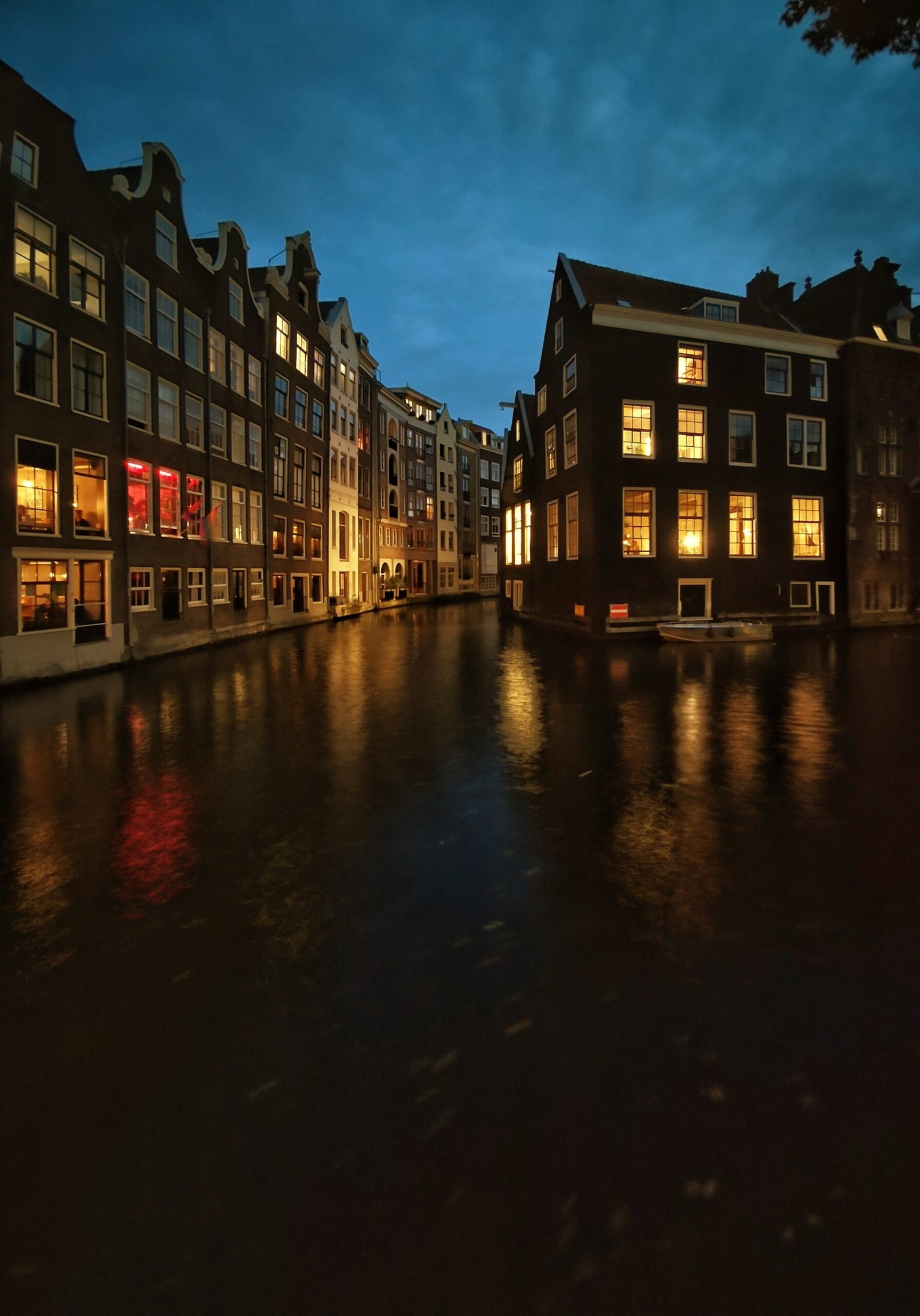
If you walk, or take a boat in the canal, through almost any Dutch city at night, something strange happens. The streets glow with living rooms. Lamps are on. People read, cook, watch television. And the windows, often floor-to-ceiling, sit completely uncovered. It is a complete voyeuristic experience, and you can marvel into the private lives of people throughout the Netherlands.
In much of the world, that would feel almost scandalous. In the Netherlands, it is normal. Nudity? Sure, but the rule is: if you do not want to see something, you should not be looking.
The habit has puzzled travelers for centuries. It has also produced several explanations, some historical, some sociological, and some simply very Dutch.
The Calvinist idea: honest people have nothing to hide
The most common explanation reaches back to the Protestant Reformation. Large parts of the Netherlands were strongly influenced by Calvinism, the branch of Protestantism associated with the 16th-century reformer John Calvin. Calvinist culture emphasized sobriety, discipline, and moral transparency.
Within that worldview, hiding behind curtains could look suspicious. An honest household, the idea went, had nothing to conceal. Anthropologists and historians often link the open-window habit to this cultural logic of visible respectability. (VOI)
In practical terms, leaving curtains open signaled something simple: this house is orderly, respectable, and morally upright. If neighbors could glance inside and see a tidy living room and a family behaving normally, social trust increased. (Polyglottist Language Academy)
In other words, Dutch living rooms doubled as small public statements about private virtue.
Windows as social transparency
Modern anthropologists argue that the practice also functions as a subtle form of community visibility. Research on Dutch housing culture found that neighborhoods where residents interact more frequently tend to keep their windows open more often. (StickyMangoRice)
The window becomes a thin boundary between public and private life. Not an invitation to stare, but a signal that the household is part of the street.
There is also an unwritten rule: you can glance, but you do not linger. The openness of the window reflects the household’s comfort with visibility, not permission to inspect someone’s dinner. (Polyglottist Language Academy)
That small cultural contract is easy for locals and slightly baffling for visitors.
A country that hoards daylight
The Netherlands sits far north. Winters are long, skies are gray, and daylight can feel scarce. Curtains block light that many households would rather keep.
As a result, many people leave their windows uncovered during the day simply to capture as much natural light as possible. (Polyglottist Language Academy)
Architecture reinforces the habit. Dutch townhouses often have large front windows facing directly onto the street. Once those windows exist, covering them permanently defeats their purpose.
Showing the living room to the world
There is another explanation, slightly more mischievous.
Historically, the Dutch were enthusiastic traders and urban merchants. Houses often doubled as places of business. A well-arranged living room could quietly advertise prosperity and good taste. (Telegrafi)
Open curtains let passers-by see polished furniture, paintings, porcelain, or the newest lamp. The window functioned almost like a shop display.
The tradition never disappeared. Many Dutch windowsills still contain carefully arranged objects, plants, or small decorations, subtly curated for the street outside. (StickyMangoRice)
The paradox of Dutch privacy
Here is the twist.
The Netherlands values privacy deeply. Personal questions can be intrusive. Friendships often take time to develop.
Yet the living room window remains open.
The explanation is cultural geometry. Dutch society tends to separate physical visibility from personal intimacy. You may see someone reading on their sofa. That does not mean you know them.
Anthropologists sometimes describe this contrast as a “peach” culture. The outside layer is open and visible. The inner core remains private. (cursor.tue.nl)
The result: a nation of illuminated living rooms
Walk through Amsterdam, Utrecht, or Delft after sunset and the streets turn into a gallery of domestic life. Every window frames a small scene.
A family eating dinner.
Someone watering plants.
A cat sitting on a radiator.
The Dutch are not inviting you in. They are simply comfortable letting the world see that ordinary life is happening.
And in a country famous for directness, that openness makes a certain kind of sense. Curtains hide things. The Dutch prefer clarity.