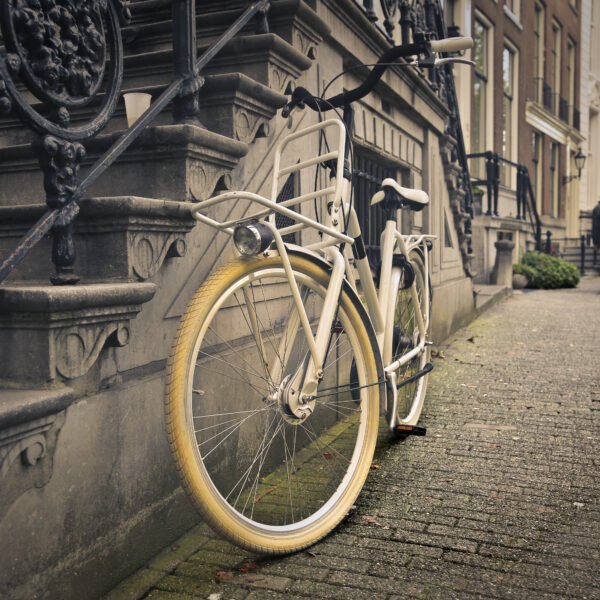

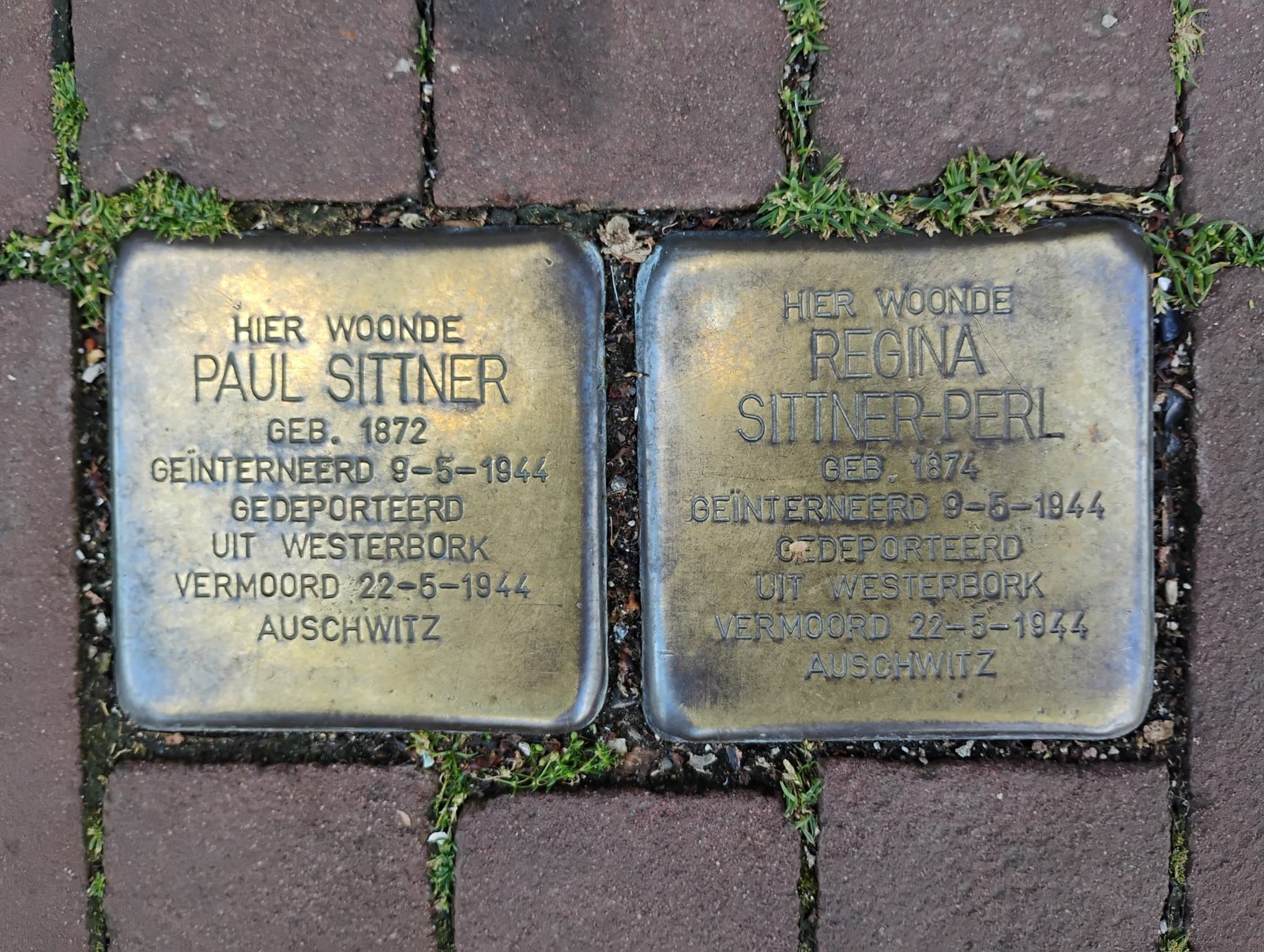
There is a particular kind of memorial that does not let you keep walking. Not because it is large or loud, but because of where it is — right there in the pavement, at your feet, outside a building that looks like every other building on the street. The struikelsteen asks nothing dramatic of you. Just a moment. Just a name.
They are more or less everywhere in the Netherlands once you learn to look for them.
What Are Struikelstenen?
Struikelstenen — Dutch for “stumbling stones” — are small brass plaques set into the pavement directly in front of the last freely chosen address of a victim of the Nazi regime. Each one is a 10×10 centimetre concrete cube with a hand-engraved brass face. Every stone begins with the same two words: Hier woonde — “Here lived.”
What follows is a name, a birth year, and then a short, brutal biography compressed into a few lines. The date of arrest or deportation. The transit camp — usually Westerbork or Vught. Then, most commonly: vermoord — murdered — followed by a place and date. Sometimes overleefd, survived. Sometimes bevrijd, liberated. Sometimes only a year, because nobody recorded the exact day they died.
These are not gravestones. The people they remember mostly have no grave. They were murdered in places designed to leave no trace. The stone in the pavement — outside the apartment where they once made coffee, raised children, argued with neighbours — is often all that physically remains of their presence in the world.
The Origin: Cologne, 1992
The project began with German artist Gunter Demnig, born in Berlin in 1947. He grew up in a country trying to process what it had done, and he had watched the official forms of that processing gradually become routine. Solemn ceremonies, speeches, two minutes of silence. He felt the meaning was draining out.
The first stone came not from a plan but from a specific injustice. In 1990, Demnig traced the deportation routes of Sinti and Roma through Cologne, painting the paths on the street. When he quoted official figures to a local woman, she told him flatly that there had been no Gypsies living in her neighbourhood. This, Demnig realised, was the problem. The absence of visible, individual evidence made denial easy.
On 16 December 1992 — the 50th anniversary of Himmler’s Auschwitz Decree, the order that sent Sinti and Roma to the death camps — Demnig laid the first stone in the pavement outside Cologne’s city hall without asking permission. It did not yet commemorate an individual. It reproduced the opening lines of Himmler’s decree itself. But in the press, it was already being called a Stolperstein — a stumbling block.
Demnig’s own explanation of the name is characteristically understated. He cites a schoolchild who said: “Man fällt nicht über die Stolpersteine, du stolperst mit dem Kopf und dem Herzen” — you don’t fall over the stumbling stones. You stumble with your head and your heart.
Over the following years, the project evolved. The stones moved from marking historical events to marking individual lives. They moved from Cologne to other German cities, then to Austria in 1997, and gradually across Europe. The first stones arrived in the Netherlands in 2007, in Belgium in 2009. By May 2023, the hundred-thousandth stone was laid in Nuremberg. As of 2024, more than 115,000 struikelstenen have been placed across over 1,800 cities and towns in 31 countries — making this the largest decentralised memorial in the world.
Not Just Jews
This matters, and it gets overlooked.
The struikelsteen project commemorates, in Demnig’s own words, “anyone persecuted and/or murdered by the Nazi regime.” That means Jews, Sinti and Roma, Jehovah’s Witnesses, homosexuals, people with physical or mental disabilities who were euthanised, political prisoners, resistance fighters, trade unionists, and people persecuted on grounds of race, religion, or what the Nazis classed as “anti-social” behaviour — including homeless people and sex workers.
The project’s organising principle is not victimhood by category. It is, deliberately, the opposite: one human being, one stone, one fate. The brass plate does not say Jew or homosexual or Roma. It says Here lived, followed by a person’s name. What unites all the stones is not the reason for the persecution but the humanity of the person who was persecuted.
This matters for how we understand the Holocaust and Nazi terror more broadly. The six million Jews murdered by the Nazis are at the centre of any honest account of what happened. But the total number of people killed by the regime — when you include Soviet civilians, Polish non-Jews, Sinti and Roma, disabled people murdered in the T4 euthanasia programme, political opponents, gay men — was somewhere between 11 and 17 million. The struikelstenen make no hierarchy of victims. Every life that was taken gets a stone.
In the Netherlands, this has not always been without tension. In 2024 and 2025, a dispute arose in Haarlem over stones for 45 Dutch political prisoners — communists and activists who were gassed “experimentally” by the Nazis at the Bernburg psychiatric clinic in 1942. The local Stolpersteine foundation had a municipal mandate specifically for Jewish, Roma, and Sinti victims, and some argued these political prisoners should receive a different form of commemoration. The story was reported by Euronews as an example of the ongoing, live argument about who the stones are for. The foundation’s answer, and Demnig’s, has always been the same: they are for everyone.
The Netherlands and the Holocaust
To understand why there are so many struikelstenen in Dutch cities, you have to understand what happened here.
Of the approximately 140,000 Jews living in the Netherlands in 1940, around 107,000 were deported to concentration and extermination camps. Fewer than 5,000 returned. This was a death rate of over 73% — the highest in Western Europe, higher than Belgium, higher than France, higher even than Germany itself. The reasons are complex and still debated by historians: the flat geography offered nowhere to hide; the Dutch bureaucratic infrastructure was efficient and largely intact; the German administration in the Netherlands was particularly zealous.
Over 70% of Holland’s Jewish population was murdered. The country has been living with that fact for 80 years. After bulldozing (1982-1986) much of the Jewish quarter in a short-sited decision to make way for the Amsterdam Opera House, the struikelstenen — roughly 1,800 in Amsterdam alone — are one of the most visible parts of how it continues to reckon with it.
Plantage Middenlaan: Where the Stones and the Building Meet
If you want to understand the struikelstenen in Amsterdam, walk to the Plantage neighbourhood — the former Jewish quarter in the east of the city centre — and stand on Plantage Middenlaan.
The building at number 33 is the Hollandsche Schouwburg. It was built in 1892 as a popular theatre, and because of its location in the heart of the Jewish quarter, it drew many Jewish performers and audiences. In September 1941, the Nazi occupiers renamed it the Joodsche Schouwburg — Jewish Theatre — as part of the systematic exclusion of Jews from Dutch cultural and social life. Then, from July 1942, the Germans repurposed it entirely.
It became a holding pen.
Jews from Amsterdam and the surrounding areas were ordered to report here, or were brought here after raids. They were registered, packed into the old performance hall and onto the stairs and balconies, and held — sometimes for hours, sometimes for days, sometimes for weeks — until they were loaded onto trams and trains to Westerbork transit camp, and from Westerbork to Auschwitz, Sobibor, or Bergen-Belsen. Between 60,000 and 80,000 people passed through those doors. Across the street, at the nursery on Plantage Middenlaan 31, children under twelve were separated from their parents and held separately until the transports came. Around 600 children were smuggled out of the nursery by resistance workers and hidden. The rest were deported with their families.
Today, the Hollandsche Schouwburg is a memorial. Its auditorium was removed after the war — nobody wanted to use it as a theatre again — and the remaining facade and walls were converted into a place of remembrance. A wall inside is engraved with 6,700 family names representing the more than 104,000 Dutch Jews who were murdered. An eternal flame burns in the memorial garden. In March 2024, following renovation, it reopened as part of the Jewish Cultural Quarter, with audio testimonies from survivors guiding visitors through the building.
And outside, set into the pavement in front of the building and along the street, are struikelstenen.
In the spring of 2024, around the time the National Holocaust Museum opened nearby at Plantage Middenlaan 29, approximately 100 new stones were laid in the surrounding area — outside the Schouwburg, the former nursery, and the teacher training college next door where resistance workers had passed children to safety. The stones were placed to make visible what the neighbourhood once was and what happened to the people who lived there.
Five Names Outside One Building
The stones in front of the National Holocaust Museum at Plantage Middenlaan 29 are documented on TracesOfWar, the Dutch database of war memorials. Six of them read as follows:
Schoontje Roodenburg, born 1859. Interned 9 February 1943. Deported from Westerbork to Auschwitz 23 February 1943. Murdered 26 February 1943.
Rachel Duinkerk, born 1867. Deported from Westerbork to Auschwitz 9 February 1943. Murdered 12 February 1943.
Schoontje Gosschalk, born 1879. Interned 30 January 1943. Deported from Westerbork to Auschwitz 23 February 1943. Murdered 26 February 1943.
Jansje Parijs-Bleekveld, born 1865. Interned 4 March 1943. Deported from Westerbork to Sobibor 18 May 1943. Murdered 21 May 1943.
Marianne Worms-Vieijra, born 1873. Interned 6 February 1943. Deported from Westerbork to Auschwitz 9 February 1943. Murdered 12 February 1943.
Five women. The oldest was 84. The youngest was 64. All of them had lived within walking distance of a theatre that spent a century staging plays and then, for sixteen months, staged something else entirely. They did not die in the building where their names are now remembered. They were processed through it.
That gap — between where the stones lie and where the people died — is part of what the struikelsteen is trying to close. The stone is in the neighbourhood. It is in the street you walk through. It puts the person back where they belong, in the place they lived before the state decided they did not deserve to.
The Design of the Thing
Part of why the struikelstenen work — and they do work, in a way that large official memorials sometimes don’t — is the physical experience of encountering them.
You have to look down. You have to bow your head, slightly, to read the engraving. Demnig knew this. In a tradition that draws on the Talmud — a person is only forgotten when their name is forgotten — there is something right about the posture of reading. You are not gazing up at a monument. You are bending toward a person.
The stones are also not isolated. Walk down almost any residential street in Amsterdam’s old Jewish quarter and you will find clusters of them. Three together outside one building, a whole family. Two next door. One alone. As the research article by Arnoud-Jan Bijsterveld on the Dutch struikelstenen notes, the “pure factuality” of the stones — their compressed, repetitive, precise language — conveys something about scale that a single large monument cannot. You begin to feel the sheer number. Each stone is just one name. And there are 1,800 of them in this one city.
The iamexpat.nl piece on the stones quotes Demnig describing a moment at a stone-laying ceremony when two sisters, who had fled Germany and been separated for 60 years, were reunited. “There they were,” he said, “standing in front of the stone.” The stone had brought them back to the same place. That is what it is supposed to do.
How a Stone Gets Laid
Anyone can request a struikelsteen. The process varies slightly by city, but in Amsterdam it goes through Stichting Stolpersteine (stichting-stolpersteine.nl). The foundation does not try to arbitrate which victims are “eligible.” The request can be for anyone who was murdered, driven to suicide, forced underground, or otherwise persecuted by the Nazi regime.
Each stone costs around €120 to produce and lay, and is typically funded through private donations, often from family members or neighbourhood residents who want to mark a specific address. The stones are still engraved by hand — originally by Demnig himself, now by sculptor Michael Friedrichs-Friedländer, who has engraved tens of thousands of them.
Once laid, the stones are permanent. They require occasional cleaning — Amsterdammers have been known to go out on Remembrance Day with cloths and metal polish — and they are sometimes stolen or vandalised, which happens most often in Germany but has occurred across Europe. When a stone is stolen, it is replaced.
The Scale of It
The struikelstenen are the largest decentralised memorial in the world. That description does something important: it makes visible how different this is from a central monument you travel to. The stones are not in one place. They are everywhere. They are in the streets where people were taken from. They are where the persecution actually happened, not in a park outside it.
As of 2024, more than 115,000 stones have been laid in over 31 countries. The countries with the most stones outside Germany are those that were occupied — the Netherlands, Belgium, France, Italy. But there are stones in Norway, Greece, Slovakia, Croatia, Hungary. Each one follows the same design, the same formula, the same plain factual language. Here lived. Born. Deported. Murdered.
The Consider the Source essay on the stones puts it clearly: “Victimhood, as defined by the Stolpersteine, is all-inclusive: the stones do not distinguish between, nor do they specify, Jews, homosexuals, communists, Sinti and Roma or any other group. Rather, they follow the principle of ‘one human being — one stone — one fate.'”
There are also Stolperschwellen — “stumbling thresholds” — larger slabs placed at sites where groups were taken, rather than individuals. In the Netherlands, one lies before Kasteel De Vanenburg in Putten, marking the approximately 125 people deported from there. One now lies at a tram stop on Plantage Middenlaan, marking the routes along which tens of thousands of Jews were transported to the Hollandsche Schouwburg in 1942 and 1943.
Why It Matters Now
There are people alive today who knew some of the people named on these stones. In a few years, there will not be. The generation of survivors is almost gone. What replaces the living witness is argument — about how to remember, who to include, what the right form of memorial is, whether the memorials that exist are sufficient.
The struikelstenen are not sufficient. Nothing is. But they are one of the more honest attempts, because they refuse to let the scale of the murder become abstract. Each stone is one person. Each stone was placed by someone who cared enough to find out the name, raise the money, and arrange the ceremony. The brass does not last forever. It oxidises. It needs to be polished. That is part of the point. Memory requires maintenance. While the stones are sometimes defaced and destroyed, particularly in Germany, the Dutch generally maintain them.
Walk through Amsterdam. Keep your eyes down, occasionally. You will find them.
Useful Links and Sources
- Stichting Stolpersteine Amsterdam (request a stone, find a map): stichting-stolpersteine.nl
- Joodsmonument.nl (database of Dutch Jewish war victims): joodsmonument.nl
- TracesOfWar (Dutch memorial database with stone locations): tracesofwar.com
- Hollandsche Schouwburg (memorial, Plantage Middenlaan 33, Amsterdam): hollandscheschouwburg.nl
- Consider the Source — Stolpersteine essay: considerthesourceny.org
- IamExpat — Stolpersteine in the Netherlands: iamexpat.nl
- Euronews — Controversy in the Netherlands, 2024: euronews.com
- Gunter Demnig’s project website: stolpersteine.eu
- Anne Frank House knowledge base on the Hollandsche Schouwburg: annefrank.org