NL for Beginners · Life on the Water
The History of Houseboats in Amsterdam
What began as decommissioned cargo barges and a desperate housing shortage is now some of the most expensive real estate in the city. Here’s how a fleet of floating slums became a protected, oversubscribed, distinctly Dutch way of life.
Amsterdam has roughly 2,500 houseboats today, most of them squeezed onto a fixed number of legal moorings that the city stopped issuing decades ago. If you want one now, you mostly have to wait for someone to die, sell, or sink.
That scarcity is a fairly recent problem. For most of the twentieth century, a houseboat in Amsterdam meant you couldn’t afford anything else.
What they were
People have lived on Amsterdam’s water since long before anyone thought of it as charming. In the seventeenth century, the boats moored along the canals mostly belonged to itinerant traders selling goods the city guilds didn’t want sold on land, and the relationship with the municipality was frosty from the start, according to the Grachtenmuseum’s history of canal living. By 1840, drawings of the period show simple wooden structures moored behind the Tolhuis that Amsterdammers called hondenhokken, dog houses, not exactly a term of civic pride.
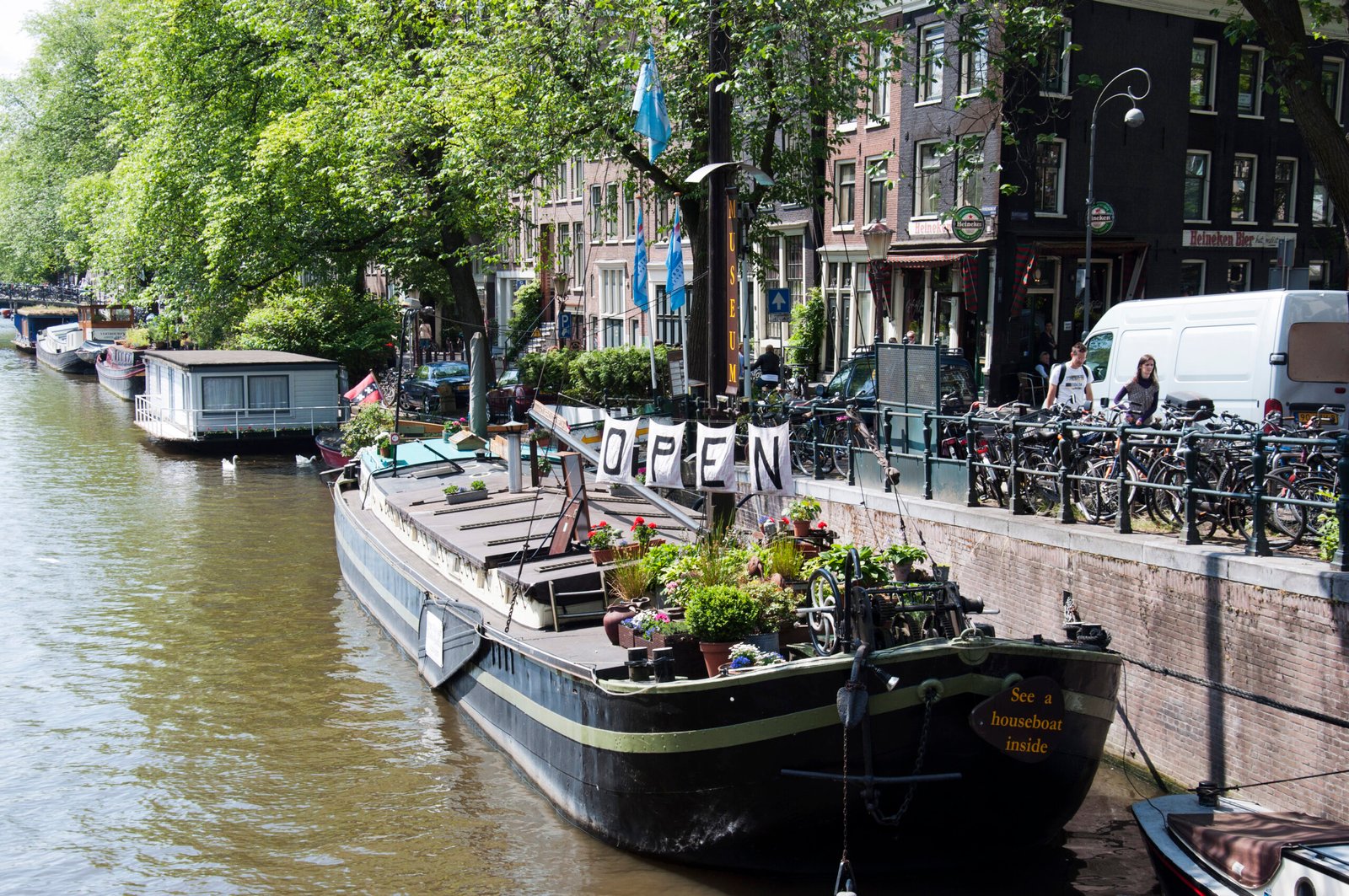
The modern houseboat, the kind you see lining the Prinsengracht today, is a twentieth-century invention built out of two coinciding shortages. Steel cargo barges were replacing the old wooden sailing ships around 1900, which left a surplus of retired wooden vessels sitting idle. Then came two world wars, and with them, a housing crisis severe enough that people moved into whatever would float. The post-war shortage after 1945 was the real turning point: bombed housing stock, returning soldiers, displaced families, and a fleet of decommissioned freight barges that road transport had made obsolete. Turning one into the other wasn’t romantic. It was the cheapest option available.
By the 1960s and 70s, students, artists, and squatters were living on the water because renting on land was either impossible or something they were actively refusing to do, per the Amsterdam Guide’s account of the era. This is the image most people carry around, of houseboats as bohemian, slightly lawless, decorated with whatever the last owner left behind. It was true for about two decades. Then the city noticed.
What the rules actually are
Amsterdam did not regulate houseboats out of hostility. It regulated them because thousands of unlicensed, un-plumbed vessels moored along a working canal system was, eventually, a public health and safety problem the city couldn’t ignore. The framework that resulted is still what governs every houseboat in the city.
To keep a houseboat anywhere in Dutch public water long-term, you need a ligplaatsvergunning, a mooring permit, issued to a specific person, for a specific spot, for a specific vessel, according to the Dutch government’s official regulation summary. Change the boat, and you need a new permit. Amsterdam froze the number of these permits years ago, which is the entire reason a houseboat mooring now counts as real estate rather than a parking spot. You’re not really buying a boat. You’re buying the right to occupy a piece of public water that the city has decided not to hand out anymore.
Every houseboat in Amsterdam is now required to connect to the municipal sewage system, a rule that only became mandatory in 2005, per local reporting on the city’s houseboat regulations. Before that, a working toilet on a houseboat meant a holding tank, or, less delicately, the canal itself. Anyone renting an older houseboat today is renting the tail end of that transition.
Every three to four years, owners of the older ship-hulled houseboats are required to haul out at a shipyard for a hull inspection, a process that can take up to a week, according to a local guide to canal life. On top of that comes a mooring fee, insurance that tends to run higher than a comparable policy on land, and property tax. None of this is optional, and none of it is cheap, which is part of why “houseboat” no longer means “affordable.”
If you want to list your houseboat on Airbnb, the City of Amsterdam requires a holiday rental permit, and the boat has to be your actual registered home address, not a side investment. You’re capped at 30 nights a year, or just 15 if you’re moored in the Centrum or De Pijp districts, and no more than four guests at a time, per the municipality’s own rules. The city that once let anyone with a barge and a rope move in now treats short-term letting with the same suspicion it applies to land-based apartments.
What they’ve become
Somewhere between the 1990s and now, the houseboat flipped from housing of last resort to a category the Dutch have a slightly resentful nickname for: wateryuppies, the professionals who bought a mooring permit when they were still obtainable and now sit on what amounts to a small, illiquid fortune. A legal mooring in the city center is effectively unrepeatable. The city isn’t issuing new ones, and the old ones only change hands when someone sells, which means owning one now functions less like owning a boat and more like owning a rent-controlled apartment that happens to float.
At the same time, an entirely new category of houseboat has shown up alongside the converted barges: the purpose-built floating home, engineered from scratch rather than salvaged from a shipping career. The most serious example is Schoonschip, a neighborhood of 46 households in Amsterdam-Noord’s Buiksloterham district, built by a group of residents rather than a developer, with a shared smart energy grid, separated grey and black water systems, and green roofs on every home. The Washington Post’s reporting on the project quotes founder Marjan de Blok describing the deliberate distance she wanted from what she calls the “quirky” converted barges that crowd the rest of the city’s canals. Schoonschip isn’t nostalgic. It’s a climate-adaptation prototype that happens to have showers.
So the modern Amsterdam houseboat now exists in two entirely different registers at once: a hundred-year-old wooden barge with a leaning stove and mismatched windows on one canal, and a smart-grid engineered floating house with underfloor heating a few kilometers away in IJburg or Buiksloterham. Both are legally “houseboats.” Neither would recognize the other as kin.
What it’s actually like to live on one
Ask anyone who’s done it and you get the same handful of stories, in slightly different order.
One expat writer for DutchReview described being jolted awake by a passing speedboat, rocking “like a baby in a 30 ft cradle,” with everything not nailed down sliding across the floor, a hazard of mooring on a canal that’s still, technically, a working waterway shared with tourists who haven’t quite grasped the speed limit, per her account of houseboat life.
Houseboats are long and thin by nature, which means your actual neighbor might be moored a hundred meters down the same stretch of water, closer in spirit to the people living on land behind you than to the boat two spots over. The same writer noted she’d love to borrow a cup of sugar from a boat neighbor, but the geography rarely cooperates.
De Dogger, moored at Amstelveld, started life as a “waterhaler,” ferrying water out to the Amstel brewery before Amsterdam had piped water. Once the pipes went in around 1888, a fuel merchant named Dogger bought the boat, used it to sell coal and wood, and simply moved in. His boat stayed continuously inhabited on that same spot until 2022, according to the Grachtenmuseum, which makes it one of the longest-running houseboat tenancies in the city’s history and a reminder that some of these boats have had entire unrelated careers before becoming a home.
Not every Amsterdam houseboat has a human owner. De Poezenboot, on the Singel, has operated as a floating shelter for stray and abandoned cats since 1966, when a woman named Henriette van Weelde ran out of room in her actual house and bought a barge instead, according to the Amsterdam Museum’s account of her life. It’s still there, run by volunteers, and it may be the only houseboat in the city where the residents genuinely don’t care what canal they’re on.
Neighborhoods and their houseboats
Not every canal has the same kind of houseboat, and the differences track the city’s own history: old money on the Amstel, bohemian holdouts in the Jordaan, engineered sustainability out in the newer eastern and northern districts.
| Neighborhood / Waterway | Character | A boat worth knowing |
|---|---|---|
| Prinsengracht, Jordaan | The postcard canal ring. Dense, historic, mostly older ship-hulled houseboats packed close together. | The Woonbootmuseum, a former 1914 cargo ship called the Hendrika Maria, converted into the world’s only museum dedicated to houseboat life. |
| Singel | Around 750 permitted moorings sit within the historic Singel ring alone, per the Grachtenmuseum. | De Poezenboot, the floating cat shelter operating since 1966, moored near Singel 38. |
| Amstel river | Wider water, historically the address of choice for wealthier houseboat owners rather than the working poor. | De Dogger at Amstelveld, a former brewery water-boat continuously inhabited from the 1880s until 2022. |
| Westerdok | A former harbor basin near Centraal Station, now lined with architect-designed floating homes rather than converted barges. | Contemporary purpose-built floating houses, popular on short-term rental platforms and a common Amsterdam Airbnb setting. |
| Buiksloterham, Amsterdam-Noord | A former industrial zone, once home to Shell and a Fokker aircraft plant, now the city’s floating sustainability laboratory. | Schoonschip, 46 households with a shared smart energy grid and separated wastewater systems, plus De Ceuvel, a cluster of reclaimed houseboats repurposed as a creative, land-based eco-district nearby. |
| IJburg (Steigereiland & Haveneiland) | Built-from-scratch floating neighborhoods on a reclaimed archipelago in the east of the city, designed by architects rather than assembled by residents. | Dozens of individually architect-designed floating houses on Steigereiland, plus a cluster of 34 converted barges on Haveneiland-West. |
“Before I visited that boat, I wasn’t really conscious that I didn’t like the way I was living.” Marjan de Blok, founder of Schoonschip, on the visit that started it · The Washington Post
That’s really the throughline. Nobody in Amsterdam ends up on the water by pure accident. Someone always went looking, whether out of necessity in 1946 or out of a very specific kind of dissatisfaction in 2016. The boats changed. The impulse didn’t.
Sources
- Grachtenmuseum Amsterdam: Living on Water
- Private Boat Tour Amsterdam: The Magic of Houseboats in Amsterdam
- The Amsterdam Guide: Houseboats in Amsterdam
- What’s up with Amsterdam: Houseboats
- Introducing Amsterdam: Houseboats in Amsterdam, Life on the Canals
- Business.gov.nl: Mooring Permit in the Netherlands
- City of Amsterdam: Apply for a Holiday Rental Permit
- Schoonschip Amsterdam, official site
- The Washington Post: In Amsterdam, floating homes show the world how to live alongside nature
- DutchReview: 5 Questions People Ask About Living on a Houseboat
- Amsterdam Museum: Founder of the Cat Boat
- Amsterdam Local Gems: Amsterdam’s Floating World