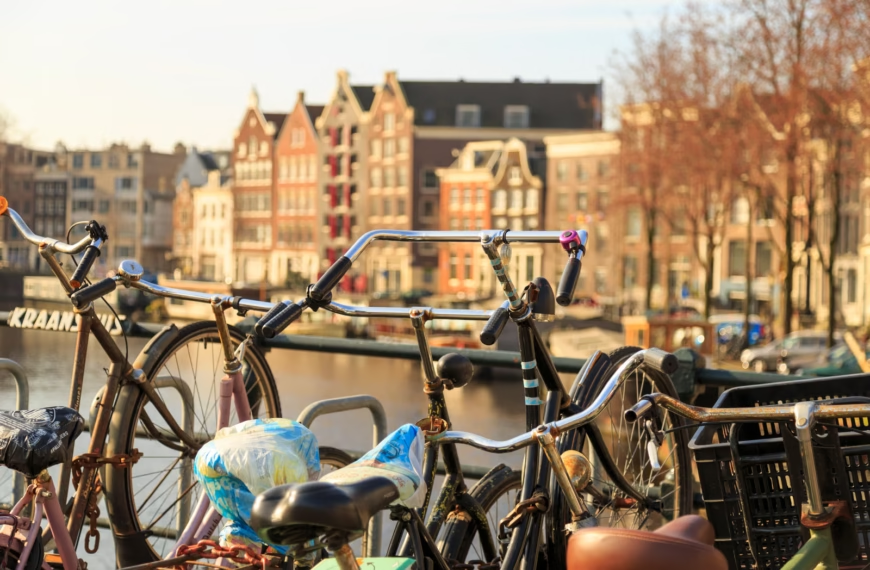
In January 2024, police in Maarssen arrested a 32-year-old man from Utrecht on suspicion of dealing in stolen goods. The police report describes a warehouse that doubled as a bike shop of sorts: buyers answered a Marktplaats listing, then came to look at the stock. Officers counted 177 bikes they believed to be stolen.
That warehouse is a small part of a much larger market. The Netherlands loses roughly a bicycle every thirty-five seconds, and most of the people it happens to will never see the bike again.
The numbers
Official counts and survey estimates differ by a factor of ten, and the gap is the most important statistic in the whole subject. Police recorded 86,950 reported thefts in 2025, about 41 percent more than in 2020. CBS’s Veiligheidsmonitor, which asks people directly, puts the real figure near 900,000.
| Measure | Figure | Source |
|---|---|---|
| Thefts reported to police, 2025 | 86,950 | Risk & Business, from CBS police data |
| Estimated thefts, 2025 | about 900,000 (6.4 per 100 residents) | Fietsersbond, citing CBS |
| Residents aged 15+ who were victims, 2025 | 4.9% (3.8% in 2021) | Fietsersbond |
| Estimated thefts, 2023 | 928,000 | CBS |
| Financial damage, 2023 | €698 million (€465 million in 2021) | CBS |
| Value of stolen bikes, 2023 | half under €350, a quarter over €800 | CBS |
| Stolen bikes recovered | about 5% | VbV, via NOS |
| Stolen from garages, sheds and offices | 35 to 40% | NOS |
Arithmetic on the survey figure gives about one hundred thefts an hour, against roughly ten reports an hour in police data. The share of victims who go to the police is itself disputed: 11.5 percent in the latest Fietsersbond summary of CBS data, 40 percent in a 2023 NOS report, and about 20 percent in a Bureau Beke study for the anti-theft foundation SAFE. The method matters, and so does who is asked. Owners of insured e-bikes report far more often than owners of a 40-euro city bike, because an insurer wants a police report.
Geography is uneven. Amsterdam recorded more than 10,000 reports in 2025, or 12.8 per 1,000 residents, narrowly ahead of Groningen (12.7) and Nijmegen (12.4). Timing is uneven too. King’s Day sees about 2.5 times the usual daily number of thefts, according to the insurers’ VbV campaign.
Where the bikes go
The standard answer used to be Eastern Europe, and part of it still holds. René Middag, who leads the national police project on mobile banditry, told De Telegraaf that thousands of stolen e-bikes cross the border every month. Gangs reportedly paste forged frame-number stickers over the originals and carry fake consignment notes. Bureau Beke’s research for SAFE found that organised groups, often from Bulgaria, Poland, Romania, Serbia and Albania, take many expensive bikes home.
A year of private investigation commissioned by the insurers’ foundation VbV points somewhere less exotic. Ad Metzen, VbV’s bike project manager, said in July 2026 that most stolen bikes never leave the Netherlands. They are re-identified at home and sold back through Marktplaats, from garage units, and sometimes through shops that look legitimate. Niels Penning of tracker maker Tracefy, who has his own commercial interest in the subject, says he knows of dozens of dubious dealers that receive vans of stolen bikes. His reasoning is plain: a Gazelle, Urban Arrow or Lovens is worth most in the country where the brand is known.
The mechanism is called omkatten, re-badging. Metzen explained that many bikes costing €3,500 to €4,000 carry a printed frame-number sticker rather than a stamped number. A thief peels it off and applies a lookalike. A case in Joure in early 2026, per VbV, involved e-bikes stolen in The Hague and driven to Friesland for professional re-badging. Police have since turned toward the buyers and resellers on the other end. The Supreme Court has made this harder to deny: in a 2022 ruling (ECLI:NL:HR:2022:44), as summarised in the same article, a professional bike dealer is expected to recognise signs of theft and investigate when in doubt.
| Route | What happens | Evidence |
|---|---|---|
| Resold in the Netherlands | Frame number swapped, sold on Marktplaats or through dealers | VbV investigation, 2026 |
| Exported | Vans to Eastern Europe, mostly e-bikes | Police (Middag), Bureau Beke |
| Parts | Batteries and motors sold separately | ANWB notes batteries and displays are often stolen |
| Canal | Dumped, mostly cheap bikes | Waternet estimates |
The canals deserve a mention because everyone else gives them one. Waternet pulls an estimated 12,000 to 15,000 bikes a year out of Amsterdam’s water. Former superintendent Arie Beer told the Associated Press that nobody throws their own bike in, so theft or vandalism is the assumption, per Dutch Amsterdam. Salvaged bikes mostly go for scrap, though some are sold to wholesalers who repair them. The figure is repeated everywhere and rests on an assumption, not a count. Against 900,000 thefts nationally, it is a footnote with good photography.
Then there is the depot. Amsterdam’s fietsdepot registers about 100,000 bikes a year, and Metzen says 70 percent are never collected. Those are wrongly parked and abandoned bikes, not stolen ones, but the lesson carries over. Finding a bike is one problem. Proving whose it is, without a registered frame number, is another.
Trackers change the odds. SAFE’s Jeroen Snijders Blok said that 80 percent of stolen e-bikes with a track-and-trace chip are found. That is an older figure from a period when few bikes had one, and it assumes the theft is reported quickly.
Locks
The Dutch lock standard is the ART mark, awarded by Stichting ART. Most bike insurers require at least a two-star lock, and the ANWB says its own policy always does. Three stars is nominally for mopeds, which is why heavier chains tend to turn up on expensive bikes. For an e-bike, the ANWB notes that a second ART-2 lock is often required.
The industry’s own diagnosis is blunt. Metzen says the ring lock bolted to the frame has barely changed in forty years while bike values have risen about tenfold: lift the back wheel and walk away. His comparison is a €1,000 laptop left beside a supermarket entrance. VbV’s STAAT-E-LEKKER campaign asks owners to use two ART-approved locks. Keep the receipt and note the key number, because insurers often ask for both keys after a theft. A lock also has to go on at home. A third or more of thefts happen indoors, in sheds, garages and offices.
Insurance
Theft cover is cheap relative to the loss, and cheaper than the premium tables of many comparison sites suggest at first glance. One comparison site lists entry-level theft premiums of €5.62 a month for a €1,000 city bike, €9.91 for a €2,500 bike and €14.22 for a €4,000 bike. Another price check puts an e-bike of about €2,500 at roughly €9 a month with theft and damage cover on a one-year term.
| Bike value | Theft-only premium (from, per month) | Source |
|---|---|---|
| €1,000 city bike | €5.62 | Fietsverzekeringen.nl |
| €2,500 city bike | €9.91 | Fietsverzekeringen.nl |
| €4,000 city bike | €14.22 | Fietsverzekeringen.nl |
| About €2,500 e-bike, theft plus damage | about €6 to €15 | Lastenvrij |
| About €400 standard bike, theft cover | about €4 to €8 | Lastenvrij |
Those are indicative quotes from October 2026, not offers, and premiums move with the bike’s value, the deductible and the town. One comparison site’s worked example has the same bike costing €14.80 a month in Amsterdam-Oost with a weaker lock and €9.50 in Leiden with a stronger one. That is a single illustration rather than market data, but the direction matches the theft statistics.
The economics for insurers explain the new conditions. In 2023, insurers paid out €271 million for bike theft, nearly double the 2021 total, according to CBS figures reported by ANP. Only 13 percent of thefts were even partly reimbursed. That is why GPS trackers increasingly earn discounts or are required above a value threshold. For a bike worth €400, a €3 to €6 monthly premium adds up to €36 to €72 a year, between 9 and 18 percent of the bike’s value, so the decision is closer than it looks. For a €4,000 cargo bike it is not close.
A Nordic comparison
Copenhagen has the same problem on a smaller scale. Danmarks Statistik counted 17,316 reported thefts in the city in 2023, and Lord Mayor Sophie Hæstorp Andersen convened police, insurers and the cyclists’ union in response. The Danish fence looks familiar as well. In 2015 a customer spotted his own bike being repainted in a Nørrebro shop, which led police to between 250 and 400 stolen bikes on the premises. Whether bike theft is worse in the Netherlands depends on what is counted and how, which is a polite way of saying nobody can say with confidence.
Practical points
Report the theft. The police number is 0900-8844, and a report is the precondition for an insurance claim and for any recovery. Record the frame number now, preferably after having it stamped or engraved, since depots in many cities run regular engraving sessions. A second-hand bike can be checked against the police-linked Stop Heling register before purchase. If a price looks too good, Dutch law treats a buyer who could have suspected theft as a handler of stolen goods.
None of this is glamorous. The main protection is two good locks and a bike whose frame number is on file.
Sources
- Politie.nl, arrest of dealer in stolen bikes, Maarssen (January 2024)
- Risk & Business, Fietsverzekering.nl analysis of 2025 CBS police data
- Fietsersbond, summary of Veiligheidsmonitor 2025
- CBS, citizens suffered more financial loss from crime in 2023
- CBS, Financiële schade (2023 report)
- ANP via Nieuws.nl, insurers paid €271 million
- NOS, bike theft reports rise for third year
- NOS, ANWB loses millions to e-bike theft
- Hart van Nederland, thousands of stolen e-bikes to the border (René Middag)
- Hart van Nederland, Bureau Beke research for SAFE
- Tracefy/Tweewieler.nl, VbV investigation into rogue dealers (July 2026)
- Stichting VbV, 5 questions on tackling bike theft (Ad Metzen, May 2025)
- Security Management, STAAT-E-LEKKER campaign
- Dutch Amsterdam, bikes and cars in the canals
- Sustainable Amsterdam, recovering bikes from the canals
- Wikipedia, Canals of Amsterdam
- ANWB, ART lock explained
- ANWB, rising bike theft
- Mantel, choosing a bike lock
- ID.nl, locking your e-bike
- Fietsverzekeringen.nl, premium comparison and e-bike insurance
- Keuze.nl, bike insurance
- Lastenvrij, cheapest bike insurance 2026
- Fietsvergelijk.nl, e-bike insurance comparison
- TV2 Kosmopol, Copenhagen mayors against bike thieves
- The Local Denmark, Copenhagen shop held hundreds of stolen bikes (2015)