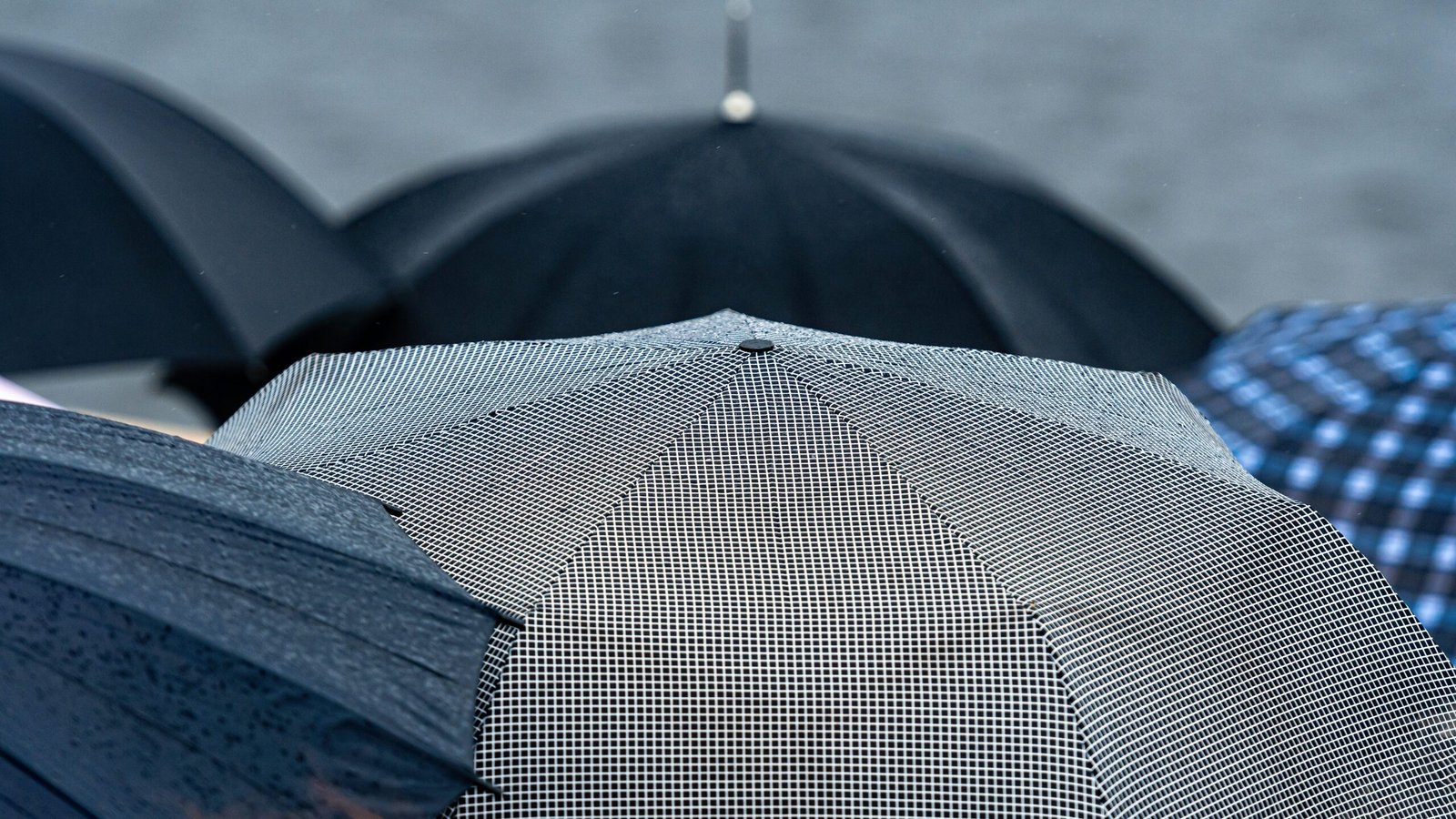
Walk through Amsterdam in a downpour and the umbrellas belong to tourists. The Dutch bike through it, hood up or bare-headed, sometimes one hand steering and one hand holding a phone (technically illegal but regardless), rarely an umbrella. Visitors tend to read this as toughness or indifference. The more accurate explanation is mechanical: an umbrella and a bicycle solve different problems, and the Netherlands is a country built around the bicycle.
The bike is the reason
Roughly a quarter of all trips in the Netherlands are made by bicycle, more than anywhere else in Europe, and cycling is woven into commuting, shopping and school runs rather than treated as recreation. An umbrella needs a free hand. A bicycle needs two, particularly on the country’s narrow, crowded cycle paths, where a sudden gust can turn a held umbrella into a sail. The University of Groningen’s student magazine put the physics plainly: on a bike, an umbrella is “incredibly dangerous… if used normally,” and the only safe method is holding it low, almost like a windshield, angled into the headwind rather than up over the head (UKrant). A poncho comes with its own hazards: the hood catches wind like a small parachute, and the loose fabric can snag in pedals or a chain (UKrant).
The weather makes the bet worthwhile
Two features of Dutch weather make going without an umbrella a reasonable gamble rather than pure stubbornness.
The first is wind. The Netherlands sits exposed on the North Sea, flat and largely without high ground to slow the air down, and the national average wind speed is 4.8 metres per second, a Dutch climate service benchmark used as the baseline for measuring future change (KNMI’23 climate scenarios). An umbrella that would hold up fine in a still city turns into a liability in wind that regularly gusts hard enough to invert or shred it, and the country’s engineering culture has responded by building enormous wind-power capacity offshore rather than by improving umbrella technology.
The second is the shape of the rain itself. The Netherlands gets a moderate 780 to 850 millimetres of rain a year, well below what London, Bergen or most of the tropics receive (IamExpat), but it falls in short, frequent, unpredictable bursts rather than the long, steady, all-day soakings more familiar in Britain. One account of the country’s weather sums up the resulting mindset: in the Netherlands you don’t so much predict the weather as prepare for it, since spring and summer especially bring intense but short convective showers that blow through fast (overview of Dutch precipitation patterns). A ten-minute downpour that passes before the next traffic light does not justify unpacking an umbrella, especially not on a bike. Waterproof coats handle the same problem without the wind risk, which is why raincoats and ponchos are the more common backup, not umbrellas.
Put the two together and the local logic is straightforward. A short, hard shower plus a genuinely windy climate plus a country that moves by bicycle makes an umbrella the wrong tool for the job most of the time. Getting slightly wet on a five-minute ride is often the more efficient choice than fighting an umbrella against the wind while trying to steer.
Other Dutch traits that follow the same logic
Once the umbrella habit is understood as a rational response to wind, bikes and short showers, several other well-known Dutch traits start to look less like national eccentricity and more like the same handful of underlying forces showing up again: a flat, wet, windy delta; a Calvinist inheritance that prizes plainness and self-reliance; and a culture that treats saying what you mean as basic courtesy rather than rudeness.
| Trait | What people notice | Why it tracks |
|---|---|---|
| Bluntness in conversation | Direct opinions, little small talk, criticism delivered plainly | Same “no wasted motion” instinct that skips the umbrella |
| Bare, uncurtained windows | Living rooms fully visible from the street after dark | Same “nothing to hide, no unnecessary cover” logic, rooted in Calvinism |
| Being the tallest people on Earth | Average adult male height around 183 cm, female around 170 cm | A dairy-heavy diet and generations of taller Dutch people having more children |
| Frugality, splitting the bill | “Going Dutch,” modest displays of wealth | The Calvinist thread again, filtered through trade-nation pragmatism |
| Building enormous wind-power capacity | Wind farms rather than umbrella innovation | Wind as inescapable fact of national geography, so it gets engineered with, not against |
Bluntness. Outsiders often experience Dutch conversation as harsh: a colleague will tell you plainly that an idea is bad, a stranger will comment on your food choices, a friend will state something most cultures leave unsaid. Geert Hofstede, the Dutch social psychologist whose cultural-dimensions framework is still the standard reference for this kind of comparison, put it simply: “The Dutch are direct and straight to the point; they say what they think” (quoted in Fast Company). His data shows why. The Netherlands scores 80 on individualism, meaning personal opinion is expected rather than suppressed, and just 14 on masculinity, the lowest of any country he measured, meaning status is built through modesty and consensus rather than display (Cyborlink’s summary of Hofstede Insights data). The two scores together produce exactly what visitors experience: people who will tell you what they think, but who consider boasting about achievement close to a social offense. The Dutch have a phrase for it, “doe maar gewoon, dan doe je al gek genoeg,” roughly “just act normal, that’s crazy enough” (same source). Skipping the umbrella and skipping the pleasantries both come from the same place, a preference for the shortest route between two points.
Windows without curtains. Walk any older Dutch neighborhood after dark and living rooms sit lit up and visible, sofas, art, dinner table and all, often with no curtains at all. The most common explanation traces to the Dutch Golden Age and its Calvinist values: an honest person had nothing to hide, and leaving your windows bare was a small daily demonstration of that (Hunter Douglas). DutchReview’s version lands on the same idea, “honest living means having nothing to hide” (DutchReview), while a longer piece in The Low Countries adds a practical layer: this is a country not exactly famous for sunshine, so the light that does show up gets let in (The Low Countries). There’s a second, more mischievous theory too, that open windows let a household display a well-kept home and good taste to passersby, so the custom carries a bit of quiet pride alongside the piety. Both readings can be true at once. Either way, an outsider reading Dutch openness as exhibitionism is missing the same cultural root that makes Dutch bluntness feel rude: a genuine belief that concealment itself is the more suspicious act.
Being remarkably tall. The Dutch are the tallest people on Earth, men averaging around 183 to 184 centimetres and women around 170, a height the country did not hold two centuries ago; in the 18th century the Dutch were among Europe’s shortest (Gulf News). Average male height climbed about 20 centimetres in 150 years, more than three times the American increase over the same span (same source). Diet explains part of it: the Netherlands became one of the world’s largest dairy producers, and a childhood diet rich in milk, cheese and buttermilk supports growth in exactly the years it matters most (iamExpat). A 2015 University of Groningen study found something stranger underneath the nutrition story: taller Dutch men, going back several generations, had measurably more children than shorter men, meaning natural selection compounded the dietary effect rather than diet alone explaining it (summarized by ScienceABC). This one connects to the umbrella habit only loosely, through the same dairy-and-cattle economy that shaped a flat, wet, grass-covered delta into a nation of farmers. But it is the clearest case of a trait outsiders notice constantly and rarely think to ask about, and the answer turns out to combine a very practical cause, food, with something closer to evolution in real time.
Frugality. The custom of splitting a restaurant bill evenly, still called “going Dutch” in English, sits inside the same Calvinist frame as the bare windows: financial modesty as a form of moral seriousness, extravagance as something to be a little embarrassed by. It shows up as the same instinct that produces Hofstede’s rock-bottom masculinity score, where “quality of life over material achievement” beats status display as a cultural value (Cyborlink). The country that invented globally dominant trading companies is also the country that made thrift into a virtue worth advertising rather than hiding, which is a more interesting combination than either fact alone.
Fighting wind with engineering instead of umbrellas. The wind that makes umbrellas impractical on a bike is the same wind the Netherlands has spent centuries turning to its advantage, first with windmills draining polders, more recently with one of Europe’s largest offshore wind sectors. It’s a small irony worth noticing: a country that never solved the umbrella problem, because an umbrella was never really the right tool, built an entire energy strategy around the same force that keeps blowing them inside out.
The pattern underneath
None of these traits are isolated quirks. A flat, windy, rain-prone delta produced a cycling culture that made umbrellas impractical. A Calvinist inheritance turned plainness, honesty and modesty into everyday values, visible in open curtains, blunt speech and a resistance to showing off wealth. A dairy economy built on that same waterlogged land helped make the Dutch the tallest people alive. None of it required a plan. It is what happens when a small country spends centuries answering the same set of geographic and religious pressures, and the answers add up into something that now reads, to outsiders, as a distinct national character rather than a long chain of practical adaptations.
Sources
- “Ponchos or umbrellas?”, UKrant, University of Groningen
- “Dutch Quirk #2: Bike with an umbrella,” DutchReview
- “Who’s afraid of the rain?”, Resource, Wageningen University
- KNMI’23 climate scenarios user report, Royal Netherlands Meteorological Institute
- “Dutch weather records and rainfall,” IamExpat
- “What is the climate like in the Netherlands,” climate overview
- Geert Hofstede, quoted in “How leaders communicate with care,” Fast Company
- “Netherlands: Cultural Analysis,” Cyborlink, citing Hofstede Insights
- “The Curious Case of Dutch Windows,” Hunter Douglas
- “Why don’t the Dutch like to use curtains?” DutchReview
- “Dutch Windows – Nothing to Hide Here,” The Low Countries
- “A tall story: Why do the Dutch tower over us?” Gulf News
- “How did the Dutch get so tall?” IamExpat
- “Why the Dutch are so tall,” ScienceABC, citing the 2015 University of Groningen study