Somewhere between “the Dutch never tip” and “you must tip 15 percent or you’re an uncultured tourist,” there’s an actual answer, and it’s less dramatic than either version. The same goes for most of the small daily-life rules that trip people up here — half of what gets repeated about Dutch etiquette is exaggerated, and the other half is real enough to cause a genuinely awkward moment if nobody warns you first. This is the warning.
Part One: Tipping, Actually
The short version: tipping in the Netherlands is real but modest, closer to a thank-you than an obligation, because service staff here are paid a proper wage rather than relying on gratuities to make rent. Multiple current guides converge on roughly the same range, so treat any of them as safe defaults.
1. Sit-down restaurants. Round up the bill or leave 5 to 10 percent for good service. Nobody will do mental arithmetic checking your percentage — rounding a €43 bill up to €45 or €47 reads as completely normal. Service charges are rarely added automatically here the way they are in some other countries, so check the bill, but don’t expect to find one.
2. Cafés and bars. The same logic applies at a lower volume: leave loose change or round up to the next euro. One longtime Amsterdam server put the real-world average tip across a typical shift at 5 to 7 percent, with plenty of guests tipping nothing at all and simply saying thank you, which is entirely acceptable.
3. Taxis. Round the fare up to the nearest euro. Nobody expects more, and drivers won’t hint for it. For Uber or Bolt, nothing is expected but appreciated.
4. Hotels. Not a strong custom. If housekeeping did a good job on a longer stay, one to two euros a day left in an envelope is a generous, appreciated gesture, not a requirement.
5. Food delivery. Not expected, but appreciated, especially for cyclists working through rain or a Dutch winter to get your food to your door. Most delivery apps now include an optional tip screen; a euro or two, in cash or through the app, is plenty.
6. Hairdressers, spas, and tour guides. Tipping is optional across the board here and mostly reserved for genuinely exceptional service. Nobody will chase you for it, and nobody will be offended if you don’t.
The one universal rule underneath all six: the Dutch round up, they don’t calculate percentages. If in doubt, round the total to a slightly higher, cleaner number and hand that over. It will read as generous without looking like you’re trying too hard.
Extra bonus: don’t be afraid to take the check to the main counter or station to pay. It’s common in the Netherlands. If there is table service payment only, the server will tell you if you approach.
Part Two: 24 More Things Worth Knowing
7. Shoes: don’t assume either way. The often-repeated “always take your shoes off in a Dutch home” isn’t quite accurate. Official guidance for newcomers actually says the opposite — keep your shoes on unless invited or instructed to remove them. In practice it varies household to household, generation to generation, and even room to room (plenty of Dutch families keep shoes on in the hallway and take them off once they’re sitting on the couch). The safest move is simply to watch what your host does, or ask.
8. Coffee comes with exactly one cookie, and you wait to be offered a second one. Coffee-drinking is close to a ritual here, and the etiquette around it is oddly strict: it is considered impolite to help yourself to a second cup or a second biscuit. Your host will offer. Wait for it.
9. A new checkout lane opening is every shopper for themselves. There is no orderly file-over the way there is in a British or German queue. When a second till lights up at Albert Heijn, expect a small, cheerful scramble rather than a polite handoff of turns — it’s one of the more visible signs that Dutch culture, for all its reputation for order, has genuinely never developed a queuing culture the way some of its neighbors have.
10. That goes for train platforms too. Commuters famously cluster around where they predict a door will stop, shuffle along the platform as the train adjusts, and board in something closer to a scrum than a line. It isn’t rudeness by local standards — everyone is doing it to everyone else, and the ticketed-number systems at pharmacies and town halls exist precisely because free-form queuing doesn’t work here.
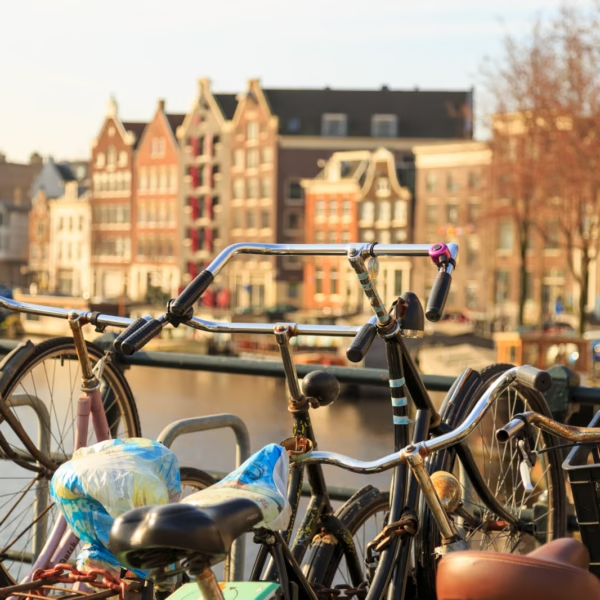
11. Ring your bike bell before overtaking. Cyclists are legally required to have a working bell, and using it before passing someone on the bike path is standard practice, not aggressive.
12. Hand signals aren’t optional. Before turning, extend the arm on the side you’re turning toward, straight out and horizontal, and glance back over your shoulder first. Not signalling is a fineable offense in some circumstances and, more immediately, will get you called out by the cyclist behind you.
13. Bike lights are mandatory after dark, and the police do check. A missing front or back light can bring a fine in the €55–75 range, and riding through a red light or holding a phone while cycling carries steeper penalties still. It doesn’t stop people from doing it, but it’s the law. Detachable lights are a genuine target for theft, so many riders remove them every time they park.
14. Lock your bike properly, always. Bike theft is close to a national pastime here, and an unlocked or poorly locked bicycle — even for two minutes outside a shop — is treated as an open invitation.
15. Never cycle on the sidewalk. It’s illegal in built-up areas and will draw a fine, common as the shortcut temptation is. People still do it, but don’t expect pedestrians to move out of your way.
16. Curtains stay open, and that’s not an invitation to stare. Many Dutch homes have little to no window covering, a habit most commonly traced back to Calvinist ideas about having nothing to hide, reinforced later by a cultural comfort with transparency and light. A casual glance while walking past is fine; stopping to look is not.
17. Bills get split down to the cent, usually through an app called Tikkie. Splitting evenly, even for a €2.40 coffee, isn’t stinginess here — it’s considered fair and precise. Tikkie, a payment-request app built on the Dutch banking system, has become so embedded in daily life that “I’ll send you a Tikkie” is now just how Dutch people say “you owe me.”
18. If you get invited onto someone’s birthday calendar, take it as a compliment. Many Dutch households keep a small, dateless perpetual calendar — the verjaardagskalender — hanging inside the toilet door, tracking friends’ and family’s birthdays. Adding yourself to someone else’s is considered presumptuous; being added by them is a small but real marker that you’re in their circle.
19. When you congratulate a birthday person, congratulate their family too. It’s customary in the Netherlands to wish “gefeliciteerd” not just to the person having a birthday but to their partner, parents, or siblings present — congratulating the people around them, not only the birthday person themselves.
20. Social visits get scheduled, not dropped in on. The Dutch agenda is close to sacred; spontaneous visiting is much less common here than in many other cultures, and a friend or colleague may need to check a calendar weeks out before confirming coffee.
21. Arrive on time, or a few minutes early. Punctuality reads as basic respect here; five minutes early is treated as on time, and running late without a heads-up is a genuine faux pas.
22. Bring something small when invited to dinner, and don’t assume you’re staying for it. Flowers (an odd number, never chrysanthemums, which are associated with funerals), a bottle of wine, or chocolates are the standard gift. Unless a dinner invitation was explicit, don’t assume a coffee visit will turn into a meal.
23. Directness is efficiency, not rudeness. Blunt feedback, quick “no” answers, and a general lack of small talk before getting to the point are cultural defaults here, not personal slights. It takes some recalibration for anyone used to more indirect cultures, but it isn’t meant unkindly.
24. Wait for “eet smakelijk” before you start eating. Someone, usually the host, will say it — roughly “enjoy your meal” — and it’s the informal cue that everyone can pick up a fork.
25. Cutlery stays continental: fork in the left hand, knife in the right, and you don’t switch back and forth. Set them side by side on the plate, not crossed, when you’re finished, as the signal to staff that you’re done.
26. Cash is increasingly rare outside markets and small vendors. Contactless and pin payments dominate day-to-day life in Dutch shops and cafés; some smaller businesses now accept cards only. The one reliable exception is King’s Day flea markets, where most sellers still prefer small coins and cash over digital payments for small purchases.
27. Prices are fixed — don’t haggle in shops. Markets and King’s Day flea-market stalls are the exception where a bit of friendly back-and-forth is expected; in a regular shop or supermarket, it isn’t.
28. King’s Day means orange, cash for the flea market, and everyone’s front lawn becomes a shop. Held each 27 April to mark the king’s birthday, Koningsdag centers on the vrijmarkt — a nationwide, permit-free flea market where anyone, including children, can sell secondhand goods on the street — alongside orange clothing, canal parties, and a fairly enthusiastic embrace of daytime drinking.
29. Terraces fill up the second the sun comes out. Outdoor café seating, even in distinctly non-tropical weather, becomes prime real estate the moment there’s blue sky; grabbing a terrace seat when the sun appears is close to a reflex here, heaters and all.
30. When in doubt, remember the closest thing the Netherlands has to a national motto: “doe maar normaal, dan doe je al gek genoeg.” Loosely, “just act normal, that’s already crazy enough” — a deep-seated cultural preference for modesty over showing off, understatement over boasting, and blending in over standing out. It underlies a lot of the smaller rules above, and it’s the single most useful thing to keep in mind if a specific etiquette point ever slips your mind in the moment.
Sources
- Tipping in the Netherlands Etiquette — Wise
- What You Need to Know About Tipping in the Netherlands — IamExpat
- Tipping in Amsterdam: All You Need to Know in 2026 — DutchReview
- Tipping in Netherlands — How Much to Tip on Each Occasion? — Amsterdam Private Boat
- New in the Netherlands: Etiquette — TU/e Cursor
- Wearing Shoes in the House in the Netherlands — DutchReview
- Dutch Customs and Etiquette — XPAT.NL
- Dutch Culture & Etiquette for Tourists: A Complete 2026 Guide — Amsterdam Tourism
- How to Queue Like the Dutch and Survive — Accidentally Dutch
- No. 62: Not Queuing — Stuff Dutch People Like
- Cycling the Dutch Way: Priority Rules, Fines, and Signs — Holland2Stay
- Dos and Don’ts of Riding a Bicycle in the Netherlands — DutchReview
- Things That Will Get You a Fine When Cycling in the Netherlands — IamExpat
- Why Dutch People Don’t Like Curtains — DutchReview
- Why Dutch People Don’t Mind You Staring Into Their Homes — CNN
- What’s Tikkie? How to Use This Popular Dutch Payment System — DutchReview
- Why Dutch People Split the Bill So Seriously — Dutch Fluency
- A ‘Verjaardagskalender’ in a Toilet? Absolutely Normal — UKrant
- Dutch Birthday Traditions — ExpatCopilot
- Your Complete Guide to Kingsday (Koningsdag) 2026 — Remitly
- Koningsdag — Wikipedia