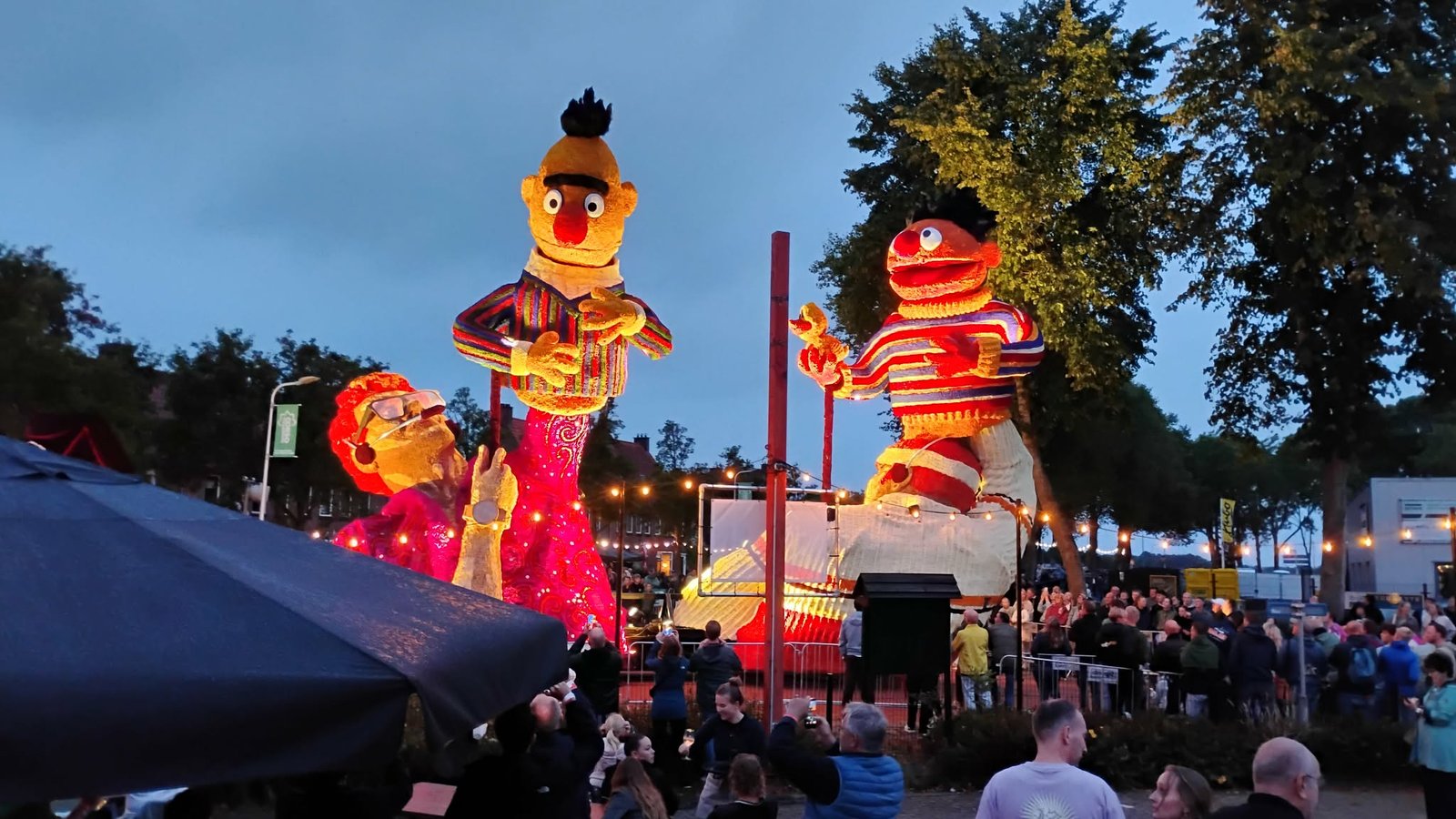
1st place, 2026, Vollenhove corso
Drive through a small Dutch town on a Saturday in late August and you might come across something that looks, at first glance, like a parade someone forgot to stop building. House-sized floats, covered edge to edge in flowers, inching down a village high street while thousands of people who clearly planned their whole summer around this moment stand rows deep behind rope barriers. This is a corso, and the Netherlands has roughly thirty of them every year, more than any other country on earth.
What the word actually means
Corso comes from the Italian for a main street or promenade, the kind of avenue a procession would move down, and it entered Dutch usage around 1914 to describe exactly that: an optocht, a parade, specifically one built around elaborate floats. The format’s deeper roots go back further, to nineteenth-century religious processions in Italy and France — Corpus Christi parades built around allegorical floats depicting biblical scenes — which secularized over the following decades into community festivals built around local history, folklore, and, increasingly, flowers. By the time the practice crossed into the Netherlands later in the nineteenth century, the religious content had mostly fallen away, leaving the structure: a float, a theme, a crowd.
A bloemencorso is specifically the flower version — as opposed to a fruit corso, like Tiel’s, which uses produce instead — and it’s now such a distinctly Dutch institution that in 2021 UNESCO added Dutch and Flemish corso culture to its Representative List of the Intangible Cultural Heritage of Humanity, recognizing it as a living tradition rather than a museum piece.
Why they happen at all
Most Dutch corsos didn’t start as flower shows. They started as an excuse to organize something else entirely, and the flowers came later. The country’s largest, Zundert’s, began in 1936 as neighbourhood groups decorating a handful of bicycles for Queen Wilhelmina’s birthday, and only slowly grew into the fully engineered dahlia sculptures the town is known for today. Valkenswaard’s corso commemorates the town’s liberation during Operation Market Garden in September 1944. The Bollenstreek corso, in the bulb-growing region south of Haarlem, began in 1947 as a postwar celebration of freedom, built by flower growers using dahlia heads that were, at the time, simply agricultural waste — the flower has to be cut off a dahlia tuber early to keep the tuber’s energy for growth, so growers had heads to spare and no real use for them. Vollenhove’s traces to 1905, when a group of residents in the Overijssel town, tired of the drunken disorder that came with the annual kermis fair, founded an association to put on a more respectable alternative built around Queen Wilhelmina’s birthday instead.
The common thread across nearly all of them: a corso usually starts as a substitute for something — an unruly fair, a wartime absence, a bare patch of agricultural byproduct — and only becomes a flower-covered institution in its own right once the substitute outgrows the original occasion.
The 105-year (and counting) tradition in Vollenhove
Vollenhove, 2026
Vollenhove’s Vereniging Voor Volksvermaken was founded in 1905, which by 2026 makes the organization itself considerably older than a hundred and five years — it’s now past its twelfth decade. The flower parade specifically, though, took longer to become the main event: the early parades were decorated farm wagons with an accompanying stage play, and dahlias didn’t come to dominate the floats until the 1950s. A jury was introduced in 1961 to judge the best float, the route was closed to other traffic starting in 1970, and Vollenhove has, in the words of its own historical account, “never gotten over the corso virus” since. Whichever milestone the “105 years” refers to, the tradition is genuinely old by the standards of the form, and Vollenhove wears its age visibly: the corso was the first tradition in the province of Overijssel recognised on the Netherlands’ National Inventory of Intangible Cultural Heritage, in 2013, ahead of the UNESCO listing in 2021.
Vollenhove, 2026
Today the corso is organized by an association with roughly 5,500 members in a town of only a few thousand residents — meaning a large share of Vollenhove is involved in some capacity — and the day itself unfolds in three parts: a morning Jeugdcorso, where local schoolchildren parade decorated go-karts and small floats they built themselves; an afternoon Middagcorso, the main event judged by an expert jury; and an evening Avondcorso, where the same floats pass again under lights. Around a dozen neighbourhood building groups — names like Fulnaho, Rataplan, and Klein Cuba have competed for decades — each build a float independently, some reaching up to ten metres high, entirely covered in hand-placed dahlias.
How a float actually comes together
The planning cycle for a Dutch corso float typically starts almost as soon as the previous year’s parade ends. At the Bollenstreek corso, for instance, groups begin evaluating the past season and brainstorming new themes as early as mid-May, months before a single flower is planted, let alone cut. The building itself follows a fairly consistent sequence across corsos: a steel or iron skeleton is welded into the float’s basic shape, then wrapped in layers of chicken wire, cardboard, or papier-mâché — often as many as seven layers — to create a surface dense enough to hold flowers without them sliding off. That structural work happens across most of the year, but the visible transformation is compressed into the final week: flower-pinning, or prikken, generally doesn’t start until the days immediately before the parade, since a cut dahlia has a working life of about a week at most before it browns.
Vollenhove, 2026
Volunteers press each dahlia bloom onto the papier-mâché or foam surface using a nail, staple, or small pin through the flower’s center, working from a colour plan the way a mosaic artist works from a cartoon. Depending on the corso, groups either grow their own dedicated dahlia fields — which doubles as a modest revenue source, since surplus blooms get sold to other corsos with staggered dates — or buy tubers in bulk from growers and have volunteers harvest by hand in the days beforehand. The scale is difficult to overstate: a single float at Sint Jansklooster’s corso carries between 150,000 and 350,000 dahlias, and Vollenhove’s own floats use anywhere from 100,000 to 250,000 blooms each.
Dahlias dominate corso culture specifically because late summer is their peak season and because the plant is forgiving to grow and cheap relative to other cut flowers — but it isn’t indestructible. Growers describe dahlias as thirsty, and a season with too little rain, or fields that flood and leave the tubers underwater for more than about 24 hours, can genuinely threaten a corso’s flower supply; several 2023 corsos, including Lichtenvoorde’s, faced real shortages after storms drowned dahlia fields close to the parade date. To manage that risk, some corsos — Leersum among them — now permit up to 30 percent of a float’s covering to be alternative material, like cabbage leaves, birdseed, or berries, rather than dahlias alone.
Where the black dahlias come from
True black doesn’t exist in dahlia pigmentation, and it doesn’t exist anywhere else in the plant world either — there’s no black pigment for a flower to produce. What corso builders and gardeners call a “black” dahlia is really an extremely dense concentration of anthocyanin, the same pigment family behind deep reds and purples, layered so thickly that the petal reads as black under most lighting. Varieties bred and marketed for this effect carry names like ‘Karma Choc’, ‘Black Jack’, ‘Chat Noir’, and ‘Arabian Night’, ranging in true colour from deep burgundy to near-black aubergine. Builders use them the way a painter uses black paint: not because the pigment is literal, but because it reads as black from twenty feet away in bright August sunlight, which is what actually matters on a ten-metre float.
What happens to the flowers afterward
The parade itself is, in a strict sense, the shortest part of the whole enterprise — a few hours of driving a route that took months to prepare for. What comes after is more mundane than the spectacle suggests. Within days, the cut dahlias begin to brown, and most corsos simply discard them; Bollenstreek’s chair told regional broadcaster NH Nieuws plainly that the flowers “eventually turn brown, and we throw them away.” Some corsos have started separating the waste stream more deliberately — sorting polystyrene, steel, and flower matter at a grower’s site rather than sending everything to a single skip — and Bollenstreek in particular has begun framing this as part of a broader sustainability push, since, as its organizers point out, the dahlia heads used on the floats are technically a byproduct of the bulb-growing industry to begin with, similar to how the corso itself began.
The steel skeletons underneath fare somewhat better. Most are broken down and either scrapped or stored for reuse the following year, since rebuilding a chassis from scratch is far more expensive than re-skinning an existing one. A few floats get a genuine second life outside the corso circuit entirely — one of Zundert’s Poteind neighbourhood floats, for example, was preserved intact and installed as a permanent memorial structure rather than dismantled, and Bollenstreek has begun selling off decommissioned float objects to carnival associations, garden centres, and other corsos for a token fee instead of scrapping everything by default. It’s a small, practical postscript to an event that is, at every other stage, defined by excess: months of unpaid labour and hundreds of thousands of flowers, aimed at a display that a village will spend one single day looking at before taking it apart again.
Sources
- Corso Vollenhove — Wikipedia (NL)
- Bloemencorso Vollenhove — Wikipedia (EN)
- Geschiedenis Corso Vollenhove — Corso Vollenhove
- Bloemencorso Vollenhove — Immaterieel Erfgoed (EN)
- Immaterieel Cultureel Erfgoed — Corso Vollenhove
- corso — WikiWoordenboek
- Ontdek de wereld van Corso’s — Agra-Wool
- Bloemencorso — Wikipedia (EN)
- Wat is een corso? — Corsokoepel
- Oorsprong — Corso Valkenswaard
- Bloemencorso Bollenstreek — Immaterieel Erfgoed
- Praalwagen van buurtschap Wernhout — Rabobank
- Hoe wordt een praalwagen gemaakt? — Corsogroep Hillegom-Haarlem
- Corsogroep Symboliek Sint Jansklooster
- ‘Een nachtmerrie’, dahlia’s voor bloemencorso verzuipen — Omroep Gelderland
- Droogte raakt ook bloemencorso’s — Hart van Nederland
- De Zwarte Dahlia — CorsoNetwerk
- Zwarte dahlia — Dahliastore
- Dit gebeurt er met de praalwagens van het bloemencorso — NH Nieuws
- Bloemencorso Zundert — Omroep Brabant