

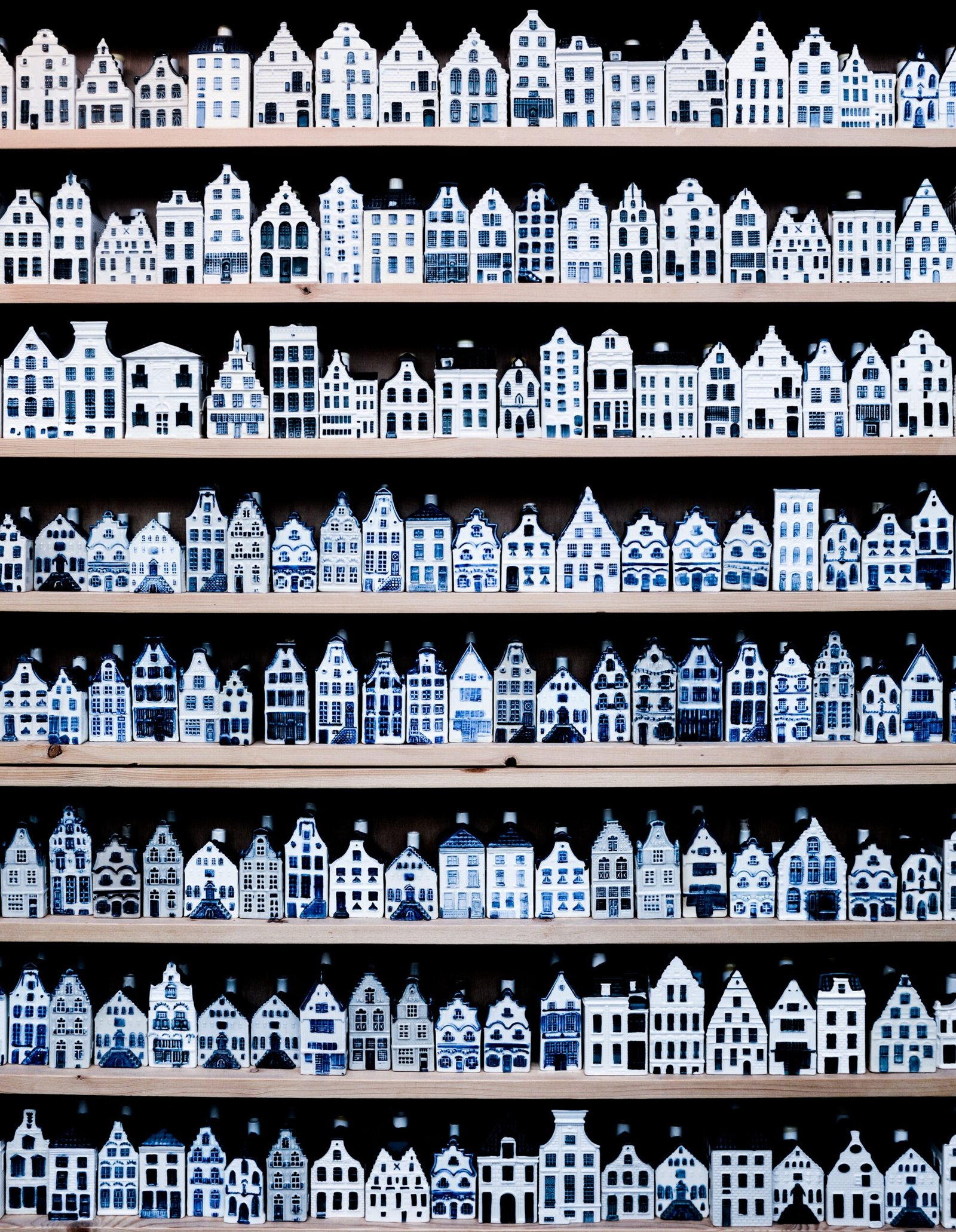
Walk down almost any street in the Netherlands and a house will tell you more than its number. A row of doorbells stacked with digits instead of names. A wooden plank by the door reading “‘t Vosje” or “Rust Wat.” A carved stone stork tucked above a canal-house window. A cast-iron “1923” set into a gable. None of it is decoration for its own sake. Each layer is a leftover navigation system from a period when the address on an envelope wasn’t enough to find a person, and the habit never quite went away.
Before there were numbers, there were pictures
For most of Dutch urban history, buildings weren’t numbered at all. Instead, they carried a name and, on the wealthier or more commercial ones, a carved and painted stone tablet built into the facade — a gable stone, or gevelsteen. If you wanted the cobbler, you looked for the stone with a shoe. If you wanted a tavern, you looked for a barrel. Someone pointing you toward a friend’s house might say it was “the third door past the Black Sheep,” using the neighboring house’s name and sign as the landmark, the way a person today might say “next to the Albert Heijn.”
Amsterdam alone still has roughly 850 of these stones, out of some 2,500 surviving nationwide, with more concentrated in Maastricht and scattered as far as Brussels, Copenhagen and Stockholm — cities the Dutch traded with, evidently taking the habit along. A quill marked a writer’s house. A ship marked a sailor’s. A basket of nails marked a nail merchant. Some stones carried puns: the “Batenburg” stone on the Prinsengracht plays on baten (to profit) and burg (castle), spelling out the name of a village near Nijmegen that had nothing to do with the house itself. Others carried pious mottos like Nooit Volmaakt — “never perfect” — a reminder that only God gets to be finished with anything.
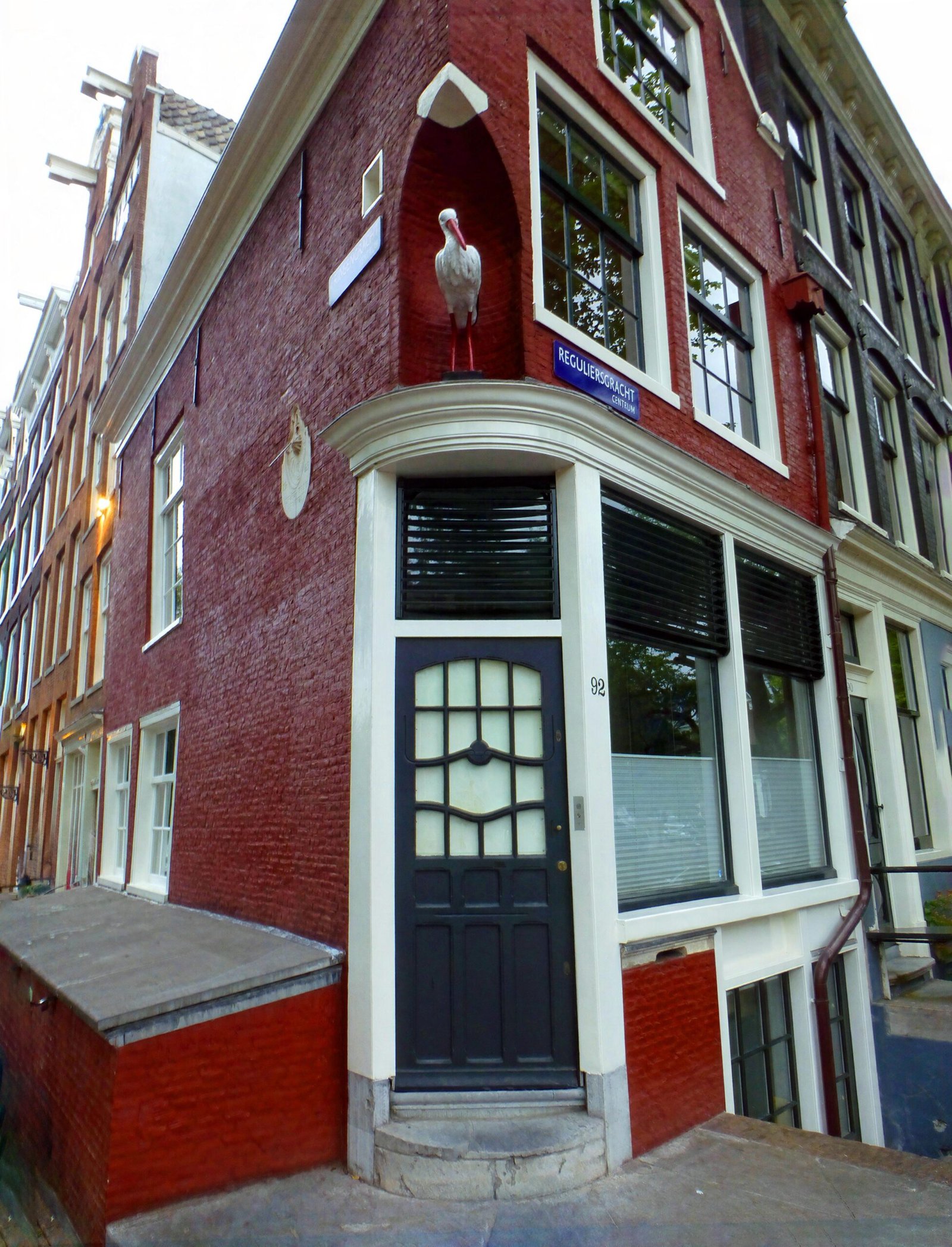
One of the more specific examples still stands at the corner of Reguliersgracht and Prinsengracht: a house with a carved stork set into a niche above the door. Canal-boat guides tell every tour the same story, and local historians confirm it holds up — a 17th-century midwife ran her practice there, and the stork was her shingle. It wasn’t a random flourish. Storks were already tied to childbirth in Dutch and northern European folklore, and a bird was easier to spot from across a canal than any signature would have been. The building is a national monument today, stork and all.
The literacy question is more interesting than it looks
The standard explanation for all this is that people couldn’t read, so houses needed pictures instead of words. That’s broadly true, but the real picture is more specific — and more interesting — than a flat statement of mass illiteracy.
Gable stones became common in the 16th century, when literacy across the Netherlands was still low, estimated around 12 percent of the population. But the Netherlands didn’t stay there. Over the following century, in what’s now called the Dutch Golden Age, literacy climbed faster than almost anywhere else in Europe. By the mid-1600s, estimates put roughly 40 to 60 percent of Dutch men able to read, with rates in cities like Amsterdam and Leiden higher still, and — unusually for the period — girls in the Dutch Republic were being taught to read and write as a matter of course, not as an exception. The Dutch Republic became one of only two places in Europe, alongside England, to cross fifty percent literacy by the mid-seventeenth century.
So the gable stone tradition didn’t emerge from a fully illiterate society and then persist out of habit into a literate one, as the shorthand version suggests. It ran alongside rising literacy for well over a century, doing something that reading and writing didn’t fully replace: giving a building a fixed, memorable identity in a city with no formal address system at all. A visitor could read perfectly well and still have no way of finding “the house of Jan Willemsz” without a signpost, because there was no number to write down in the first place. The picture wasn’t only a workaround for illiteracy. It was the address.
Napoleon ends the guessing game
The gable stone era ran out not because people finally learned to read, but because someone finally numbered the streets. Amsterdam introduced house numbering in 1795, under the French-backed Batavian Republic, and after the Kingdom of Holland was founded in 1806, a nationwide numbering system followed — imposed for tax purposes, tied to a property levy called the verponding. It wasn’t yet the tidy odd-numbers-on-one-side system used today; early schemes numbered buildings sequentially through a whole district regardless of which street they sat on, which is its own kind of chaos for anyone doing historical research now. Cleaner, street-by-street numbering came later in the 19th century.
Once a number could get a letter delivered, a gable stone stopped being infrastructure and became something closer to what house names are today: a flourish that says something about the people inside, aimed at anyone paying attention rather than at someone trying to find the front door. The tradition never fully died. Stonemasons still carve new gevelstenen on commission, and some of the newer ones are openly tongue-in-cheek — one Amsterdam house added a stone in 1976 reading Nooit Weer (“Never Again”), commissioned by an owner who’d apparently had enough of renovations.
What replaced the picture
The number won, but the Netherlands never fully gave up on marking a house as more than a digit, and a few habits from the gevelsteen era are still visible on almost any street.
Named houses. Standalone homes and especially farmhouses often carry a name of their own, mounted on a small board by the door — a naambordje — alongside or instead of the street number. Some describe the place itself. Others are a private joke, a family name, or an old Dutch proverb about slowing down and taking things as they come. It’s the same instinct that named the Black Sheep or the Golden Elephant four centuries ago, just downsized from a carved stone tablet to a piece of engraved slate.
Numbered doorbells. Dutch cities are dense, and a great many “houses” are really one building carved into several independent flats behind a single street door. Rather than assign each flat its own street number, the building keeps one number and the bells beside the front door get sorted out instead — often numbered by floor, sometimes lettered, occasionally both. It’s the same logic that put a shoe on a cobbler’s gable stone: the address gets you to the right building, and a second layer of marking gets you to the right door once you’re standing in front of it.
Initials and dates. Older facades, especially in smaller towns and former farming villages, often carry a builder’s initials and a construction year worked into the brick or the gable stone itself, sometimes alongside a small emblem tied to the family’s trade or coat of arms. It’s a quieter cousin of the gable stone: less a shop sign, more a signature, but doing the same job of telling a passerby something about who built the place and when, long after everyone involved has gone.
None of these habits were designed as a system the way house numbering was. They survived because a bare number, however useful for the postal service, has never been enough to make a building feel like somebody’s. The gable stone solved a practical problem for a couple of centuries. What replaced it never quite let go of the idea behind it — that a home is allowed to say something about itself, not just where it is.
Sources
- Gable stone — Wikipedia
- The Gable Stones of Amsterdam — Amusing Planet
- The House with the Stork — MforAmsterdam Tours
- States, Institutions, and Literacy Rates in Early-Modern Western Europe — Journal of Education and Learning (ERIC)
- Women in the Seventeenth-Century Netherlands — Essential Vermeer
- Gevelstenen (plaques) in Amsterdam — Amsterdam Oriole
- Friesland and the Dutch Introduction of House Numbering (1806) — KNAW
- Historic Canal House Gable Stones — Amsterdam Local Gems