
A 600-year-old “new” church, roughly 10,000 burials, a floor that has been rearranged more than once, and one very sleepy bronze cat.
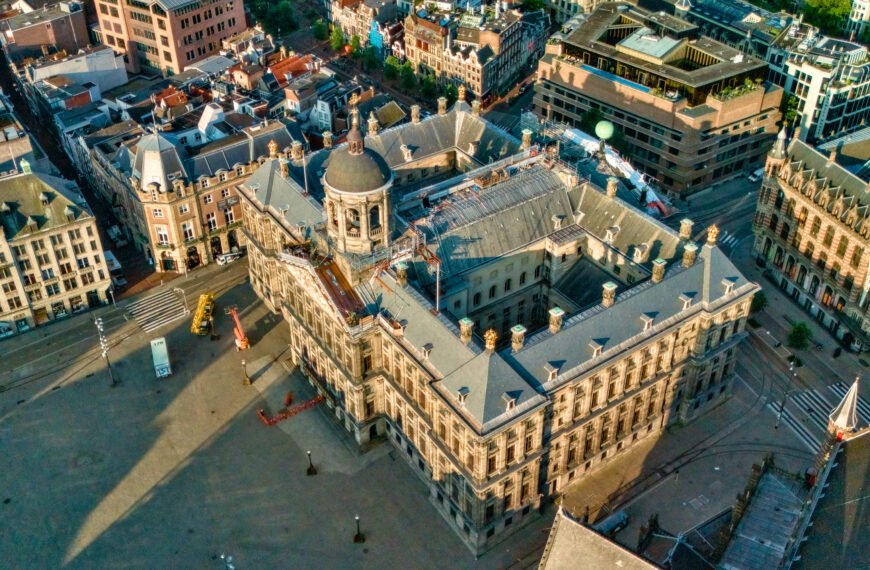
Stand on Dam Square, face the Royal Palace, and the large Gothic church squeezed up beside it looks like it has always been there. It nearly has. The Nieuwe Kerk (the new church) is more than six centuries old, and its name is a bit of a joke. It was “new” only because the Oude Kerk, the city’s first parish church, was already standing.
Inside, the floor is paved with gravestones. That sounds simple, but it hides a more interesting story about who was buried here, what happened to them, and why the stones you walk over don’t always sit on top of the people they name.
A church built because the old one was full
Amsterdam grew fast in the 1300s, and the Oude Kerk could no longer hold the congregation. Construction began around 1380, and the bishop of Utrecht formally approved a second parish church in November 1408. According to Dutch Wikipedia, the builder and financier was a man named Willem Eggert, who donated the land beside his own orchard and saw the church consecrated in 1409.
The church was a Catholic one until 1578, when the city switched sides in the Alteration and the building became Protestant. Much of the old interior was stripped out. Then came the disaster that shaped everything you see today.
The fire that cracked the gravestones
On 11 January 1645, plumbers were working on the roof on a cold, clear day with a strong wind. By the account on Dutch Wikipedia, the whole church was burning in under half an hour. The roof came down around three in the afternoon. Only the choir and its radiating chapels survived. The heat was so fierce that gravestones and pillars cracked, though the copper chandeliers were pulled out of the rubble intact. The church reopened in May 1648, rebuilt in Gothic style even though Gothic was long out of fashion.
A tower was supposed to follow. Builders hammered in the last of 6,363 foundation piles in 1647, then stopped in 1653 because the new town hall next door was eating the city’s money. The town hall is now the Royal Palace. The tower was never built.
Why everyone wanted to be buried here
Burial in a church was a status purchase. According to the church’s own page on its grave slabs, prosperous congregants paid to be interred inside, and spots near the high altar were the most coveted and only the very wealthy could afford them. Archaeologist Thijs Terhorst puts the appeal simply: being buried here meant being “close to God”.
The church estimates about 10,000 people are buried here. A 2024 news report put it higher, saying tens of thousands were buried up to 1866. Nobody counted exactly, so treat both figures as estimates.
What the floor markers actually mark
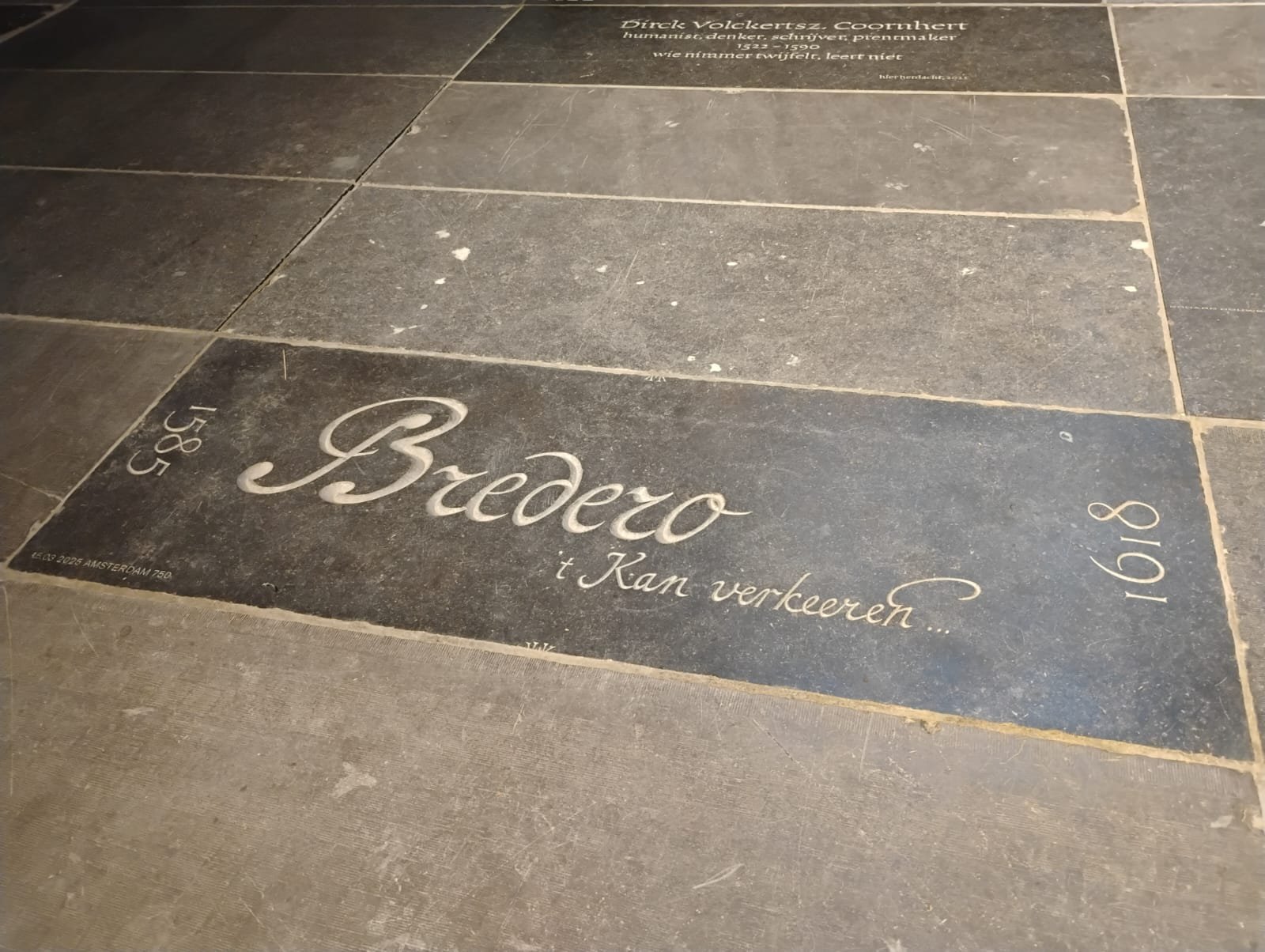
Here is the part most visitors don’t expect. Very few gravestones are still in their original places. The church explains that slabs were often reused, and that parts of the floor were relaid after the building subsided.
It goes further than that. Dutch Wikipedia reports that during the 1959 to 1980 restoration, almost all the graves were cleared. The archaeologists who dug in 2024 confirm the picture: most graves had already been cleared in the last century, and the ones still there date from the 18th and 19th centuries.
So the floor is part memory, part archive. Some stones are old grave covers that have been moved or reused. Others are commemorative stones placed on purpose for people who may not lie beneath them at all. No published map matching each slab to a body turned up in the sources, so if you visit, read the names as “remembered here” rather than always “buried exactly here.”
The painters of the 1600s saw a messier version. A 1654 painting by Emanuel de Witte of the Nieuwe Kerk shows gravediggers at work in an open grave, one older man supervising a younger one. The floor was a working cemetery, and it looked like one.
The famous residents
The church site lists several well-known Amsterdammers among the names on the slabs around the chancel: the poet and playwright P.C. Hooft, the poet Joost van den Vondel, the writer Isaäc da Costa, and the surgeon and burgomaster Nicolaes Tulp, whose anatomy lesson Rembrandt painted.
Then there are the naval heroes, which suits a church built by a seafaring city. Admiral Michiel de Ruyter, Commodore Jan van Galen and Jan van Speyk are all buried here. De Ruyter’s grand monument by Rombout Verhulst was put up in 1681, on the spot where the high altar once stood. The Rijksmuseum even holds a 1683 painting of the tomb by Emanuel de Witte.
Vondel has a nice wrinkle. He was Catholic, yet he is buried in a Protestant church. According to the church’s own material on him, he has two monuments inside.
The oldest, the newest, and the strangest
The oldest documented burial in the sources belongs to the founder himself. Willem Eggert was buried in 1417 in the Eggert Chapel, built for him. Records of an earlier burial would be a welcome find.
The last burial came on 30 December 1865, and it was not just the last in this church. It was the last burial in any Amsterdam church, because burial inside churches became illegal in 1866. The sources don’t name that final person.
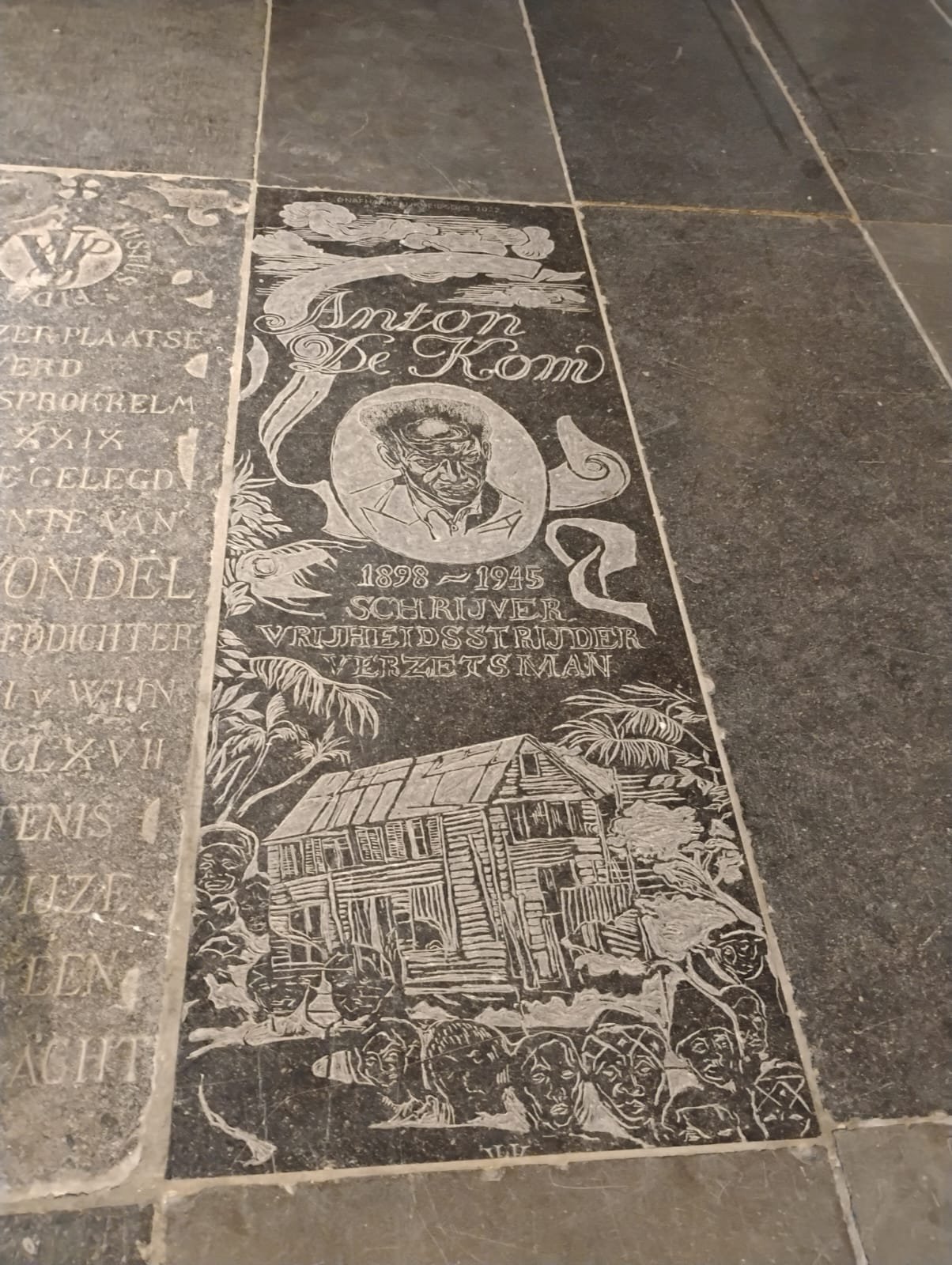
The newest names are on stones, not coffins. The church keeps adding a memorial stone for a writer, so, as Dutch Wikipedia notes, the literary pantheon keeps growing. The recent additions include Hella Haasse (2018), Johan Huizinga (2019), and Multatuli, whose stone King Willem-Alexander unveiled in February 2020. Louis Couperus followed in July 2023, and Annie M.G. Schmidt in September 2025. The Surinamese-Dutch writer and activist Anton de Kom also has a stone.
The children
The famous names get the monuments, but the archaeology tells a quieter story. When the city dug around the church ahead of foundation work, the bones of children turned up alongside the adults.
In 2023, during a first round of digging, an anthropologist from the University of Amsterdam held up the bones of a small child and explained that DNA sampling later could reveal illnesses invisible on the bone, plague among them. That dig also found a coffin with a copper name plate, which the archaeologists said was a first for Amsterdam.
The 2024 dig went bigger. Teams unearthed 32 skeletons in a single week and expected around 200 graves in total. The earlier survey had already turned up roughly 50 skeletons, mostly adults but including children and babies. The small details are the ones that stick: a gold crown in an older woman’s tooth, a woollen vest, and a coin that had been placed over a dead person’s eyes. The remains were reburied after study.
The reason for all that digging is unglamorous. Eight columns of the nave were sinking slightly faster than the rest of the church, by up to 1.5 millimeters, and cracks were starting to show.
And the pets?
No animal graves turn up in the sources, and none is invented here. What does turn up is better than a made-up story.
In August 2021, the church unveiled a memorial stone for the novelist Willem Frederik Hermans, on the eve of his 100th birthday. It was designed by Piet Schreuders, director of the cat magazine De Poezenkrant, and it carries a bronze drawing of a sleeping cat by Franka van der Loo. The inscription reads “Zlaap zacht,” because Hermans claimed cats can’t pronounce the letter S. The unveiling program credits the design team.
Hermans was a devoted cat lover, and when the king visited the stone in 2022, a cat named Abatutu acted as host. So a cat is not buried in the Nieuwe Kerk. But a cat is, in a way, on the floor.
One thing to keep straight
Amsterdam’s Nieuwe Kerk is not the Nieuwe Kerk in Delft, which holds William of Orange and the Dutch royal crypt. Both are real, and both are worth a visit. They just aren’t the same church.
Sources
- De Nieuwe Kerk: Grave slabs
- Wikipedia: Nieuwe Kerk, Amsterdam
- Dutch Wikipedia: Nieuwe Kerk (Amsterdam)
- NL Times: Skeletal remains of 32 people found
- NH Nieuws: Archaeologists make a unique find
- Huygens Institute: Hermans Complete Works completed
- De Nieuwe Kerk: Hermans stone program (PDF)
- Rijksmuseum: Tomb of Michiel de Ruyter
- Church Monuments Society
- NOS: Stone for Anton de Kom