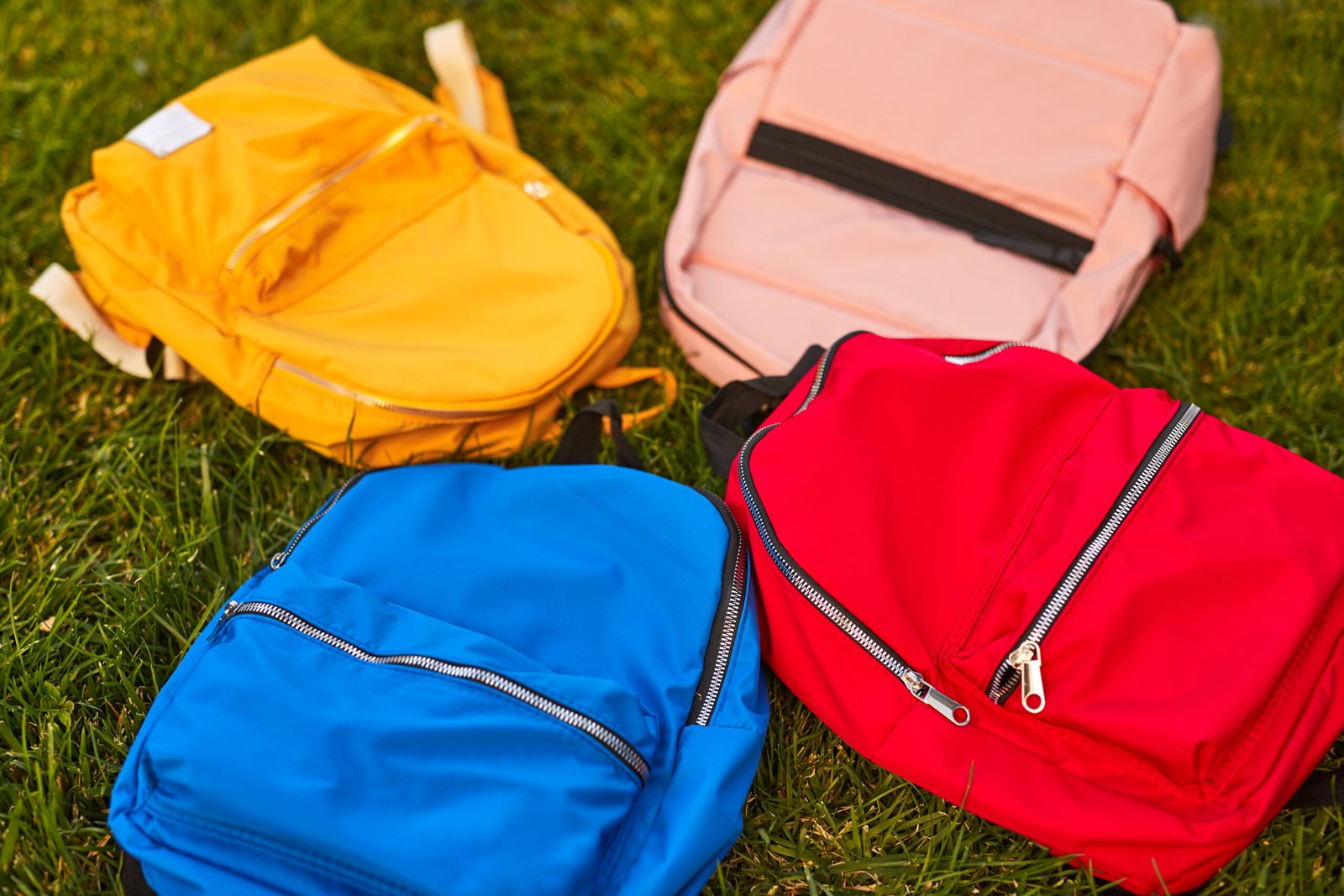
Every June, something strange happens in Dutch streets. Flags appear on houses, not for a national holiday, not for a football tournament, but with a school bag dangling from the top of the pole. Backpacks, notebooks, sometimes an entire battered pencil case. If you’re new to the Netherlands, your first thought might be that someone has lost their mind, or perhaps that a very dedicated child has mistaken the flagpole for a coat rack.
It’s neither. It means someone in that house just passed their eindexamen, the final school exam, and the family wants the street to know.
What is the eindexamen, exactly?
Before you can appreciate the tradition, you need to understand what Dutch students are actually celebrating.
The eindexamen (literally “final exam”) is the national exam taken at the end of secondary school. Every student across the country sits the same centrally set exams in May and June. Results come back on a single designated Wednesday in June — uitslagdag, results day — which is, depending on whether you passed or not, either one of the best or worst days of your teenage years.
Every year, over 200,000 high school students wait to hear the results of their final exams. Schools call students with their results on that Wednesday — starting with those who have failed, followed by those who need to resit, and ending with those who have passed. The order of the calls is no accident. If your phone rings early, it’s probably not good news.
In the 2022–23 school year, 89 percent of VMBO students, 79 percent of HAVO students, and 84 percent of VWO students passed their final exams. That means tens of thousands of students don’t pass every year, and if you walk down a street in June and notice a house with no flag out, you might be looking at one of those families. It’s a bit raw, honestly. The tradition is joyful, but it does make the absences visible.
A brief guide to the Dutch school system
To understand who is hanging what from which pole, it helps to know that Dutch secondary education is divided into three separate tracks, and students are sorted into them at age 12 based on the advice of their primary school teacher and the results of a national test called the Cito-toets.
Primary school in the Netherlands has eight grades, known as groepen, running from Groep 1 (age 4) to Groep 8 (age 12). After that, students go into one of three secondary tracks:
| Track | Dutch name | Duration | Approx. ages | Leads to |
|---|---|---|---|---|
| Pre-vocational | VMBO (Voorbereidend Middelbaar Beroepsonderwijs) | 4 years | 12–16 | MBO (vocational college) |
| General secondary | HAVO (Hoger Algemeen Voortgezet Onderwijs) | 5 years | 12–17 | HBO (universities of applied sciences) |
| Pre-university | VWO (Voorbereidend Wetenschappelijk Onderwijs) | 6 years | 12–18 | University (WO) |
| Vocational college | MBO (Middelbaar Beroepsonderwijs) | 1–4 years | 16+ | Work or HBO |
| University of applied sciences | HBO (Hoger Beroepsonderwijs) | 4 years | 17+ | Bachelor’s degree (applied) |
| Research university | WO (Wetenschappelijk Onderwijs) | 3 years | 18+ | Bachelor’s degree (academic) |
VMBO lasts four years, from age 12 to 16, combining vocational training with theoretical education. Around 60 percent of students nationally enrol in VMBO. HAVO is the middle track, preparing students for higher professional education at universities of applied sciences, completing around age 17. VWO is the six-year track that leads to research university, completed around age 18. Within VWO, there are two sub-types: gymnasium (which includes Latin and Greek) and atheneum (without).
One thing that surprises a lot of newcomers: students can move between tracks, up or down, depending on their grades. There’s no shame attached to repeating a year (zittenblijven), and many students spend a few years climbing through the levels. It’s a more fluid system than it might look from the outside.
So why the flagpole?
A Dutch friend explains it as representing the act of throwing your school bag away, out the window, because it’s no longer needed. When you see a school bag on a flagpole, you know that a high school student in that house has passed their final exams.
The tradition probably started in the 1950s. Back then, the flag was only hung out for official celebrations, so putting it up for graduation was seen as disrespectful, particularly towards the Royal House. As a fix, the school bag was added, to make clear this was a personal celebration rather than a national one. It was particularly in the 1970s, when there was less deference to the royals, that the tradition became widely accepted.
So the school bag is not just decoration. It’s a qualifier. It says: yes, we are flying the flag, but we’re doing it for this reason, not that one.
Families sometimes go further — hanging notebooks alongside the bag, or putting up a banner that says geslaagd (passed), just to make it completely clear. The Dutch, generally not known for public displays of national pride, fly the flag on very few occasions. Graduation is one of the main ones.
The tradition extends beyond high school too. Whether the diploma is from VMBO, HAVO, VWO, MBO, HBO, or university, the flag goes up with a school bag attached. Some families put up a different bag for each level — by the time a third child graduates, the flagpole can get quite crowded.
What it looks like from the street
Walking through a Dutch neighborhood on uitslagdag is its own experience. The flags tend to go up fast, sometimes within minutes of the phone call. By afternoon, you can usually get a rough sense of how the street’s students did by counting the flags.
Neighbors come by to feliciteren (congratulate) when they see the flag. It’s a quiet, Dutch way of announcing good news, not a party thrown in the street, but a signal that invites people to stop and knock.
Princess Catharina-Amalia did it too. When she passed her eindexamen cum laude at the Christelijk Gymnasium Sorghvliet in June 2021, the Dutch flag went up with her school bag attached, just like every other Dutch student. There’s something very Dutch about that: the heir to the throne following exactly the same ritual as the kid down the road.
A word about the bag itself
The bag usually stays out for a few days, through whatever weather June decides to deliver. It gets rained on. It fades a little. Some people frame the bag afterwards; others just chuck it when it comes down.
After twelve or thirteen years of school, lugging that bag back and forth every day, there’s a certain satisfaction to seeing it flap in the wind from a flagpole. Not quite throwing it out the window, but close enough.