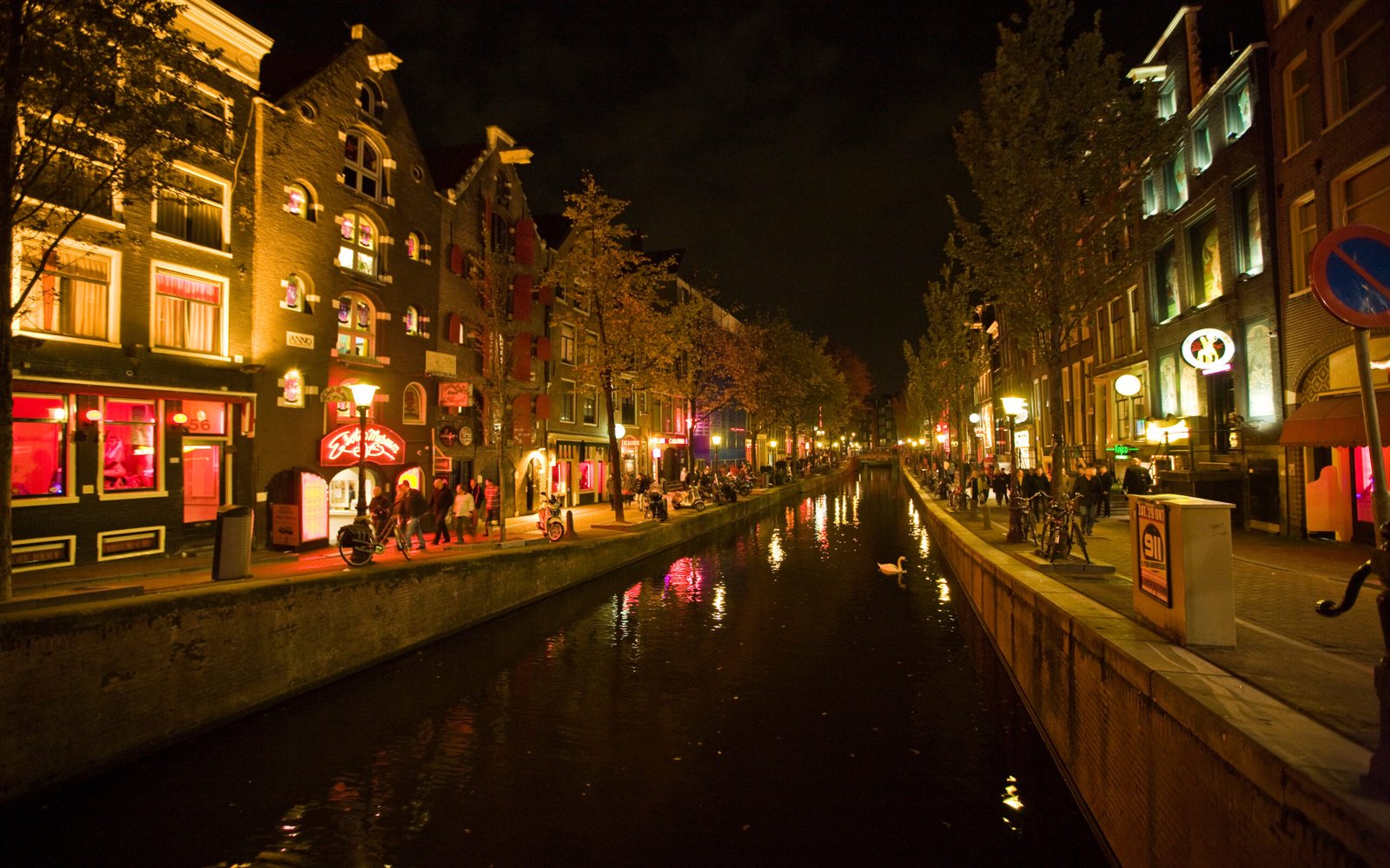
Walk through De Wallen on a Saturday night and you’ll find what might be the most condensed tension in European civic life: stag parties from Sheffield drinking through streets that Spinoza once wandered, neon-lit windows a hundred metres from a 13th-century church, sex workers holding red umbrellas outside city hall chanting “Save Our Windows.” The question of what Amsterdam is, and what it’s becoming, isn’t new. The city has been arguing about itself for centuries.
Mokum: The City That Said Yes When Everyone Else Said No
The tolerance that Amsterdam became famous for wasn’t ideological. It was a business decision that turned into a way of life.
When the Dutch Republic broke from Spain in 1581, the new state found itself inheriting a port city with a population hungry for trade and deeply suspicious of religious monopoly. The Dutch Reformed Church became official but, crucially, the state didn’t hand it a sword. Catholics faced civil restrictions — exclusion from office, no public worship — but they weren’t executed. Jews fleeing the Spanish Inquisition, Huguenots driven out by Louis XIV’s revocation of their liberties in 1685, and radical Protestants from across Europe all found something rare: a city that would let them stay and work.
The calculation was explicit. Spanish persecution of Huguenots drove skilled craftspeople, bankers, and merchants to Amsterdam. Portuguese and Spanish Jews brought capital and trading networks. The cost-benefit analysis was clear: tolerance = wealth. In a period when most of Europe was burning people over theological disputes, the Dutch were opening joint-stock companies.
By the year 1600, one third of Amsterdammers were foreign-born. The city’s Jewish nickname for itself — Mokum, from the Hebrew and Yiddish for “safe place” — tells you something about how this felt from the inside. An estimated half a million migrants settled in the Dutch Republic during the 16th and 17th centuries, an extraordinary number for a country of barely one million inhabitants. Immigration wasn’t marginal; it was structural.
Sephardic Jews fleeing persecution brought sophisticated banking practices and international commercial connections. Huguenots contributed advanced manufacturing techniques. The trade routes, the credit networks, the VOC’s global empire — all of it ran, in part, on the productive energy of people who had been kicked out of everywhere else.
The Republic of Ideas
The practical openness bred something less expected: intellectual freedom. Philosophers from across Europe — Descartes, Locke — gathered in Amsterdam to pursue their work, enjoying relative freedom to publish new ideas without censorship. Descartes spent much of his career in the Netherlands because he could publish there. Locke drafted parts of his Essay Concerning Human Understanding while in exile in Amsterdam.
The most remarkable case is Spinoza himself — born in 1632 to Portuguese-Jewish refugees who had fled the Inquisition. His parents came to Amsterdam specifically because of what it offered. He repaid the city by producing some of the most radical philosophy in European history, defending the separation of church and state and the freedom of expression at a time when those ideas could get you killed. He published his Theologico-Political Treatise in 1670 anonymously, under a fake imprint, and even so the book caused a storm. He wore a ring engraved with the word caute — caution. He needed it.
Even Amsterdam’s tolerance had its limits. Spinoza was excommunicated by his own Jewish community in 1656, his most important work published posthumously, his name attached to it only after he was safely dead. While there was far more tolerance in the Netherlands than elsewhere, Spinoza’s story clearly shows that significant constraints remained. The Dutch Golden Age was a genuine experiment in pluralism. It was also built on slave labour in Brazil and Indonesia, and its religious tolerance stopped well short of full civic equality. What the city offered was a floor, not a ceiling.
Still. By 17th-century standards, that floor was very high.
De Wallen: Vice by Necessity
Prostitution in Amsterdam is as old as Amsterdam’s port, which is to say it’s very old. It can be traced to the 13th century, when sailors and merchants arriving in the young harbour sought recreation close to the docks. The Oude Kerk — the city’s oldest church, founded around 1213 — sits in the middle of what became De Wallen. The name itself comes from the medieval city walls (wallen) that once defined the neighbourhood. Churches and brothels sharing the same canal, much like today. This is not a recent irony.
By the 17th century, more than 1,000 women were performing sex work in Amsterdam. Prostitution was tolerated in the Middle Ages rather than prosecuted, though sex workers were denied certain civil rights — they couldn’t marry, for instance. The city’s attitude shifted when Amsterdam became Protestant in 1578 and formally banned prostitution, but the trade simply continued underground. A Protestant city council threatening men with “severe measures” for visiting sex workers and threatening the women themselves with expulsion, then doing almost nothing to enforce any of it — this is a very Dutch story.
The word for this has a name in Dutch: gedogen. To tolerate. To look the other way because prohibition makes things worse, not better. The city ran on this principle for centuries before it had a name for it.
In 1795, French invasion briefly legalised prostitution under strict regulation. When the French left in 1813, cities tried to ban it again. Amsterdam resisted. By 1911, another crackdown pushed sex workers onto the streets, and through the 1930s police simply allowed workers to signal through red lights or parted curtains. The window displays that tourists photograph today evolved from this — a way of working that was simultaneously illegal and completely visible.
In 2000, the Dutch government lifted the ban on brothels entirely, making them legitimate businesses. Brothels in De Wallen must now be licensed, and sex workers rent their windows from licensed establishments and pay taxes. The system is intended to separate consensual adult sex work from trafficking, regulate health and safety, and give workers legal recourse if they experience violence.
Whether it achieves all of that is genuinely contested.
Gedoogbeleid: The Policy of Permitted Illegality
The Dutch approach to cannabis follows the same basic logic. Since the 1970s, the Dutch government adopted a tolerance policy — gedoogbeleid — allowing coffeeshops to sell and consumers to possess small amounts of cannabis, while technically keeping it illegal. The 1976 reform of the Opium Act codified what had already been happening on the street: a pragmatic decision to separate soft drugs from hard drugs, reduce harm, and avoid the social cost of mass prosecution for minor offences.
It’s worth dwelling on how strange this is. The Netherlands does not have legal cannabis. What it has is an agreement by prosecutors not to enforce drug laws against coffeeshops that follow strict rules. The front door of every coffeeshop in Amsterdam is technically legal. The back door — the supply chain — remains criminal. The Dutch call this the achterdeurproblematiek: the back-door problem. For fifty years, the country has maintained a policy it knows is logically incoherent because the alternative seems worse.
By the time the first High Times Cannabis Cup was held in Amsterdam in 1988, the city had become a pilgrimage site. That’s when gedoogbeleid started to eat itself. The policy was designed for harm reduction among Dutch citizens. What it produced, partly, was a global brand for drug tourism.
The Tourists Ate Everything
The numbers tell the problem. Amsterdam saw 15.1 million overnight visitors in 2023, up from 12.6 million in 2019. That works out to roughly 10 tourists for every resident. The city’s infrastructure — its canals, its narrow streets, its medieval centre — was not designed for this volume. Neither were its sex workers, who found themselves treated as an attraction by coach-tour operators, bachelor parties, and smartphone-wielding visitors who ignored every sign asking them not to photograph through the windows.
The city’s response has been extensive and not entirely successful. Over 75 measures to deter nuisance tourists have been introduced. Group tours of the red light district were banned in 2020. The tourist tax went from 7% to 12.5%. Cannabis smoking was banned in the Red Light District. New hotels were blocked from construction. The city launched a “Stay Away” campaign specifically targeting British men aged 18 to 35. Amsterdam plans to reduce cruise ships in its harbour to just 100 by 2026, down from 190, before banning them outright by 2035.
The Erotic Centre Controversy: Who Gets to Define Tolerance?
The sharpest recent confrontation over Amsterdam’s identity is the proposed “Erotic Centre” — a purpose-built facility on the city’s outskirts, planned to absorb 100 of De Wallen’s roughly 249 licensed prostitution windows. The plan comes from Mayor Femke Halsema, who has been frank about her view that the current situation is untenable.
Sex workers marched to city hall in March 2023 carrying red umbrellas and banners reading “Save the Red Light,” presenting a petition to the mayor. Their argument was not sentimental. Moving workers out of a dense, established district with safety-in-numbers dynamics and onto the outskirts — isolated from their support networks, from passing foot traffic, from colleagues — would, they argued, make their jobs more dangerous, not safer.
“We really don’t agree with the solutions they are offering. They’re not even negotiating with the sex workers’ organizations,” said Sabrina Sanchez, a sex worker who spoke at the demonstration.
A coalition of 40 businesses, cultural institutions, residents’ associations, and interest groups submitted a petition with over 22,000 signatures against the plan. The European Medicines Agency — which moved its headquarters to Amsterdam after Brexit — expressed concern that one proposed site was 800 metres from its offices. Residents near potential sites protested that they didn’t want the largest brothel in Europe near their homes either.
Mariska Majoor, a former sex worker and long-time advocate, pointed out the moving goalposts: “The authorities had a plan to reduce part of the brothels already in 2007. Then it was because of the fight against people trafficking and abuse, and now it’s about the fight against mass tourism.”
This is the core of the problem. Amsterdam’s tolerance was never a fixed principle — it was always a negotiation, often with the city making decisions about marginal groups rather than with them. The Golden Age refugees benefited from Dutch pragmatism, not Dutch idealism. The sex workers of De Wallen were tolerated for centuries while being denied full civil rights. The coffee shop patrons operate in a grey zone that serves the state’s interests as much as their own. When conditions change — when the tourists become genuinely overwhelming — the tolerance proves to be conditional.
Is Tolerance Under Threat?
It depends what you mean by tolerance, and whose.
The case that it is: a ban on cannabis smoking in the red light district, earlier closing times, a blanket ban on guided tours of De Wallen, a plan to relocate sex workers to a suburban facility they don’t want to move to. The city that once let Spinoza’s ideas circulate (however cautiously) and let Descartes work in peace now runs “Stay Away” campaigns and is trying to move its most famous industry outside the ring road.
The case that it isn’t: the city is trying to protect the working conditions and safety of sex workers from mass tourism that treats them as a spectacle. Banning group tours of De Wallen because workers were experiencing “abusive behavior and unwanted photography” is not intolerance — it’s protection. Closing windows isn’t the same as prosecuting the women behind them. And the gedoogbeleid framework, for all its contradictions, is moving toward regularisation: the Netherlands is now running a controlled cannabis supply experiment in ten municipalities, moving the back door closer to legal.
What’s actually happening is a collision between two different versions of tolerance. One belongs to Amsterdam’s residents, who have tolerated extraordinary levels of tourism for decades and are now saying, firmly, that they have had enough. The other belongs to the workers and communities whose livelihoods depend on the city’s permissive reputation — and who are not wrong to notice that when the city tightens its belt, it tends to do so at their expense first.
The 17th-century version of this trade-off was simpler. Refugees brought skills and capital; the city got richer. The calculation today is murkier: 15 million tourists bring money but also noise, disrespect, displacement, and a housing market that prices out the people who live there. Amsterdam’s own residents have watched housing regulations get overridden, promised visitor limits exceeded, and their neighbourhoods restructured around people passing through.
Spinoza would recognise the bind. He spent his life arguing for a secular democratic state that could protect freedom of thought and expression from both religious authority and mob pressure. He also signed his letters caute. He knew that tolerance, in practice, is always provisional — extended carefully, withdrawn when it becomes inconvenient.
Amsterdam hasn’t stopped being tolerant. It’s trying to figure out who deserves that tolerance now, and who gets to decide. That argument has been running since the 16th century. It isn’t close to over.
Sources and further reading: History of the Jews in Amsterdam (Wikipedia) · Amsterdam’s Policy on Prostitution (Red Light Secrets) · Drug Policy of the Netherlands (Wikipedia/Gedoogbeleid) · Inside the Controversy Over Amsterdam’s Erotic Centre (TIME) · Amsterdam vs. Overtourism (Skift) · Why Amsterdam Locals Are Suing the City (Time Out) · The Aura of Freedom in Amsterdam (Sapiens Travel)