Most people who can find the Netherlands on a map still get The Hague wrong. They think it’s the capital (it isn’t). They think “The Hague” is a metaphor for international justice rather than an actual city with a beach, a tram network, and a candy named after a caffeine-addicted baron. It is a real place, a strange and specific one, and it deserves a proper introduction rather than a summary for the top of a news article about a war crimes tribunal.
The name: a count’s hunting ground that never quite let go
The Hague started as real estate, not a settlement. In the early 1200s, Count Floris IV of Holland bought land on the coast and built himself a hunting lodge beside a lake called the Hofvijver. The little cluster of buildings that grew up around it became known as Die Hage — Old Dutch for “hedge” or “enclosure,” essentially “the private hunting grounds.” That name is first recorded in a document from 1242.
By the 15th century the name had grown more formal: des Graven hage, “the Count’s hedge,” eventually contracted to ‘s-Gravenhage, which is still the city’s official name on Dutch birth and marriage certificates today. Everyone else just says Den Haag. English speakers inherited “The Hague” from a French mistransliteration of Den Haag, apparently confused at some point with an unrelated French cape called La Hague — a five-century-old typo that stuck.
The government that isn’t in the capital
Here is the fact that trips up almost every visitor: Amsterdam is the constitutional capital of the Netherlands, and the government doesn’t run from there at all. It runs from The Hague, entirely.
The split goes back to the Dutch Republic, a confederation of seven fiercely independent provinces that spent the 16th and 17th centuries deliberately avoiding letting any one city accumulate too much power. Amsterdam was rich, dominant, and exactly the kind of city the other provinces didn’t want hosting the seat of government — so the States General, the republic’s ruling assembly, met instead in The Hague, a place that had grown up around a count’s palace rather than trade, had no city charter, and couldn’t parlay hosting duty into political leverage. When the Kingdom of the Netherlands was created in 1815, Amsterdam got the ceremonial title of capital — the constitution requires the monarch to be sworn in there — while The Hague kept the actual machinery: parliament, the cabinet, the Supreme Court, and the King’s own working office.
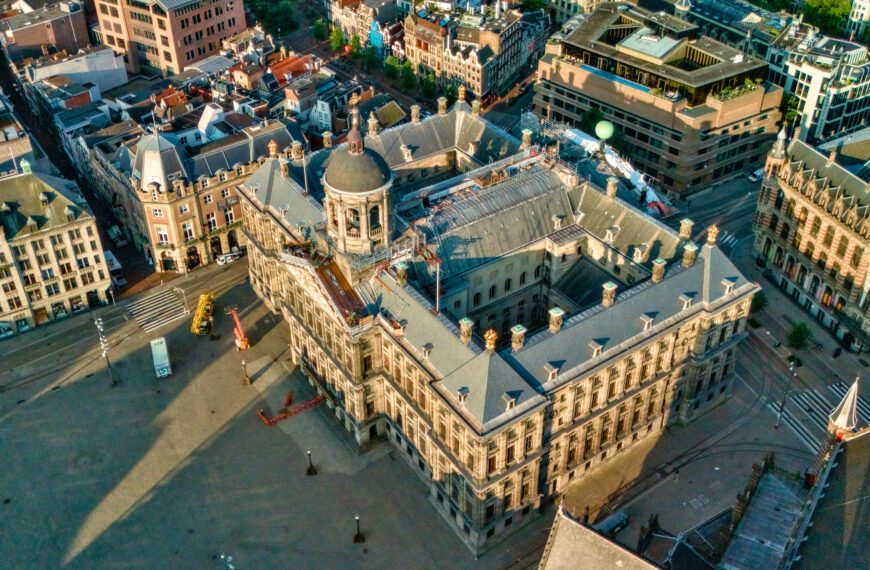
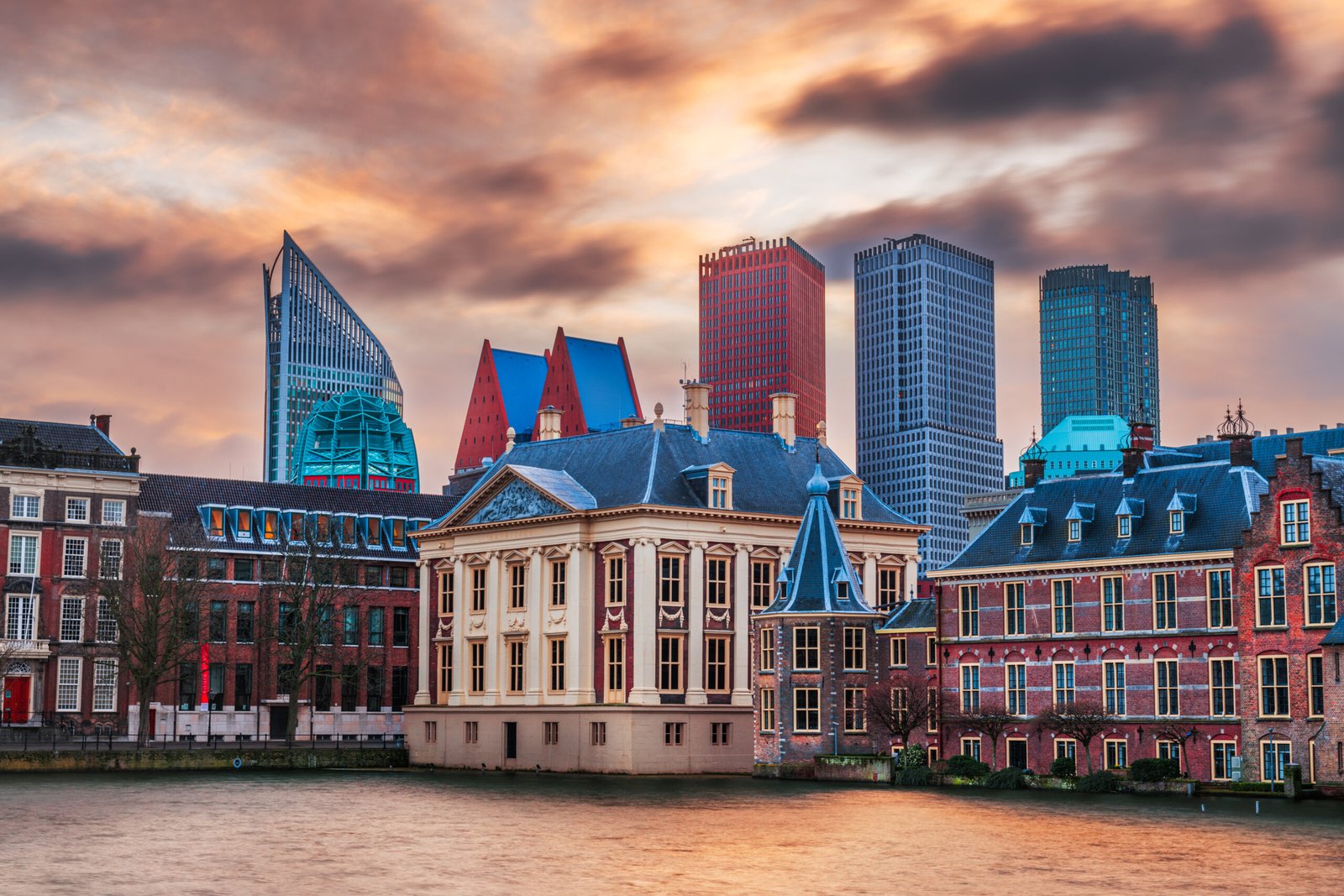
That machinery runs out of the Binnenhof, a walled complex of buildings dating to the 13th century that counts among the oldest parliament buildings still in use anywhere in the world. Its centerpiece, the Ridderzaal (Knights’ Hall), is where the King delivers the Speech from the Throne every September on Prinsjesdag, driven there in a golden carriage. The Binnenhof has been under major renovation since 2021, with parliament temporarily relocated elsewhere in the city while the work continues, expected to wrap up around 2031.
The city of peace and justice
If The Hague is famous internationally for one thing, it’s the courts — and the reason they’re all clustered in one mid-sized Dutch city rather than scattered around the world traces back to a single donation. American industrialist Andrew Carnegie funded the construction of the Peace Palace, which opened in 1913 to house the Permanent Court of Arbitration, an institution created after the First Hague Peace Conference in 1899. When the League of Nations set up the Permanent Court of International Justice in 1922, it moved into the same building; that court’s successor, the International Court of Justice — the United Nations’ principal judicial body, which hears disputes between states — has sat in the Peace Palace since 1946.
The International Criminal Court, which prosecutes individuals rather than states for genocide, war crimes, and crimes against humanity, is a newer and separate institution, established under the 2002 Rome Statute and housed in its own modern building elsewhere in the city. Since the 1990s, a wave of other organizations has settled around them — Europol, Eurojust, the Organisation for the Prohibition of Chemical Weapons, and dozens of international NGOs — enough that The Hague markets itself as “the international city of peace and justice” and is sometimes called the world’s second UN city, after New York.
Art: a small museum with an outsized painting
The Hague’s best-known cultural asset fits inside a single 17th-century townhouse. The Mauritshuis, a former private mansion on the Hofvijver, holds around 200 paintings from the Dutch Golden Age — Rembrandt, Frans Hals, Carel Fabritius’s tiny, extraordinary Goldfinch — and one painting that draws people from every part of the world on its own: Johannes Vermeer’s Girl with a Pearl Earring, painted around 1665.
It isn’t technically a portrait. Museum curators classify it as a tronie, a Dutch genre term for a study of an imagined character type rather than a specific sitter — in this case, a girl in an improbable turban with an oversized pearl that was almost certainly glass rather than a real gem, since an actual pearl that size would have been well beyond a working painter’s means. The painting spent centuries in obscurity before resurfacing at a Hague auction house in 1881, badly neglected, where it caught the attention of a cultural official who happened to be there and bought it for a few guilders. It’s been in the Mauritshuis ever since, occasionally leaving Dutch shores for a headline-grabbing world tour and always coming home again.
The city’s other essential stop, Escher in Het Paleis, is dedicated to M.C. Escher, the graphic artist behind the impossible staircases and tessellated lizards — not Hague-born, but closely tied to the city through this dedicated museum on the Lange Voorhout. That same stretch of tree-lined boulevard produced Louis Couperus, one of the towering figures of Dutch literature, born at Mauritskade 11 in 1863 and commemorated with a statue nearby.
The philosopher who died two streets from parliament
Baruch Spinoza, the Portuguese-Jewish philosopher excommunicated from Amsterdam’s Jewish community for his radical rationalism, spent his final years in The Hague grinding lenses for a living and quietly finishing the Ethics, the book that would eventually make him one of the central figures of the Enlightenment. He lived and died in a rented room on the Paviljoensgracht, a short walk from the Binnenhof, in 1677. The house is now a small museum, and a statue of Spinoza stands nearby — not without controversy at the time; when the monument was proposed in the 1870s, some Dutch circles still considered his ideas about God and nature close to blasphemy, but the funding came in anyway, and the bronze went up in 1880.
Food: a candy invented by a caffeine addict with a bad doctor
The Hague’s signature food item exists because an 18th-century baron wasn’t allowed to drink coffee. Baron Hendrik Hop, a Dutch diplomat recalled from Brussels in 1792, lived above a confectioner’s shop on the Lange Voorhout and, according to the most persistent version of the story, once left a cup of coffee with sugar and cream on a stove overnight, where it hardened into a caramel. He liked it enough that when his doctor later banned him from coffee outright, he asked his downstairs neighbor, confectioner Theodorus van Haaren, to turn that accidental caramel into something he could still enjoy. Van Haaren worked out a recipe of coffee, caramel, cream, and butter, and Haagse Hopjes — “little Hops” — were born.
They became a genuine national candy, produced for well over two centuries, right up until January 2025, when Swedish confectioner Cloetta announced it was discontinuing the classic Rademaker version due to falling demand, sparking a small local campaign — including a call to erect a statue of the baron himself on the Lange Voorhout, outside the building where it all supposedly happened.
The Hague’s place in the Netherlands
With just over half a million residents, The Hague is the third-largest city in the country, behind Amsterdam and Rotterdam, and sits at the southwestern edge of the Randstad, the dense urban ring that holds most of the country’s population and economy. It’s also the capital of the province of South Holland — a separate title from the national government it happens to also host — and the seat of a metropolitan region that, combined with neighboring Rotterdam, adds up to roughly 2.4 million people, the second-largest urban concentration in the Netherlands after Amsterdam’s.
Unusually for an old Dutch city, The Hague never grew up as a trading or fishing town the way Amsterdam, Rotterdam, and Delft did. It grew up as an administrative center from day one, which is part of why it still feels different from the rest of the country — wide boulevards and government ministries instead of merchant canals, with the beach resort of Scheveningen tacked on at its western edge, a fifteen-minute tram ride from the seat of national power.
How to get there
The Hague sits on two main train stations, Den Haag Centraal and Den Haag HS, both served constantly by Dutch Railways (NS). From Amsterdam Schiphol Airport, direct trains to Den Haag Centraal run several times an hour and take roughly 30 to 50 minutes, for around €10 one-way; a taxi covers the same route in about 30–45 minutes for considerably more. Rotterdam The Hague Airport, smaller and mostly serving regional and a handful of international routes, sits closer still — about 20 kilometers away, reachable by a short bus-and-metro combination or a roughly 30-minute taxi ride.
From Amsterdam Centraal itself, trains run direct to Den Haag Centraal every few minutes and take under an hour door to door, which makes The Hague one of the easiest day trips in the country — close enough to combine with Delft or Rotterdam on the same afternoon, and, thanks to the Peace Palace, the Mauritshuis, and a coffee candy with a genuinely good story behind it, worth a full day of its own.
Sources
- Wiktionary: The Hague
- Tripadvisor: The Origin of The Hague
- Supertravelr: The Story Behind The Hague’s Name
- LegalClarity: Capital of the Netherlands — Amsterdam or The Hague?
- Britannica: The Hague
- Holland City Tours: Why The Hague Is Not the Capital of the Netherlands
- ICJ: Practical Information
- UN News: What Is the International Court of Justice and Why Does It Matter?
- DutchReview: How the Netherlands Became Home to the International City of Peace and Justice
- Just Peace: The Hague — The Center of International Justice
- Mauritshuis: Girl with a Pearl Earring
- Britannica: Girl with a Pearl Earring
- Wikipedia: Louis Couperus
- Wikipedia: Baruch Spinoza
- Outdoor Art The Hague: Baruch de Spinoza
- Wikipedia: Hopje
- DutchNews: Campaign Starts to Save Haagse Hopjes Coffee-Flavoured Sweets
- The Hague Business: Transportation to The Hague
- Schiphol: Travelling From or To Amsterdam Schiphol Airport by Train