
The historical square was the site of some of Amsterdam’s darker moments
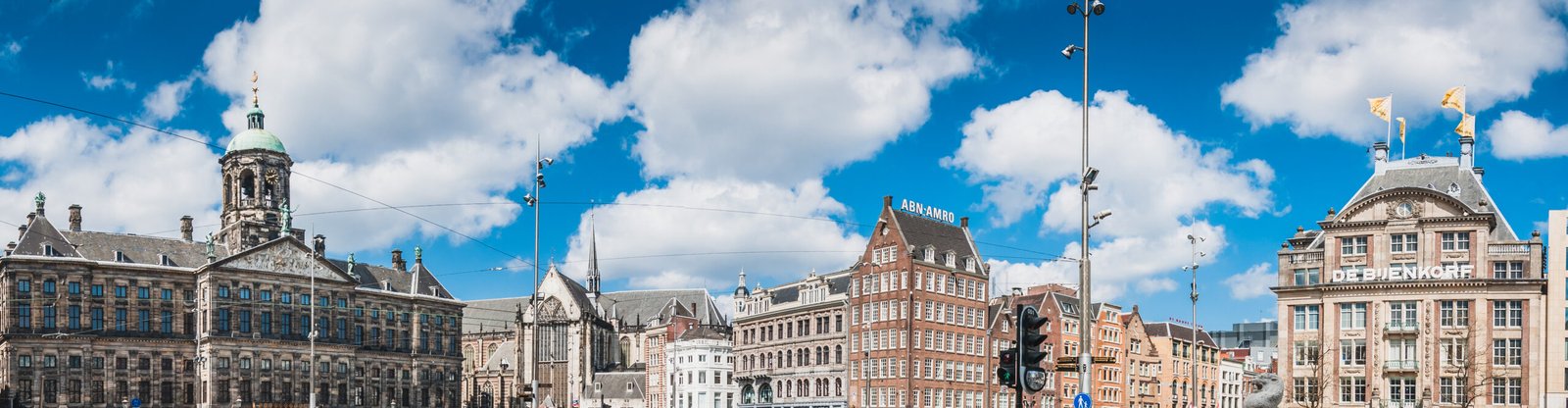
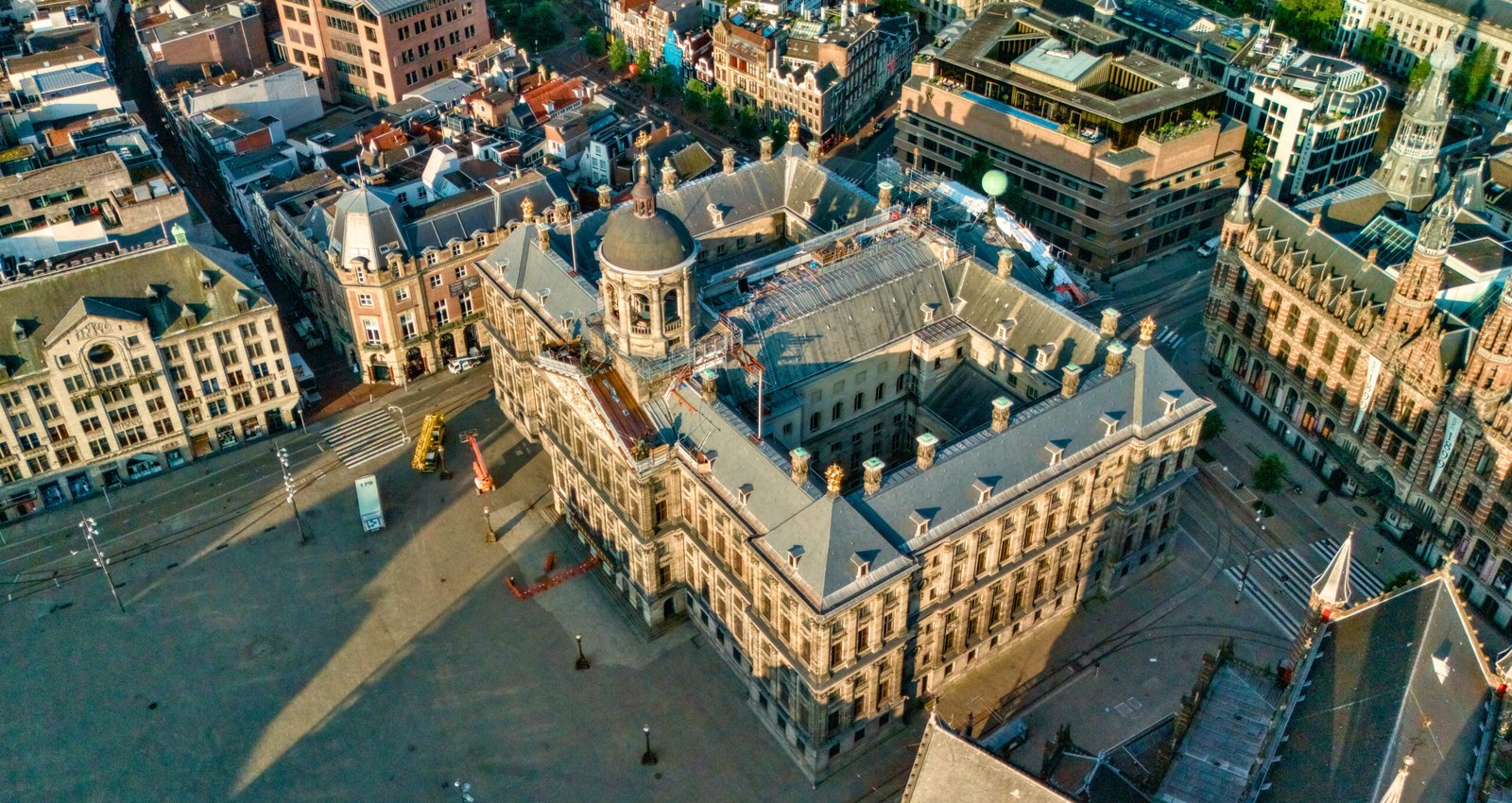
A visitor crossing Dam Square today is usually looking at something else. There is a phone, a map, or the queue for Madame Tussauds, which sits inside the Peek & Cloppenburg building. Trams cut across the open space and street performers work the paving. De Bijenkorf, the department store founded in 1914, faces the crowds. The Royal Palace fills the west side, with the Nieuwe Kerk, begun in 1408, beside it.
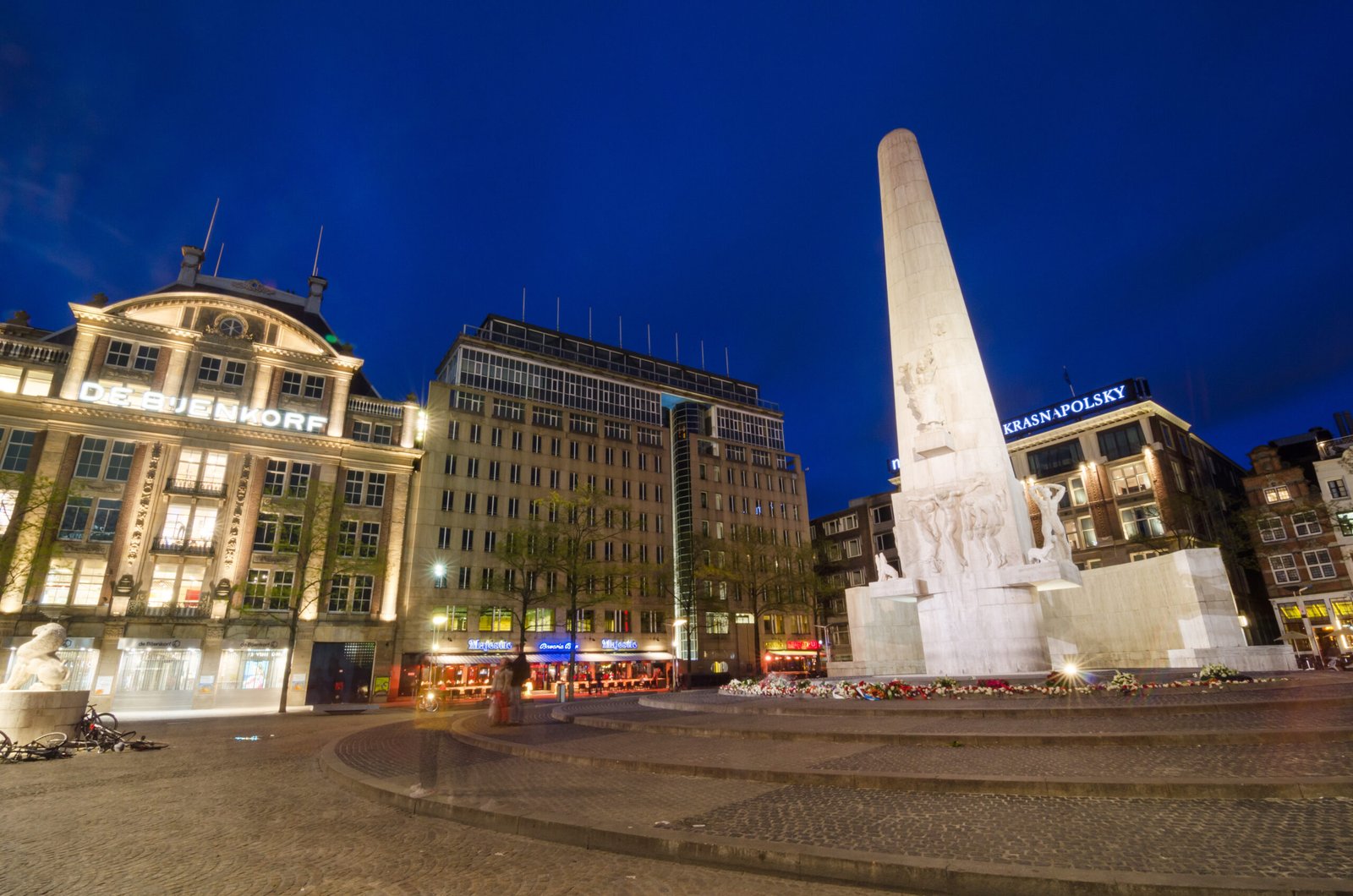
Opposite the palace stands the National Monument to the people who gave so much during the Second World War, a white pillar 22 metres tall. J.J.P. Oud designed it, the sculptor John Rädecker and his sons made the figures, and Queen Juliana unveiled it on 4 May 1956. A curved wall behind it holds twelve urns of soil. Eleven came from execution grounds and war cemeteries in the Dutch provinces, and one from the former Dutch East Indies. The urns bring earth from other killing places to a square that already had plenty of its own.
Amsterdam takes its name from a dam across the Amstel, built here in the 1270s. The spot became a market and then the seat of government. It all seems like a normal European square. But like most cities in Europe, there’s a darker side to the square. For several centuries, government here came with a scaffold.
The room that faced the crowd
The palace which occupies the main part of the square opened in 1655 as the city hall. On its ground floor, behind the three central arches on the Dam side, is the Vierschaar, the tribunal where Amsterdam pronounced death sentences. A condemned person entered and faced the schout, the city’s chief prosecutor, and nine schepenen, the magistrates who served as judges. They sat in a row on a long bench beneath Artus Quellinus’s marble reliefs of famous verdicts. Life-size figures of guilt and repentance flanked them.
The room was open to the square on purpose. The Stadsarchief records that the public could follow the proceedings from the Dam, while the city secretary read the sentence from a seat at the side. The four burgomasters did not even have to come downstairs. From their chamber on the first floor, a side window let them watch the pronouncement. The sentence had two audiences, the officials above and the crowd outside, and the building was arranged to serve both.
Then the sentence moved upstairs. According to the city’s own account, the condemned was led to the Justitiekamer, where the burgomasters, schout and schepenen knelt in a ring around the Amsterdam coat of arms set into the marble floor. A minister prayed, and the condemned knelt on the same cold stone. After the prayer, the whole party climbed through a window onto a wooden scaffold that had been built against the facade that morning. Its beams were slotted into holes in the stonework. The holes were bricked up later, but the places can still be seen.
The sentence was carried out by beheading, breaking on the wheel or hanging, about three times a year for two centuries.
Confession was a legal requirement for a death sentence, which is why the pain chamber in the building stayed in use until 1808, even though the “scherp examen” was abolished in 1798. One surviving executioner’s bill from December 1746 shows how routine the work could be. It covers eight punishments in a single day and comes to 210 guilders. The death sentences were done first and the lesser punishments after, with bells ringing and the sentences read aloud.
For the condemned, the Dam was not the last stop. Bodies were ferried across the IJ to the Volewijck gallows field and hung or bound to a wheel, a site that stayed in use until 1795.
Before the palace: the night of 10 May 1535
The scaffold stood on the Dam long before this building did. On the night of 10 May 1535, about 40 armed Anabaptists marched down Spuistraat to the old town hall. They had timed it well, because the burgomasters were at a banquet. The city militia sealed off the square with barricades, and the next morning broke down the door. Mayor Peter Colijn, some militiamen and 28 Anabaptists died, and the survivors were executed.
The attack was a Münsterite operation. Jan van Geelen had been sent to the Netherlands to stir revolt and pull attention away from Münster, and authorities across the Low Countries read Amsterdam’s attack in that light. The punishment still reached far beyond the men who stormed the building. Between 10 May and 28 July, 46 Anabaptists, many of them women, were executed in the city, although most of the congregation had opposed the uprising.
One of them was Jacob van Campen, a bishop of the movement who had argued against violence. He was tortured and executed on 10 July. The Stadsarchief treats the episode as the end of the city’s policy of tolerance. Fourteen years later, on 20 March 1549, eight more Anabaptists burned on the Dam.
Elsje, 1664
The best known case from the palace era involves a teenager. Elsje Christiaens was 18, from Jutland, and had been in Amsterdam about two weeks. She had found no work and could not pay the rent. Her landlady took up a broom and threatened to seize her belongings, and Elsje picked up an axe. The Met’s record says the landlady went down the cellar stairs and died.
What followed reads like a girl with nowhere to go. According to Wikipedia, Elsje took a coat and some linen from another guest’s chest and ran. Then she jumped into the Damrak canal, and passers-by pulled her out. She confessed.
On 1 May 1664 the executioner strangled her on the Dam after hitting her with the murder weapon. Her body and the axe went across the water to Volewijck and onto the gallows. It was the first execution of a woman in Amsterdam in 21 years, which probably explains the interest.
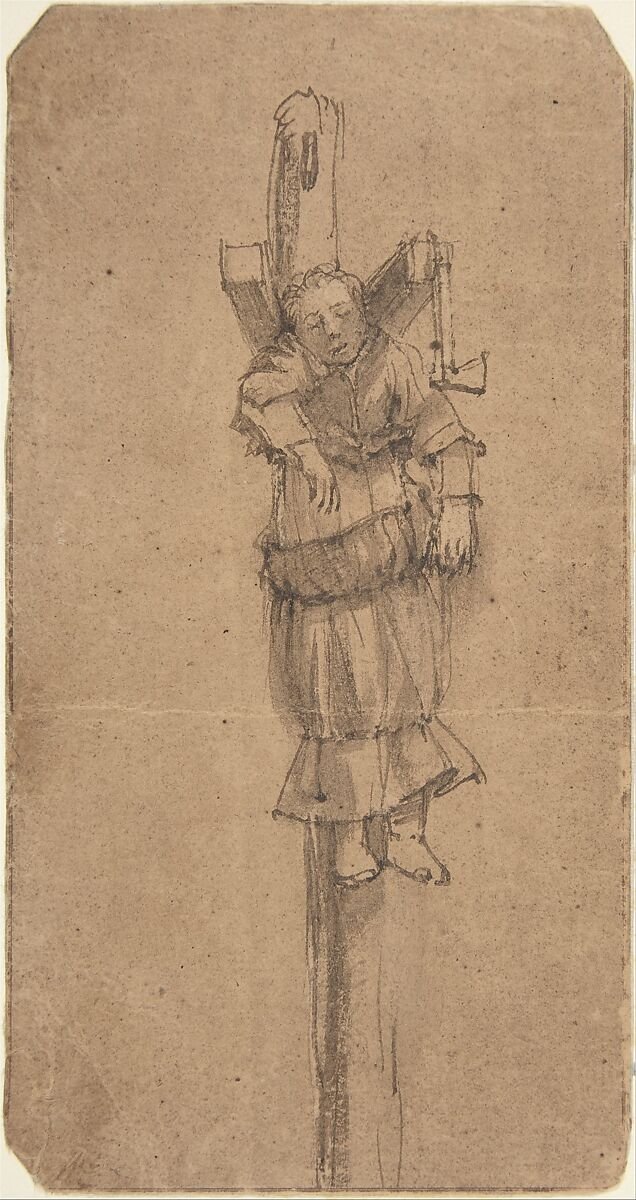
Rembrandt, then 57, crossed the IJ by boat to draw her. People often call the result a painting, but it is two small drawings in pen and brown ink with wash, and NYC’s Met owns both. The axe hangs beside her in the drawing. For decades art historians dated the sheets to about 1655 on stylistic grounds. Isabella van Eeghen’s archival work in the 1960s tied them to Elsje and moved the date to 1664. The criminal records preserve a verdict and little else, and the drawings are what keep her a person.
The last hanging, and where it was
In 1808, Napoleon’s brother Louis turned the town hall into a royal palace, and Amsterdam’s justice moved elsewhere. Corporal punishment was abolished in 1854 and the death penalty for ordinary crimes in 1870.
The final execution in the city did not happen on the Dam. On 22 November 1854, Johann Heinrich Kemper, a 21-year-old German farmhand, was hanged in the prison yard at the Weteringschans. It was officially out of public view, but the gallows stood high enough to be seen over the gates.
Monday, 7 May 1945
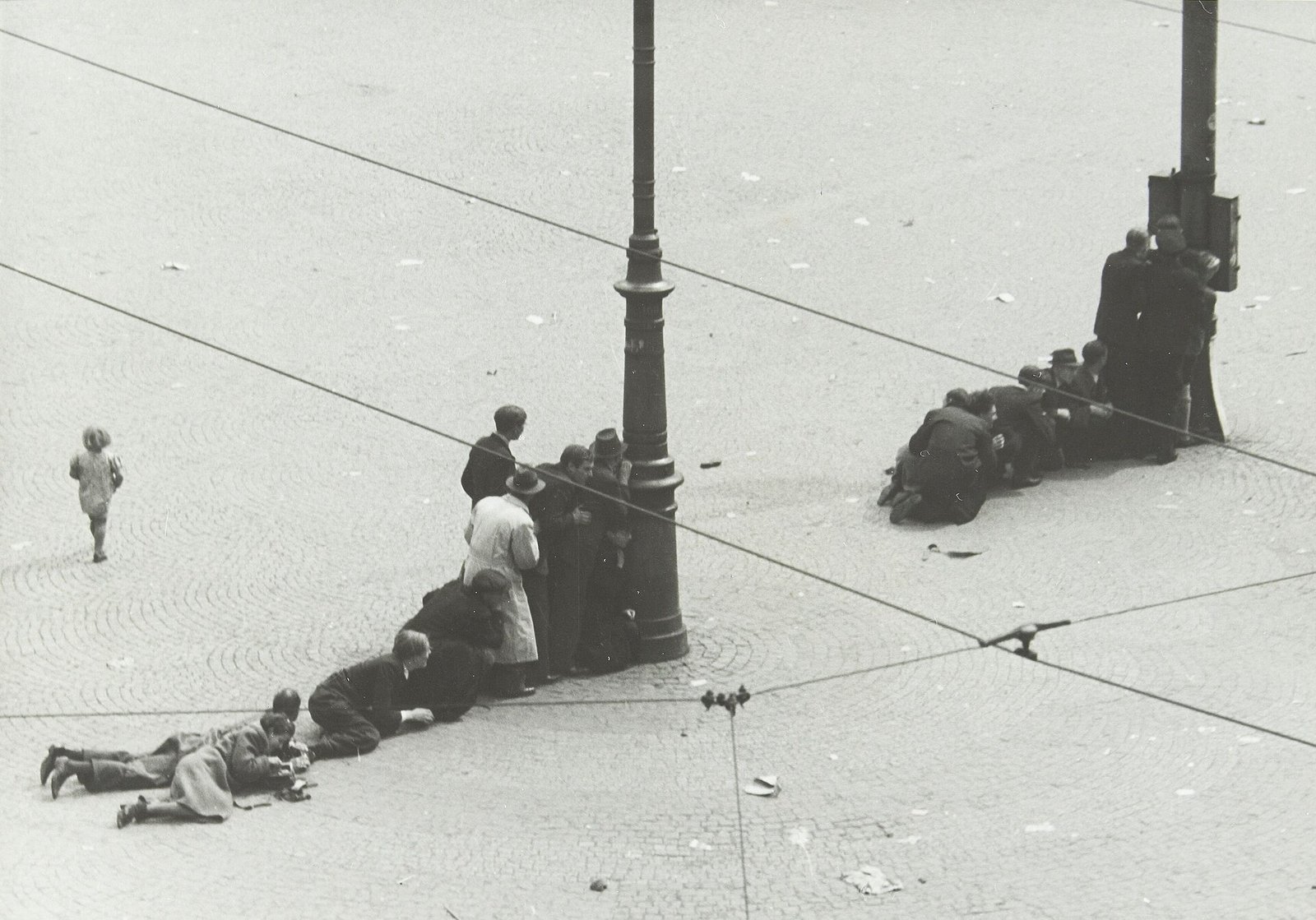
World War II. Liberation day. People seeking shelter behind lamp-posts at Dam square Amsterdam after German troops opened fire at the celebrating masses (22 killed, 120 injured). One of the pictures from the two films that Dutch photographer Wiel van der Randen consumed during the shoot-out on Dam square. Amsterdam, The Netherlands, May 7, 1945.
The deadliest day on the Dam came ninety years later, and it happened to a crowd that had come to celebrate.
The Germans had surrendered two days earlier. The western Netherlands stayed occupied until Allied troops could arrive, and local newspapers promised the Canadians for Monday. By midday thousands had filled the square. British armoured cars made a brief reconnaissance and left. Dutch resistance forces had taken the Royal Palace and two other key sites. Meanwhile German sailors were still inside the Groote Club, at the corner of the Dam and Kalverstraat.
| Date | Event |
|---|---|
| 5 May 1945 | German forces in the Netherlands surrender. Western areas stay occupied until Allied troops arrive. |
| 6 May | Local newspapers report that Canadian forces will reach Amsterdam the next day. |
| 7 May, midday | Thousands fill the Dam. British armoured cars scout the square and withdraw. Dutch resistance forces take the Royal Palace and two other key sites. |
| 7 May, afternoon | A shot is fired in Paleisstraat during an arrest. German sailors in the Groote Club open fire into the crowd with machine guns. The shooting lasts about two hours. |
| 8 May | Canadian forces enter the city. |
| 9 May | Canadians take the Germans out of the Groote Club. Tens of thousands gather on the Dam to celebrate. |
Source: Wikipedia, drawing on the Dam victims’ foundation and the national war memorials committee.
It began in Paleisstraat, where local forces arrested two German soldiers and one fired a shot. Germans then appeared in the windows, on the balcony and on the roof of the Groote Club and opened fire into the crowd. Panic broke out. People ran for the Nieuwendijk, Rokin and Damrak, and others hid behind lampposts and a barrel organ. The shooting lasted until about five o’clock.
Tiny van der Hoek was two and a half and standing near an ice cream cart at the corner of the Nieuwendijk. She remembers her ice cream falling out of her hand and being angry about it. A stranger picked her up, wrapped a coat around her and carried her toward shelter. She did not understand at the time that she had walked past wounded and dead people.
At sunset, Richard Taite of the British reconnaissance unit received the German commander’s surrender at the palace. The Canadians entered the next day, one day after the shooting and three days after the capitulation. Newspapers had reported 19 to 22 dead and 100 to 120 wounded. No official list of casualties was ever released, the shooting was never fully investigated, and no one was prosecuted.
A plaque went up on the Groote Club in 1947, but the names stayed unrecorded for decades. The Stichting Memorial voor Damslachtoffers, founded to establish who had died, has since identified 32 people. Twenty-five died on 7 May, four the next day, and three later, the last on 22 June. The count excludes German casualties, and the foundation notes that more cases are still under investigation.
What happened to the little girl in the picture?
The little girl in the famous photograph from the May 7, 1945, Dam Square shooting in Amsterdam survived the massacre completely unharmed. Her name is Tiny van der Hoek, and she was only 2.5 years old at the time. [1, 2, 3]
While generations of viewers assumed the little blonde girl wandering into the open plaza during a machine-gun ambush must have been hit, her reality was remarkably innocent: [1]
- Why she was walking away: She had just been given an ice cream cone at a cart on the corner of the square. When the shooting started, panic erupted and her ice cream fell onto the ground. Unaware of the danger or the flying bullets, she was simply upset about her dropped treat and was walking toward the German soldiers at De Groote Club to demand a new one. [1, 2, 3]
- How she was saved: As adults scrambled for cover behind lampposts, an unidentified man spotted her wandering alone. He ran out, scooped her up into his arms, wrapped his coat around her, and carried her safely away from the line of fire. [1, 2, 3]
- Finding safety: The man reunited Tiny with her mother. Because local buildings were packed with fleeing crowds and doors were locked, the man had to kick in a window of a building so Tiny and her mother could hide underneath a billiard table until the shooting stopped. [1, 2]
Decades later, the Stichting Memorial voor Damslachtoffers 7 mei 1945 (the foundation dedicated to the victims of the shooting) successfully located Tiny, confirming that she lived a full life well past the war.
The names in the pavement
The names are in the paving of the Dam itself. Between June 2015 and March 2016, 15,509 people placed virtual stones on a website, and together the stones formed the letters of the victims’ names. On 1 March 2016, the result was cut into stone reliefs and set into the square. Mayor Eberhard van der Laan unveiled the memorial on 7 May 2016, after a ceremony in the Nieuwe Kerk. Visitors cross it on their way to the palace, usually without noticing.
The scaffold holes in the palace facade and the names in the paving are about a hundred metres apart, on the same square.
Sources
- Royal Palace Amsterdam: Vierschaar and Burgemeesterskamer
- Gemeente Amsterdam, “Doodsangst in het Paleis”
- Stadsarchief Amsterdam, “Doodstraf”
- Stadsarchief Amsterdam, 1535 Anabaptist revolt (Canon of Amsterdam)
- Gemeente Amsterdam, “Meedogenloze straffen”
- Amsterdam750, “Een flinke rekening van de beul”
- Over Amsterdam, on the palace’s pain chamber
- GAMEO: Jan van Geelen, Jacob van Campen, Amsterdam
- Wikipedia: Anabaptist riot
- The Met: Rembrandt, Elsje Christiaens Hanging on a Gibbet
- Wikipedia: Elsje Christiaens
- Hart Amsterdam, “Poor Elsje”
- Executed Today, 1664: Elsje Christiaens
- Historiek, Johann Heinrich Kemper
- Wikipedia: 1945 shooting on Dam square
- Stichting Memorial voor Damslachtoffers 7 mei 1945 and Tiny van der Hoek’s account
- Place a Stone: 32 dead, 32 stones
- Wikipedia: National Monument (Amsterdam)
- Hidden Holland: Dam Square and Tours in Amsterdam: Dam Square