A field guide for the bewildered
Most visitors arrive in the Netherlands with the usual foreigner’s confidence. They’ve done the research. Tulips. Windmills. Rembrandt. Bikes. Check. They feel prepared.
Within forty-eight hours, a man has urinated six feet away on a busy shopping street while pigeons watched, unbothered, and a colleague has handed over what appeared to be black rubber candy and said to enjoy it. Both of these things are considered completely normal here. More than normal, in fact, beloved.
This is a dispatch from the other side of that culture shock.
The Urinals
Let’s start where we have to start.
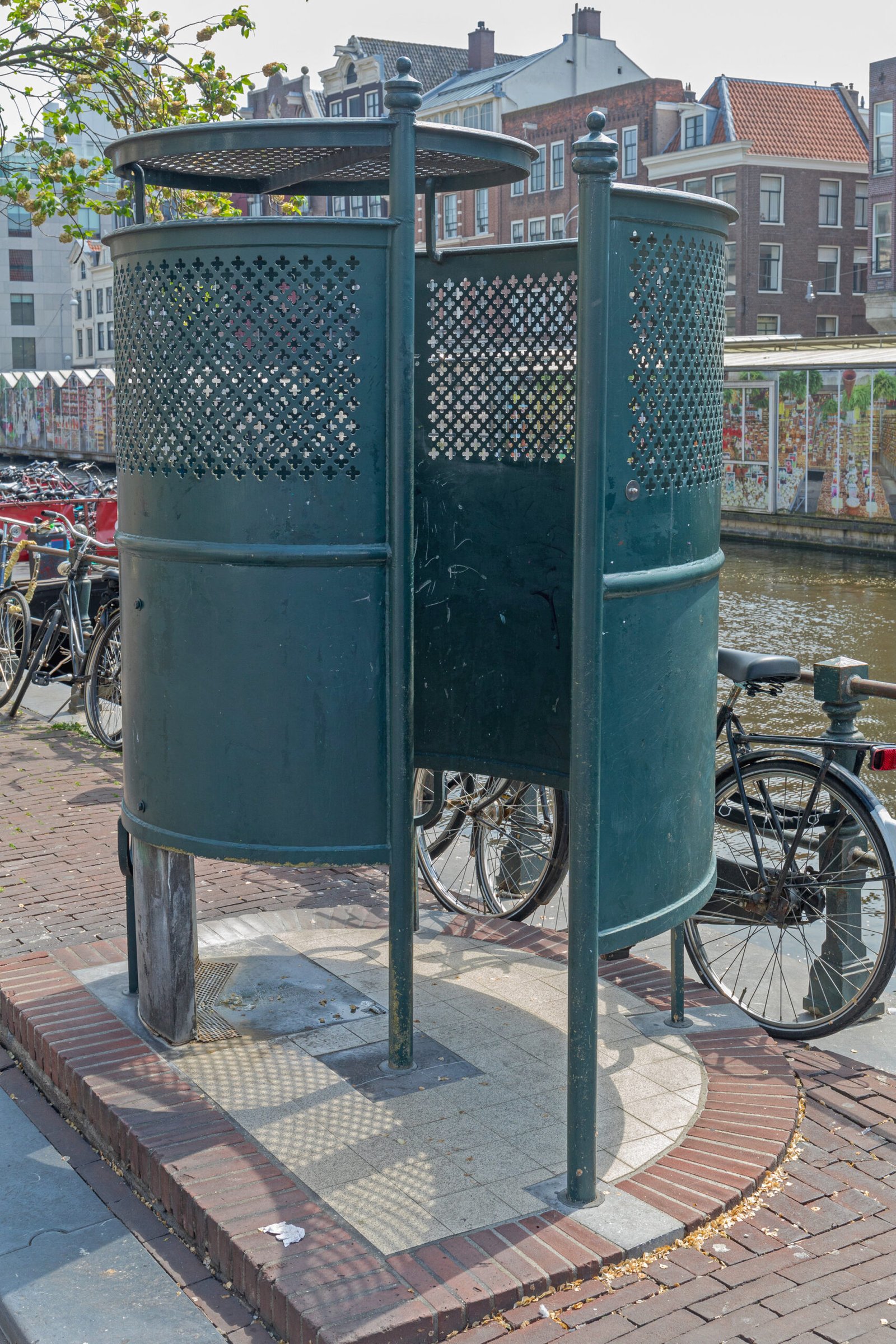
Amsterdam has roughly thirty-five open-air cast-iron urinals scattered across the city. They’re called de krul — “the curl” — a reference to their spiral design, which dates to around 1870. The concept is simple: a curved metal screen, open to the street, drain at the bottom. A passerby can see the user’s feet. Often a passerby can see a bit more. The smell announces their presence from some distance away.
While not unqiue to the Netherlands, the design has barely changed in 150 years, which is either a sign of Dutch practicality or a sign that nobody particularly wants to touch them. One of these structures, near Dam Square, was declared a national monument in 1988. It has a small sculpture of a man on top, carved by the city’s official sculptor, Hildo Krop. Someone in Amsterdam city government commissioned artwork for a public urinal. This fact deserves a moment of quiet contemplation.
The French invented the pissoir first — Paris installed its first open-air urinal in the 1830s — but the Dutch took the idea and made it permanent. Where Paris eventually tore most of them down, Amsterdam kept the curls and added newer models. The plastic version accommodates four men at once and gets deployed during King’s Day, the national holiday on which the entire country dresses in orange and drinks heavily. It would be alarming if the context didn’t make it so logical.
The engineering has also evolved. Older models drained directly into the canals. Newer ones connect to the wastewater system. There’s even an initiative, noted by Pratt Institute researchers, to convert the collected waste into fertilizer. The Dutch have found a way to make this circular. Of course they have.
The krul system was never about comfort or privacy. It was about pragmatic city management: drunk people were going to urinate somewhere, and against a canal wall in a UNESCO World Heritage site is worse than a designated spiral. The Dutch saw public urination as an infrastructure problem and solved it with infrastructure. The fact that the solution involves a man peeing into the open air while tourists walk past with ice cream is, apparently, simply an aesthetic preference they’ve made peace with.
What the system doesn’t solve — and the Dutch are now grappling with this — is that it only works for men. In 2017, a 23-year-old named Geerte Piening was fined for wild plassen (urinating in public) after stopping behind a car on a night out. She took the city to court. She lost, but the case put pressure on Amsterdam to install more public toilets for women, which it is, slowly, doing. The city has said it won’t build more kruls, though the existing ones stay for now.
So they remain. Metal. Fragrant. Historically significant. Completely open to the street. Gezellig they are not.
The Candy That Tastes Like the Sea
Every visitor, at some point, gets offered drop.
Drop is a licorice-based candy. That much the name suggests. What the name does not suggest is the range of experiences it contains, from mildly sweet to aggressively, almost weaponized salt. There are over four thousand varieties, and a significant portion of them will make a face do things it didn’t know it could do.
The Dutch consume drop in enormous quantities and seem genuinely puzzled that visitors don’t love it. The salty kind tastes like distilled North Sea wind, like someone crystallized the smell of a fishing harbor. Dutch people consider this a selling point.
The sweet drop is actually fine. Good, even. But when a Dutch person hands over an unmarked piece of black candy with a slightly malevolent smile, the safest move is to eat it quickly and keep the face still.
Chocolate Sprinkles for Breakfast (and Lunch)
We’ve written about this before but it never hurts to mention it again. Here is a fact that takes most visitors several weeks to fully accept: the Dutch eat chocolate sprinkles on buttered bread for breakfast. Not as a treat. As a meal. Every day. For their whole lives.
The sprinkles are called hagelslag, which means “hailstorm” — named after an autumn storm in 1919 in Amsterdam that inspired a candy company director to name his new product after the weather. They’re not quite the same as American cake sprinkles; they contain more cocoa and less sugar, and the texture is softer. According to IAmExpat, the Netherlands consumes 14 million kilos of hagelslag per year, and 750,000 hagelslag sandwiches are eaten daily.
The ritual matters: thick butter first (it acts as a glue), then a generous layer of sprinkles, edge to edge. One doesn’t just dump them on. The Dutch have opinions about this.
What strikes outsiders most is that adults eat this without the faintest self-consciousness. In most cultures, putting sprinkles on breakfast bread is something people grow out of around age nine. In the Netherlands, it’s something Dutch expats living in New York or Sydney quietly miss and have their parents mail them in small packages. A 2023 piece in AOL/Yahoo describes it as “the one childhood indulgence that adults are still allowed to enjoy without judgment.”
The Dutch have, in this one case, simply decided that a thing is delicious and that age is irrelevant to whether one should eat it. There’s something admirable in that.
The Birthday Calendar in the Toilet
This one takes the longest to explain to people outside the Netherlands.
Walk into a Dutch person’s bathroom and look at the door, or the wall, or the back of the toilet. There will almost certainly be a calendar — not showing the current year, not organized by weekday, just months and dates with handwritten names. It’s the verjaardagskalender: the birthday calendar. And it lives in the toilet because that’s where it gets looked at, quietly, every day.
Nearly half of Dutch households have one, according to research by Dutch printing company Albelli, making it the most common decoration in the smallest room of the house. The Dutch see nothing strange about this. When told that other countries don’t do it, they look mildly confused and ask how anyone remembers birthdays then.
The calendar is yearless and perpetual — the same one gets used forever, with names added and those belonging to the dead crossed out, sometimes with a small note. There is a whole etiquette to it: one never adds one’s own name to someone else’s calendar (deeply presumptuous); being added is a mark of real friendship; and one Dutch website notes that even King Willem-Alexander is said to have a favourite toilet calendar, though this detail may be apocryphal.
During the COVID lockdowns, then-Prime Minister Mark Rutte mentioned in multiple press conferences that Dutch people were upset about missing birthday parties. A cultural researcher at the Meertens Institute pointed out, with some amusement, that both Rutte and the King’s annual speeches had referenced birthday celebrations as the specific social loss the pandemic caused. Not concerts, not restaurants — birthdays. The Dutch treat them with a gravity that other cultures might reserve for major life events. Missing a birthday is genuinely bad form. Being on the toilet calendar is a sign one matters to someone.
That turns out to be surprisingly moving for a bathroom calendar.
On Being Dutch
None of these oddities feel like oddities to the Dutch. The open urinals are a sanitation strategy. The drop is just a candy that happens to be an acquired taste. The sprinkles are breakfast. The toilet calendar is a low-tech but reliable way to tell people they’re cared about.
The Dutch have a particular genius for deciding that something is practical and then just doing it, without excessive concern for how it looks to others. That’s not the whole story of Dutch culture, the directness, the cycling-in-sideways-rain, the fact that a gezellig evening might mean sitting in a perfect circle of chairs eating cheese cubes, but it’s a thread running through most of the things that strike outsiders as strange.
Some visitors never fully normalize the krul and its, shall we say, open-door policy. But hagelslag for breakfast has a way of winning people over. And once a name appears in a Dutch friend’s toilet calendar, something shifts. It’s strange, until it isn’t.
Sources
- Amsterdam’s outdoor krul urinals and their history: The Travel | What’s Up With Amsterdam | DutchReview | Wikipedia: Pee curl | Phlush / Pratt Institute
- Dutch drop (licorice): Accidentally Dutch | PartnerPete
- Hagelslag history and culture: IAmExpat | Food Republic | HuffPost | Atlas Obscura
- The toilet birthday calendar: DutchNews.nl | DutchReview | UK Rant | Stuff Dutch People Like