There’s a body of government in the Netherlands that has been running, without interruption, since the thirteenth century. It has its own taxes, its own elected representatives, its own courts. It predates the Dutch parliament by several hundred years, survived the Spanish Habsburgs, Napoleon, two world wars, and more than a few attempts to abolish it. Most Dutch people pay it taxes without thinking much about it. Outside the Netherlands, almost nobody has heard of it.
It’s called the waterschap — the water board — and if you want to understand why the Dutch do politics the way they do, you probably need to start here.
Why the Land Forced People to Cooperate
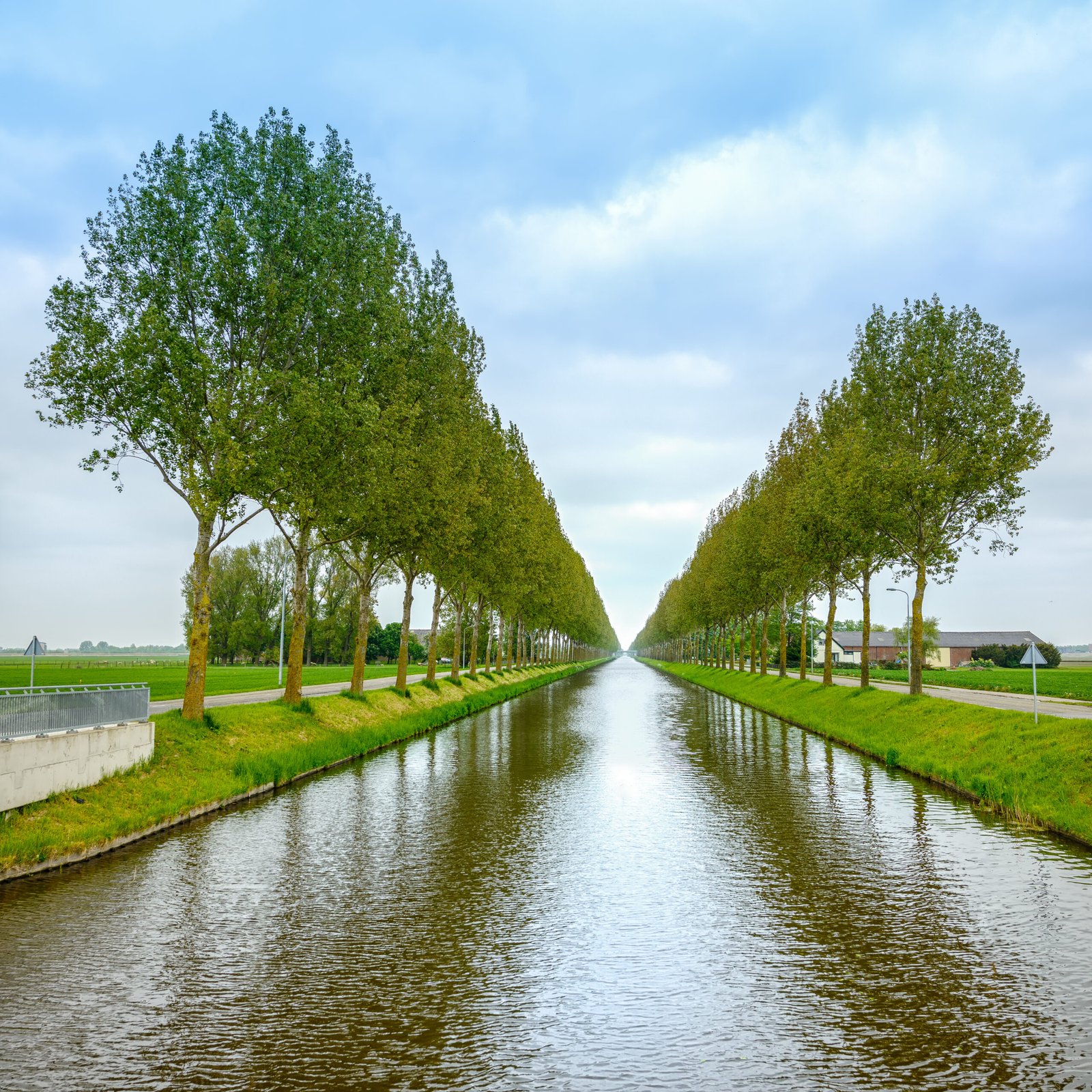
About a quarter of the Netherlands sits below sea level. Another quarter sits barely above it. The rivers — the Rhine, the Maas, the Scheldt — all empty into the North Sea through the same small delta, carrying whatever storms and snowmelt from central Europe have pushed downstream. Left unmanaged, much of what is now the Netherlands would simply be underwater.
From at least the early medieval period, communities here were building terps — artificial mounds — to keep their houses dry during floods. By around 1000 AD, they had started connecting these with dikes. But dikes are expensive, they require constant maintenance, and a failure in one section floods everyone. You cannot protect your stretch of dike while your neighbor lets theirs rot. The water doesn’t care about property lines.
This created a problem that feudal hierarchy couldn’t easily solve. In most of medieval Europe, the lord told the serfs what to do and that was roughly that. But in the low-lying peat bogs of Holland and Zeeland, there were relatively few serfs. Landowners were largely free farmers who owned their plots, and they all had an equal stake in not drowning. The old rule, still quoted by historians, was blunt: “Wie het water deert, die het water keert” — he who is harmed by the water must stop the water.
The practical upshot was that the people most affected by flooding had to sit down together and figure out what to do. Not because anyone told them to. Because the alternative was wet feet, ruined harvests, and death.
The Oldest Democratic Institutions in the Country
The first water councils formed in the twelfth century, often responsible for a single polder or stretch of dike. As they grew more organized, the counts of Holland began formalizing them with charters. In 1255, Count William II of Holland appointed a coordinating group of water boards in the Old Rhine area — the area between Utrecht and the sea — as a central authority over all waterworks in the region, under the name Hoogheemraadschap. That body, the Hoogheemraadschap van Rijnland, still exists. It still manages water in the same region. The building where its officials meet is a rijksmonument. The archive from 1255 is still there.
The Hoogheemraadschap van Delfland — responsible for the area around The Hague and Delft — was formally authorized in 1289 when Count William V empowered the Heemraden of Delft to manage water and serve as a court. Seven centuries later, it manages water for 1.2 million people including most of metropolitan The Hague and the Rotterdam port area.
For context: the English Parliament traces its origins to around 1265, just a decade after Rijnland’s first charter. The Storting in Norway dates to 1814. The Riksdag in Sweden, 1435. These water boards were doing representative governance — with elected officials, tax powers, and binding decisions — when most European countries were still waiting for their first parliament to be invented.
What made them genuinely democratic, rather than just bureaucratic, was that they were built around interest rather than hierarchy. Every landowner with property in a polder district had a stake, paid taxes, and could elect representatives. The boards operated independently of feudal lords. Their decisions weren’t advisory — they were binding, and you paid for them whether you liked the outcome or not. The ancient motto was exactly as transactional as it sounds: contribute, or lose your protection.
What They Actually Did (and Still Do)
The mandate of the water boards has barely changed in eight hundred years. They maintain dikes, dunes, and waterways. They control water levels. They punish polluters. They manage the intricate network of pumps and sluices that keeps polder land — land below sea level — from simply reverting to lake.
Early flood control involved a charmingly named practice called the Teerschouw, roughly translated as “consumption during observation.” The dike-reeve and his men would conduct a periodic inspection of the local dike system. If they found damage, they went to the nearest house or inn and stayed there, at the owner’s expense, until repairs were complete. This was, in a sense, the world’s oldest performance bond. Nobody wanted the dike inspector showing up for dinner.
The boards had the authority to levy local taxes, a power they’ve never relinquished. They could also call men to perform dike maintenance as a civic obligation. Every farmer was assigned a section of dike to maintain, with regular inspections. Neglect your section, and the board could fine you, and then repair it at your cost anyway.
Today, there are 21 water boards remaining in the Netherlands, down from a peak of around 2,670 in the early twentieth century — a consolidation that accelerated after World War II as small local boards merged into larger regional ones. In 2025, they collectively levy around €4.3 billion in taxes, an increase of roughly 8% over the previous year, driven partly by infrastructure maintenance demands and the growing costs of climate adaptation. They still hold direct elections, still maintain their own governing boards, and still operate independently of municipal and provincial governments.
The Poldermodel: When Water Management Becomes Political Culture
Here is where the history gets genuinely interesting, or at least where Dutch historians argue about it the most.
There’s a theory — popular, contested, and probably at least partially true — that the water boards didn’t just manage water. They created a way of making decisions that seeped into every corner of Dutch political life. The argument goes like this: when survival requires that farmers, nobles, merchants, and tradespeople all agree on dike policy, you develop habits of consultation and compromise that persist long after the immediate crisis passes. You learn that holding out for everything you want is a good way to get flooded.
The Huygens Institute at the Dutch Royal Academy of Sciences has an ongoing research project examining exactly this question — whether the intensive collaboration required by medieval water management actually produced a culture of consensus in the broader sense, using the water boards as a “micro laboratory” and comparing them to water management in Flanders, Germany, and England. It’s a serious academic question, not just national mythology.
The Dutch word for this political habit is polderen — to polder — and the broader system it describes is the poldermodel. It refers to consensus-based decision-making in which all affected parties get a voice before any conclusion is announced, with the goal of an agreement that everyone can at least tolerate. Applied to national economic policy, this produced the Wassenaar Accord of 1982, where unions accepted wage restraint in exchange for shorter working hours — an agreement often credited with pulling the Dutch economy out of stagflation.
Applied to climate policy, Foreign Policy reported in 2019 that the Netherlands used exactly this structure to develop one of the most ambitious national climate plans in the world, bringing industry, farmers, environmental groups, and government into the same room and not letting anyone leave until there was a deal.
The word polderen is also used as a mild insult, it should be said. Some Dutch politicians use it to describe a slow, exhausting process in which every minor interest group must be consulted before anything gets done. This critique is fair. Consensus takes time. When you have sixteen parties in parliament, including an Animal Rights party, and every one of them technically needs to be heard, things can move at a geological pace.
The Boards Against the Habsburgs (and Everyone Else)
The water boards were not always docile. In the sixteenth century, the polder boards — operating under principles of self-rule — actively resisted Habsburg king Charles V, and historians connect this resistance to the broader tensions that eventually ignited the Eighty Years War, the Dutch revolt against Spanish rule that produced the Dutch Republic.
This makes a kind of sense. An institution that has spent three hundred years making binding decisions, levying taxes, and telling counts what they could and couldn’t do in its territory is not going to gracefully accept a foreign emperor overriding that. The water boards had practical power rooted in an undeniable necessity. Nobody could afford to let them fail — not even their enemies.
The boards also had genuine authority over cities, which sometimes didn’t like it. A well-documented running feud between Haarlem and the Hoogheemraadschap van Rijnland over control of sluices and dams at Spaarndam ran for centuries. In 1517, Haarlem sent soldiers to destroy repair work that Rijnland had ordered. The Hof van Holland had to intervene. Rijnland won. The dike got repaired. Haarlem eventually got a small consolation sluice for its trouble.
What They Get Wrong
It would be misleading to present the water boards as pure democratic idylls. For most of their history, voting rights were tied to land ownership — the more land you had in a district, the more say you got. Small farmers had some voice; landless laborers had none. Women were excluded for most of the boards’ history. The system was democratic in structure but oligarchic in practice for many centuries.
There are present-day criticisms too. A 2023 report by the Dutch nature conservation organization Natuurmonumenten found that less than 1% of surface waters in the Netherlands met “good” ecological status under the EU’s Water Framework Directive — making the Netherlands the worst in Europe by this measure. The water boards bear significant responsibility for that, having been slow to act against agricultural runoff from greenhouse horticulture and intensive farming.
And their very success has, in an odd way, undermined their political support. As one observer noted: by keeping the land dry for seven hundred years, they made it easy for people to forget why they exist. The urgency that created them has been engineered away. Provincial governments have periodically argued they could do the same job cheaper. The debate recurs every decade or two.
Why They Still Matter
There are still 21 water boards operating in the Netherlands today. They still hold direct elections. Voters can cast ballots by mail or telephone — a concession to the fact that most Dutch people no longer think of water management as a daily survival question, even though it very much is.
Climate change is changing that calculation. Sea levels are rising. River flood peaks are getting higher as storms intensify across the Rhine’s catchment area in Germany and Switzerland. The Netherlands has already run programs like “Room for the River” — giving rivers more space by widening channels and creating controlled floodplains — and is now facing the question of what comes next.
The water boards are at the center of that question. Their budgets are growing. Their mandates are expanding. And they are, somewhat surprisingly, still doing what they were doing in 1255: bringing together the people who live on the land and making them figure out collectively how to keep it livable.
Eight hundred years is a long time for any institution to survive. Most democracies count their age in decades. These count in centuries. There’s something in that worth paying attention to.
Sources
- Wikipedia: Water board (Netherlands)
- Wikipedia: Hoogheemraadschap van Rijnland — founded 1255
- Wikipedia: Hoogheemraadschap van Delfland — founded 1289
- Wikipedia: Polder model
- Wikipedia: Gemeenlandshuis
- Huygens Institute / Dutch Royal Academy of Sciences: The polder model — political culture in the water boards, c.1200–c.1800
- PMC / National Institutes of Health: Water and national identity in the Netherlands — the history of an idea
- World Water Atlas: Dutch Water Legacy
- Holland.com: Evolution of Dutch Democracy and the Polder Model
- Foreign Policy (Traub, 2019): The Netherlands Shows How Democracies Can Solve Climate Change
- GuideHolland: Water Boards — Water Authority
- Springer / Water History: Between arguments, interests and expertise — institutional development of the Dutch water boards, 1953–present
- Dutch Genealogy: Waterschap
- Grokipedia: Water board (Netherlands) — current budget and water quality data
- openDemocracy: Polder and politics