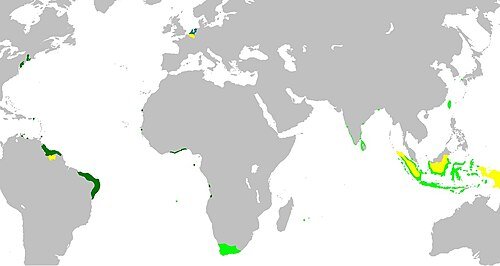
Dutch territories past, 1598-1975
The Netherlands likes to think of itself as a small country. And in some ways it is: 17 million people, flat, hemmed in by Germany and Belgium and the North Sea. But the Kingdom of the Netherlands is a different thing entirely. It sprawls across the Caribbean, with six island territories that technically make it a transatlantic state. And behind that current map lies one of the most far-reaching colonial empires in history — one that only really ended, on paper, in 1975, and in the public imagination, for better or worse, much later than that.
The word “colony” is still contested here. Dutch officials have long preferred euphemisms: gebieden, overzeese landen, rijksdelen. The current territories are officially “constituent countries” or “special municipalities,” depending on which island you’re standing on. These distinctions matter legally. Politically, they get complicated fast.
How It Started: Ships, Slaves, Spices, and Corporate Power
The Dutch empire was born not out of royal ambition but out of shareholder meetings. In 1602, the Dutch East India Company (Vereenigde Oost-Indische Compagnie, or VOC) became what was arguably the first publicly traded company in the world, and it was handed sovereign powers over trade routes, military operations, and territory across Asia. Nineteen years later, the Dutch West India Company (WIC) got the same mandate for the Atlantic.
This corporate colonialism shaped everything that followed. The Dutch were less interested in planting flags than in controlling supply chains. The East Indies — present-day Indonesia — were about nutmeg, cloves, and pepper. The Gold Coast (now Ghana) was about gold, then enslaved people. Brazil, Suriname, and the Caribbean islands were about sugar. New Amsterdam, later rechristened New York, was about the fur trade.
The VOC went bankrupt in 1799. Its territories passed to the Dutch state, which by then was under French influence and about to spend a decade being reorganized by Napoleon. What had been a corporate empire became a government one — and it lasted, in various forms, until the second half of the twentieth century.
The Former Territories: A Table
Not everything that was once Dutch stayed Dutch. Most of it was lost, sold, traded, or fought over. Here is where things ended up.
| Territory | Location | Dutch Control | How It Ended | Notable Events |
|---|---|---|---|---|
| Dutch East Indies (now Indonesia) | Southeast Asia | 1602–1949 | Indonesian War of Independence | Politionele acties, Japanese occupation 1942–45, sovereignty transferred Dec. 27, 1949 |
| Dutch Gold Coast (now Ghana) | West Africa | 1637–1872 | Sold to Britain | Capture of Elmina Castle 1637; center of transatlantic slave trade; ceded via Anglo-Dutch Treaty of 1872 |
| Suriname | South America | 1667–1975 | Independence | Received from England in exchange for New Amsterdam (New York); independence 1975; Bouterse dictatorship followed |
| New Netherlands (New York/Albany) | North America | 1614–1674 | Ceded to England | Founded New Amsterdam; lost after Second Anglo-Dutch War; exchanged for Suriname 1674 |
| Ceylon (now Sri Lanka) | South Asia | 1640–1796 | Seized by Britain | Captured from Portuguese; lost during Napoleonic Wars when Britain took it to keep it from France |
| Cape Colony (South Africa) | Southern Africa | 1652–1806 | Seized by Britain | VOC founded Cape Town as supply stop; Boer settlers became Afrikaners; Britain seized it permanently after 1806 |
| Dutch Brazil (Recife/Pernambuco) | South America | 1630–1654 | Portuguese reconquest | WIC occupied northeast Brazil; expelled after Portuguese-Brazilian uprising |
| Tobago | Caribbean | 1654–1678, later periods | British control | Changed hands repeatedly between Dutch, French, and British; finally British in 1814 |
| Berbice, Essequibo, Demerara (Guyana) | South America | 1627–1815 | Ceded to Britain | Site of 1763 Berbice slave rebellion, one of the largest in the Americas; ceded at Congress of Vienna |
| Formosa (Taiwan, partial) | East Asia | 1624–1662 | Expelled by Koxinga | Fort Zeelandia established; expelled by Ming loyalist Zheng Chenggong (Koxinga) |
| Malacca (Malaysia) | Southeast Asia | 1641–1824 | Ceded to Britain | Captured from Portuguese; exchanged for Sumatra territory in Anglo-Dutch Treaty of 1824 |
| Dejima (Japan) | East Asia | 1641–1853 | Japan opened to all | Only Western outpost allowed in Japan during sakoku isolationism; Dutch traders restricted to a small artificial island in Nagasaki harbor |
The Indonesian War: What the Dutch Called “Police Actions”
The most consequential and still most painful episode in Dutch colonial history is the Indonesian War of Independence. When Japan surrendered in August 1945, ending its wartime occupation, Indonesian nationalist leaders Sukarno and Hatta declared independence on August 17, 1945. The Dutch did not recognize it.
What followed was four years of warfare that the Dutch government, for decades, called politionele acties — “police actions.” The framing was deliberate. It made a colonial war sound like law enforcement, and it implied that the Indonesian nationalists were a problem to be managed rather than a people asserting a right. Dutch historians and the Dutch government have since acknowledged that this framing was wrong.
The reality: the Netherlands deployed roughly 220,000 troops and conducted two major military offensives — Operation Product in 1947, which seized oil fields and rubber plantations in Sumatra and Java, and Operation Kraai in December 1948, which captured Yogyakarta and arrested much of the Republican leadership. International pressure, particularly from the United States, eventually forced a ceasefire. Sovereignty was formally transferred on December 27, 1949 — though the Dutch held onto West Papua until 1962.
A major independent research project, completed in 2022 by Dutch research institutes NIOD, KITLV, and NIMH, concluded that the Dutch military used systematic and extreme violence throughout the conflict. In 2005, the Dutch government acknowledged that the war should never have been fought. The deeper accounting has taken longer.
The Gold Coast: Elmina and the Slave Trade
Before Indonesia, the other great weight in Dutch colonial history is the slave trade. The Dutch captured Elmina Castle on the Gold Coast (present-day Ghana) from the Portuguese in 1637, converting the fortified trading post into the headquarters of Dutch West Africa operations. The converted Portuguese chapel became an auction room for enslaved people.
At its peak, around 30,000 enslaved people passed through Elmina annually. The Dutch were responsible for transporting approximately 600,000 enslaved Africans to the Americas and the Indian Ocean world — roughly five percent of the total transatlantic trade. The Gold Coast became loss-making after the Dutch abolished their slave trade in 1814, and the territory was ceded to Britain in 1872.
What the Netherlands Still Has
Not everything was lost or granted independence. Six Caribbean islands remain part of the Kingdom of the Netherlands today — though their political relationship to Amsterdam is complicated, and deliberately so.
The dissolution of the Netherlands Antilles on October 10, 2010 reorganized the islands into two categories. Aruba, Curaçao, and Sint Maarten became “constituent countries” within the Kingdom — self-governing in most internal matters but tied to the Netherlands for defense, foreign affairs, and certain judicial functions. Bonaire, Sint Eustatius, and Saba became “special municipalities,” or openbare lichamen — meaning they are legally part of the Netherlands itself, though physically in the Caribbean. None of the islands voted for full independence.
| Territory | Location | Status since 2010 | Population (approx.) | Capital | Notes |
|---|---|---|---|---|---|
| Aruba | Southern Caribbean | Constituent country (since 1986) | 115,000 | Oranjestad | Separated from Netherlands Antilles in 1986; own constitution, currency (florin), parliament |
| Curaçao | Southern Caribbean | Constituent country | 160,000 | Willemstad | Largest of the Dutch Caribbean territories; 1969 Trinta di Mei uprising reshaped its politics |
| Sint Maarten | Northern Caribbean | Constituent country | 45,000 | Philipsburg | Southern 40% of island shared with France (Saint-Martin); severely damaged by Hurricane Irma in 2017 |
| Bonaire | Southern Caribbean | Special municipality (Netherlands) | 22,000 | Kralendijk | Part of the BES islands; uses US dollar; known for coral reef diving |
| Sint Eustatius | Northern Caribbean | Special municipality (Netherlands) | 3,500 | Oranjestad | Also called Statia; Dutch government took direct control in 2018 citing governance concerns |
| Saba | Northern Caribbean | Special municipality (Netherlands) | 2,000 | The Bottom | Smallest of the BES islands; no beaches; active volcano Mount Scenery |
Citizens of all six islands hold Dutch passports and EU citizenship, even though none of the islands are part of the European Union. It is one of those jurisdictional arrangements that sounds like a riddle and is, in fact, a riddle.
The Trinta di Mei: Curaçao’s 1969 Uprising
One episode that gets less attention than it deserves outside the Caribbean is the May 30, 1969 uprising in Willemstad — Trinta di Mei in Papiamentu. It started as a labor dispute. Workers at the Wescar construction firm, contracted by Shell, were being paid less than direct Shell employees for identical work. When negotiations stalled, the union declared a strike. By May 30, what started at the refinery gates had turned into a mass march on Willemstad that burned much of the city center down.
Two people died. Dozens were injured. Dutch marines were called in. The government of the Netherlands Antilles resigned. Strike leaders Wilson “Papa” Godett and Amador Nita were arrested.
It mattered because it forced a reckoning with the racial and class structure of Dutch Caribbean society, where a predominantly white minority had held economic and political power for generations. The uprising opened space for Afro-Curaçaoan political representation, pushed the Dutch to think seriously about decolonization, and accelerated Suriname’s path to independence six years later.
The Apologies (Long Overdue)
In December 2022, Prime Minister Mark Rutte formally apologized for the Netherlands’ role in the slave trade, calling it a crime against humanity. The timing was controversial. Several Caribbean and Surinamese activist groups said the apology felt rushed and had not been developed in consultation with affected communities. The Dutch government also announced a €200 million awareness fund — short of the reparations many had been calling for.
King Willem-Alexander followed in July 2023, speaking at the National Slavery Monument in Amsterdam’s Oosterpark to mark the 160th anniversary of abolition. He became the first monarch in the world to personally apologize for his country’s role in slavery, and he asked for forgiveness on behalf of the House of Orange-Nassau, acknowledging that the royal family had benefited from the system.
Whether apologies constitute acknowledgment or absolution is still being argued. In Suriname, where Dutch plantation owners generated enormous wealth through enslaved labor for two centuries, the response was largely that words without structural redress change very little on the ground.
What Remains
The current Dutch Caribbean is not a colonial project in the administrative sense — the islands have governments, parliaments, and political parties of their own. But the economic and institutional dependencies are real. The Netherlands controls defense and foreign policy. It steps in during governance crises, as it did in Sint Eustatius in 2018. It restructures Caribbean debt, which gives it considerable leverage over local budgets.
None of this is unusual by the standards of European overseas territories — the French, British, and Americans all maintain similar arrangements. But it means that the “former colonial empire” framing, tidy as it sounds, isn’t quite accurate. The Kingdom of the Netherlands is a transatlantic state with Caribbean citizens who have Dutch passports and no vote in European Parliament elections. The arrangements have their own logic. They also have their own discontents.
The Dutch keep debating this history — in classrooms, in museums, in parliamentary committees, in the naming of streets and the fate of VOC statues. That debate is livelier now than it was a generation ago. Whether it translates into anything beyond symbolic gestures is the question that won’t go away.